

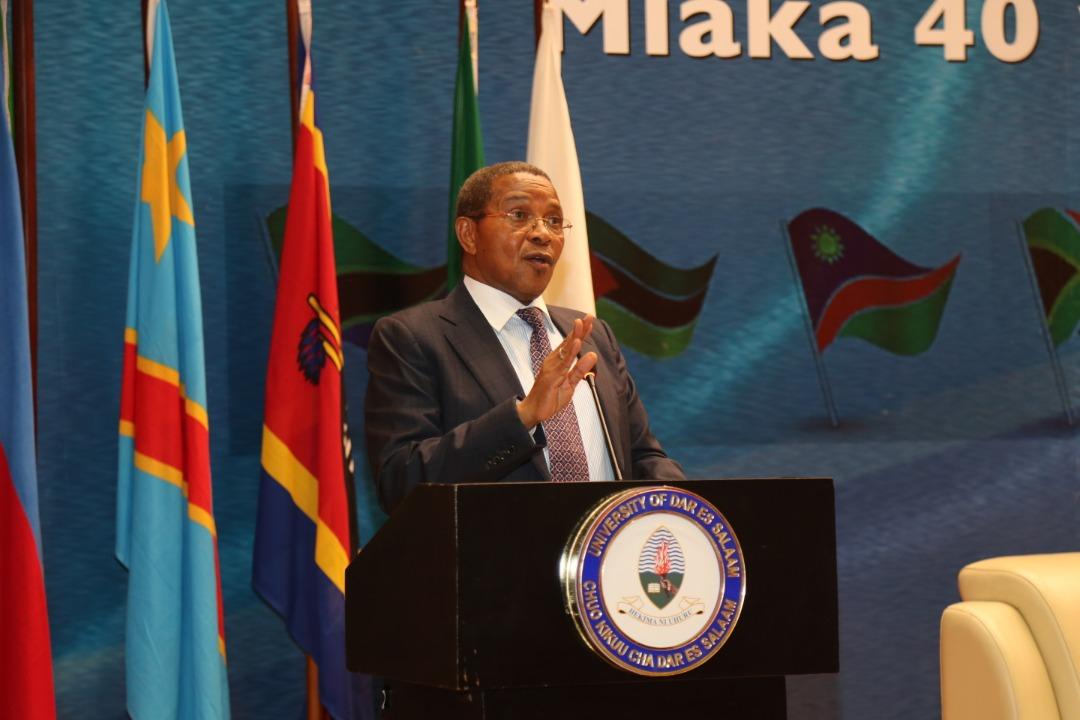
Africa-Press – Tanzania. FORMER President Dr Jakaya Kikwete has urged Tanzanians, especially youths to learn the African liberation history and the position of Tanzania in supporting the formation of the Southern African Development Community (SADC).
Speaking in Dar es Salaam yesterday at the symposium on the experiences and history of SADC as it marks its 40th anniversary, Dr Kikwete said Tanzania, and Mwalimu Julius Nyerere in particular, played a leading role in the formation of the regional bloc.
“You cannot write the history of SADC without mentioning and recognising Tanzania’s contribution unfortunately, the youth in the country do not know the crucial relationships as 60 per cent of Tanzanians are under 35, that implies we have a huge population in the country that does not know what SADC means,” he noted.
Dr Kikwete said the origin of SADC lies in the integration of Southern African states in the struggle against colonialism and apartheid.
After South Africa, Angola and Namibia saw their failed attempts to claim independence through peaceful means, they decided to use weapons to liberate themselves.
He further said Tanzania was the only independent country in the region and the freedom fighters from other countries decided to come to the East African nation whereby Mwalimu Julius Nyerere welcomed them and offered them places for military training.
He also helped them to acquire weapons and other necessities for their struggles. The Former President who is also the Chancellor of the University of Dar es Salaam (UDSM) said the formation of SADC, was proceeded by the Southern African Development Coordination Conference (SADCC), which was formed in Lusaka, Zambia on April 1, 1980 with the adoption of the Lusaka Declaration (Southern Africa: Towards Economic Liberation).
Dr Kikwete noted that SADCC was formed to advance the cause of national political liberation in Southern Africa and to reduce dependence particularly on South Africa; “The idea of forming SADCC, a tool of the Frontline States that struggled against racism and dictatorship in the southern African states, was born in Tanzania.
Since its inception, the SADC has been guided by the desire to establish a regional integration bloc to link regional economies, strengthen the economic performance, and enhance the political stability,” he explained .
He added; “Initially established in 1980 as the SADCC, the grouping wanted not only to reduce economic dependence on the then apartheid South Africa but to forge economic links for the creation of a genuine and equitable regional integration through the mobilisation of resources for the promotion of interstate and regional policies,” Dr Kikwete said when SADCC was formed; it had a membership of nine countries that signed the Lusaka Declaration in 1980.
Today, the membership of SADC has expanded to 16 countries. These are Angola, Botswana, Comoros, Democratic Republic of Congo, Eswatini, Lesotho, Madagascar, Malawi, Mauritius, Mozambique, Namibia, Seychelles, South Africa, Tanzania, Zambia and Zimbabwe.
Former Speaker of the National Assembly Anne Makinda said Tanzania has made a significant contribution to the existence of today’s SADC.
“When we gained independence the whole Southern part had several problems so it seemed impossible to continue like that, while we gained independence and then the other side South Africa was oppressing almost all southern states,” she said Ms Makinda further said Mwalimu Nyerere was the one who encouraged others that they cannot continue to be ruled.