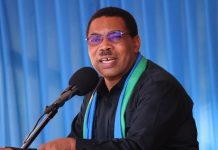


Africa-Press – Tanzania. TANZANIA has started taking various steps aimed at implementing certain decisions of the African Court on Human and Peoples’ Rights (AfCHPR) by formulating regulations, policies and legislation which align with the continental court.
The country has also contributed considerably to the jurisprudence of the continental court.
This was revealed on Wednesday in Dar es Salaam by Deputy Solicitor General, Dr Boniface Luhende, when presenting the experience of the Executive at the Conference that has brought together several high-ranking judicial officers from African countries to discuss implementation and impact of Court decisions.
He told the participants of the conference that even though Tanzania withdrew its Declaration under article 34 (6) of the Protocol to the African Charter on Human and Peoples ‘Rights in 2019 for individuals and NGOs to have direct access to the court, the move has not affected the pending cases.
As of now, Dr Luhende said, there are nearly 156 pending applications. He pointed out also that Tanzania remains alive in the spirit and mandate of the African Court as was bound by article 30 of the Protocol, which obliges States parties to comply with court judgments and guarantee their execution.
The Deputy Solicitor General was, however, quick to point out one of the challenges Tanzania was facing in implementing the court decision, including the absence of specific procedures providing for the enforcement of judgments of the African Court in Tanzania.
“Even in the absence of enforcement procedures, Tanzania has taken various steps to implement certain decisions of the court by formulating regulations, policies and legislation. One of the best examples of such implementation is the enactment of the Legal Aid Act No. 1 of 2017,” he said.
The Act, according to him, was enacted to regulate and coordinate the provisions on legal aid services for indigent persons. He said that before the enactment of the Legal Aid Act, the services were reserved for persons facing capital offences of murder, manslaughter and treason.
Dr Luhende recalled that in Application No. 027 of 2015 involving Minani Evarist and in Application No. 007 of 2013, Mohamed Abubakar, Tanzania was found to be in violation of the right to a fair trial as provided for in Article 7 (1) (c) of the African Charter for failing to provide free legal assistance.
“In our view, the enactment of the Legal Aid Act was a reverse to the pronouncement of the African Court. With the enactment of the law, the scope of application of such assistance has been extended to all criminal and civil cases and includes specific provisions for children in conflict with the law,” he said.
Through accredited legal aid providers, an indigent person who is the subject of a criminal charge may be granted legal aid. It therefore follows the implementation of the decisions of the African Court relating to free legal assistance for those who need it in each criminal offense.
The Deputy Solicitor General also mentioned another step taken by the government, which related to the introduction of plea-bargaining arrangements in criminal cases through amendment of section 194A of the Criminal Procedures Act in an effort to speed up trials and reduce the number of pending cases.
Such article provides that the parties to a case may enter into a plea-bargaining agreement, which may result, among other things, in the withdrawal of charges by the prosecutor and the payment of compensation by an accused person.
“This measure is in line with the philosophy of the African Court which emphasizes the need to speed up criminal trials,” Dr Luhende told the conference. He pointed out further that Tanzania has set up mobile court services to bring services closer to the people and improve access to justice in a timely manner.
Mobile courts adjudicate cases just like Primary Courts and District Courts, the only difference being the court which moves from one place to another. This measure, according to the Deputy Solicitor General, is in line with the decisions of African courts which insist that “justice delayed is justice denied.”
Another step related to allocation of a minimum number of cases to judges and magistrates and that the government has continued with the efforts to strengthen its own internal justice mechanisms and has embarked on a co-creation exercise analyzing the entire chain of the administration of criminal justice.
For More News And Analysis About Tanzania Follow Africa-Press