

Africa-Press – Tanzania. THE sixth phase government initiative to improve investment climate is paying off, as the country continues to receive more industrial investments.
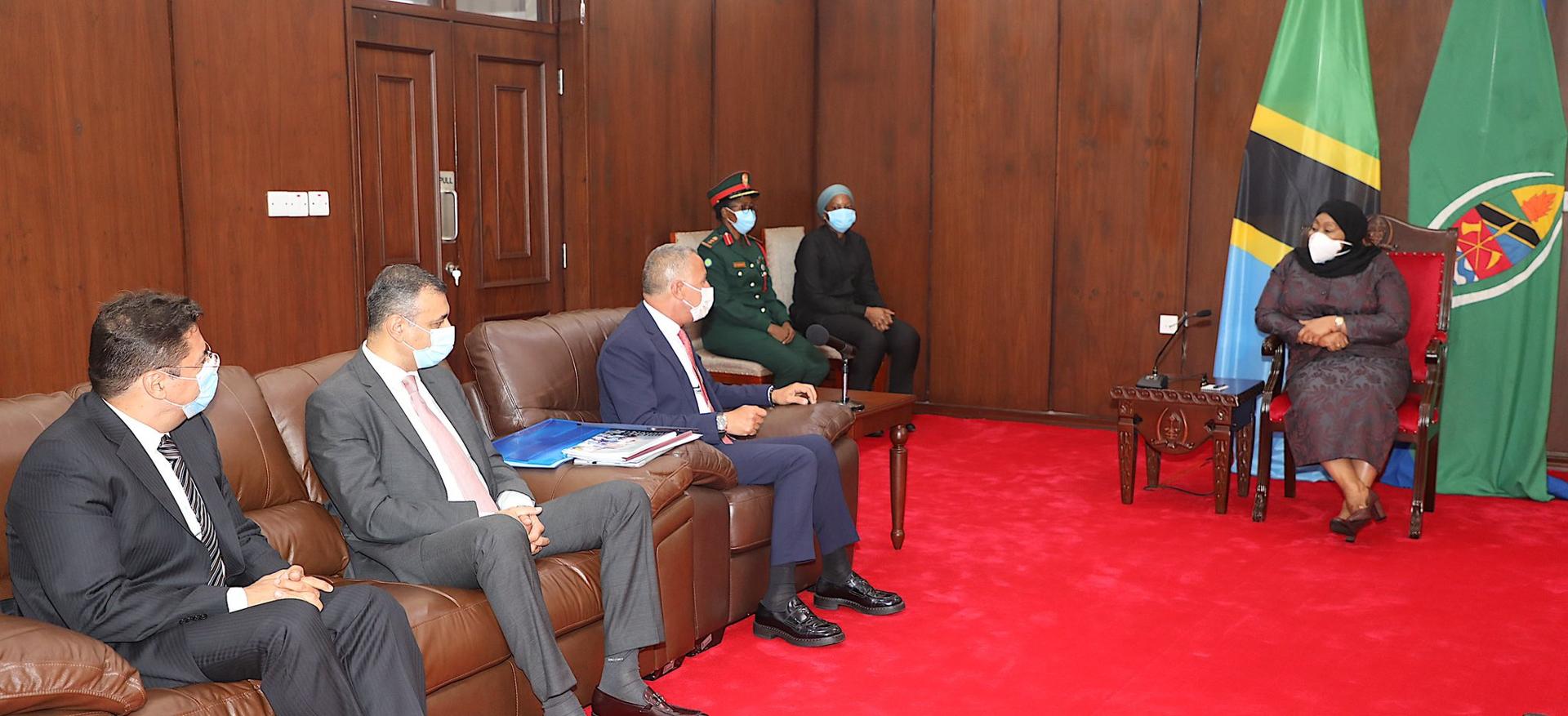
This was revealed yesterday when President Samia Suluhu Hassan met with an Egyptian investor, Engineer Ahmed El Sewedy, who is the Chief Executive Officer of El Sewedy Electric company. Eng El Sewedy informed President Samia that a conducive investment climate was the key reason for him to develop an interest in investing into the country.
“Due to the good investment environment being created by the government, we have decided to support the initiatives by also investing in an industrial park that has a total of two million square meters,” said Mr El Sewedy.
Eng El Sewedy, whose firm is undertaking the 2115 Megawatts Julius Nyerere Hydroelectricity Power Project (JNHPP) along Rufiji River in Coast Region paid a courtesy call on President Samia at Chamwino State House in Dodoma, where he reaffirmed his intention to keep investing in the country.
The Egyptian tycoon also explained the commitment of encouraging a total of 50 Egyptian companies to invest in Tanzania in the next two years.
Apart from undertaking the JNHPP, the El Sewedy Company has constructed a factory manufacturing electrical products such as transformers, energy cables, fire resistance cables and electric meters. Official launch of the factory which is being constructed in Kigamboni District in Dar es Salaam Region is set for December this year, according to a statement issued by the Director of Presidential communications, Mr Jaffar Haniu.
According to Eng El Sewedy, they are also planning to construct a fertiliser manufacturing factory as well as investing in the construction of the Standard Gauge Railway (SGR).
Responding, President Samia welcomed Eng El Sewedy’s investment plan, assuring him of a total cooperation from her government on ensuring the projects are completed on time.
The Head of State also informed the Egyptian investor that the Tanzanian government is currently reviewing various laws and policies regulating the business and investment sector to create a conducive climate for investors.
She noted that construction in the industrial park would fast-track development and provide employment to the locals who would also benefit from transfer of knowledge and skills.
Since being sworn in as the sixth President of Tanzania, Ms Samia has already taken a number of initiatives as well as issuing bold directives aimed at building the country’s economy and improving the living standards among Tanzanians.
To begin with, President Samia had in April this year demanded sweeping reforms in the investment sector, as part of her government’s grand plan to restore trust of investors in the country.
In her directives, she ordered the investment docket under the Prime Minister’s Office to immediately establish a One-Stop Centre in a bid to stamp out bureaucracy in issuance of services. She also insisted that there was no need for investors to hustle around various institutions to secure business certificates and permits.
The president also expressed her concerns over the issuance of work permits, saying there is a bureaucracy that was discouraging and chasing away investors. She also called on Tanzania Revenue Authority (TRA) to work diligently, collect taxes justly, saying she was not in favour of oppressive taxes.
When swearing-in some ministers she appointed, President Samia also ordered the taxman to stop applying force when collecting taxes from traders saying the practice caused many businesses to close.
She also directed the Minister for Finance and Planning, Dr Mwigulu Nchemba to ensure expansion of taxpayers’ base while being guided by wisdom and professionalism instead of force and harassment. Equally, the Head of State demanded creativity and hard work from Regional Commissioners, and Regional Administrative Secretaries, for the country to attain development and economic growth it envisions.
She said they should also be the champions of the industrialisation drive being implemented by the government with the aim of boosting the national economy, creating employment and value addition to the raw materials being produced in the country.