
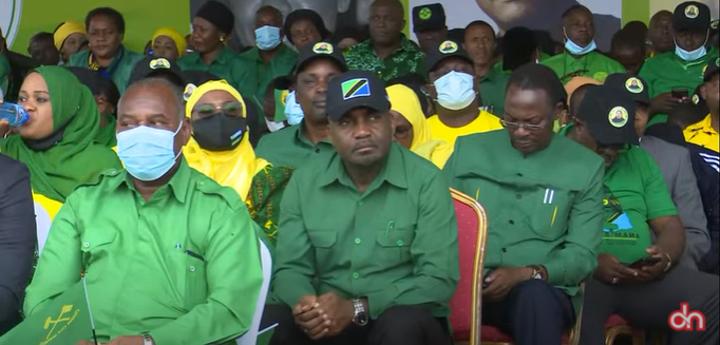
Africa-Press – Tanzania. AS Chama Cha Mapinduzi (CCM) today marks its 45th anniversary since it was formed on February 5, 1977, the Union between Tanganyika and Zanzibar on April 26, 1964, has been attributed as a driving force behind its foundation.
Panelists who spoke during a television progamme ‘MIZANI’ aired by the Tanzania Broadcasting Corporation (TBC) last Wednesday, credited the Union which gave birth to the United Republic of Tanzania as an impetus for formation of CCM 13 years later.
The then Tanganyika National African Union (TANU) led to independence of Tanganyika in 1961 while Afro Shiraz Party (ASP) was the force behind the Zanzibar Revolution of 1964. After the Union, the two parties later merged and formed CCM in 1977.
“It was very clear that after the formation of the Union Government and declaration of a one party government there emerged a contradiction since each side of the Union had its own political party,” recalls former Secretary General of CCM, Mr Wilsom Mukama.
The senior citizen was among panelists who aired their views during the ‘MIZANI’ programme which was moderated by Tanzania Broadcasting Corporation (TBC) Director General Dr Ayoub Rioba.
As such, CCM was formed 13 years after the Union between Tanganyika and Zanzibar and 10 years after the Arusha Declaration of 1967.
Mr Mukama recalls how the inconsistency then encouraged the formation of a 20-member committee in the year 1975 to draft a constitution of merging the two parties to form a single entity.
The Chairman of the committee was Thabit Kombo from ASP and Pius Msekwa from TANU was Secretary. After the formation of CCM in 1977 it was the same committee that was tasked to draft the constitution of the United Republic of 1984, he explained. In a recorded video clip which was broadcast during the same programme, Mr Msekwa substantiated the account by Mr Mukama who in 1977 was serving as tutor at the then Kivukoni College, now Mwalimu Nyerere Memorial Academy (MNMA).
“The issue of merging the parties gained momentum when the joint-party committee sat in 1975 to deliberate on the nomination of President Julius Nyerere for another term,” Mr Msekwa who is the founding Executive Secretary General of CCM, declared.
“How comes our country is a one party government but we have two parties,” Mr Msekwa said quoting Mwalimu Nyerere. Apart from being the founding Executive Secretary General of CCM, Mr Msekwa served in other senior positions including being the first Clerk of the National Assembly when Tanganyika attained its independence in 1961.
He later rose to become Speaker of the Union’s National Assembly between 1994 and 2005 and then Vice Chairman of CCM (Mainland) between 2008 and 2012.
For her part, the current Deputy Speaker of Zanzibar House of Representatives, Ms Mgeni Hassan Juma, pointed further that the ideology of national unity was among other factors that influenced the merger of ASP and TANU.
“Both parties stood for the ideology of national unity, self-rule and emancipation of oppressed people in Africa. “ASP led the Zanzibar revolution of 1964 while TANU led Tanganyika to its independence in 1961 and thus in principle the two parties stood for the same philosophy,” Ms Mgeni said during the programme.
Former senior member of CCM who is now Chairman of opposition party Alliance for Democratic Change (ADC), Mr Hamad Rashid Mohamed, hinted however that the Arusha Declaration of 1967 by TANU in Tanzania Mainland did not go well with some members of ASP in Zanzibar.
“It was at this juncture that some members from both parties reasoned that if we could unite our countries to form one state then why not merge our parties to resonate with our ideology of single party state,” he explained.
According to Mr Mohamed, ASP and TANU cooperated in many fronts in advocating for the formation of the United States of Africa.
“I know the history of the two countries very well since I was among founding members of CCM when it was formed in 1977. I went on to become a Member of Parliament of the Union Assembly,” he explained.
A political analyst at the University of Dar es Salaam (UDSM), Dr Charles Mbunda, attributed the continued existence of CCM to its ability to transform and institutionalize itself from the top to the grass-roots levels.
“Unlike other political parties in Africa which led their countries to independence and then lost power, CCM has been able to pass leadership mantle from one generation to another,” he reasoned.
Dr Mbunda mentioned other factors that have since favored the party as formation of strong wings such as parents’ wing (Umoja wa Wazazi), women’s wing (Umoja wa Wanawake) and youth wing (Umoja wa Vijana).
The founding Chairman of CCM’s young pioneers (Chipukizi), Mr Frank Uhahula, pointed to the fact that the party has as well maintained its survival due to a belief which is well enshrined in its constitution that all human beings are equal.
“CCM has stood out as a party which thrives to bring development to the people by fighting poverty, ignorance and diseases,” the party stalwart, who was elected the first chairperson of CCM young pioneer in 1981 at the age of 15, commented.
Mr Uhahula reasoned further that for any party to be strong it has to bring development to the people and fight for self-rule, stressing that it was due to this that CCM played a vital role in the liberation struggle of many countries in Southern Africa.
Dr Leonce Mujwahuzi of the University of Dodoma (UDOM), was of a view that unlike CCM, many liberation movements in Africa which led their countries failed or removed from power because they lacked unity.
“If a political party is bent on discrimination based on religion, tribalism or any other form of segregation then it will be doomed to fail. Some of the other liberation movements failed to unite their people,” the analyst commented.
Dr Mujwahuzi was of a view that CCM has been able to survive since 1977 because its advocates for unity and stands as a strong institution.
For More News And Analysis About Tanzania Follow Africa-Press