

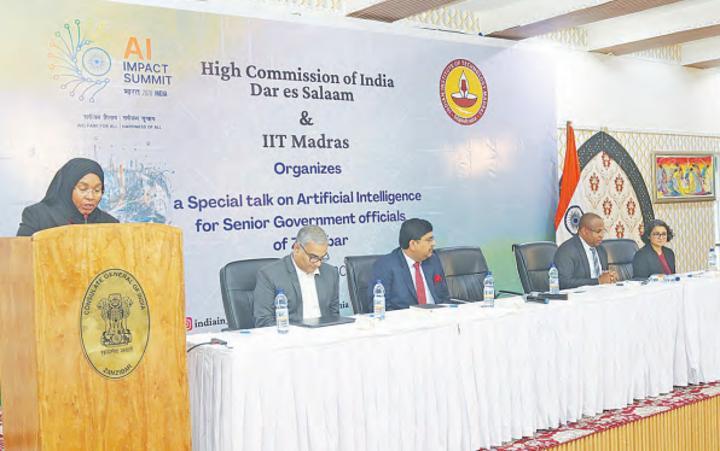
Africa-Press – Tanzania. AT around 9.30am local time, in the morning, inside a quiet conference hall at Madinat al Bahri Hotel in Zanzibar, senior government officials-Principal Secretaries (PS) sat not to discuss budgets or policies, but to confront a different kind of future, one shaped by algorithms, data, and machines that can learn.
For many of them, Artificial Intelligence (AI) still feels abstract, intimidating, even risky. But as the session unfolded, one message became unmistakably clear: the future of governance will not wait for those who hesitate.
That was the warning delivered by Zanzibar government Chief Secretary Ambassador Engineer Zena Ahmedi Said, who officiated the meeting, urging government executives — including Permanent Secretaries, to actively learn and embrace AI or risk being left behind in the rapidly evolving world of science and technology.
“Some government officials are still afraid of AI,” she said bluntly. “Don’t be afraid. Learn it and use it.”
Speaking during a special one-day AI training organised by her office in collaboration with the Zanzibar Ministry of Education and the Indian Institute of Technology (IIT) Madras with support from the India High Commission in Tanzania, Ambassador Zena said technology is no longer optional in public service it is now the engine driving development worldwide.
She explained that most government systems are already digital, making AI a powerful opportunity to enhance efficiency, decisionmaking and service delivery. From planning to monitoring, AI can help leaders move faster, smarter and with greater precision.
The message resonated strongly with participants, many of whom are tasked with managing limited public resources against growing social demands as a challenge echoed by India’s High Commissioner to Tanzania, Bishwadip Dey.
Addressing the officials, Ambassador Dey described AI not as a passing digital trend, but as a tool capable of fundamentally transforming the state itself.
“We are not here to discuss technology for technology’s sake,” he said. “We are here to discuss how governments can become more predictive than reactive.”
He described the collaboration between India and Tanzania, supported by IIT Madras, as a “Silicon Bridge” linking the Global South in the Fourth Industrial Revolution. According to him, the challenges of the 21st century cannot be solved with the tools of the 20th.
Ambassador Dey invited participants to imagine a Zanzibar where AI-driven analytics help optimise the Blue Economy by predicting maritime trends and sustainable fishing yields, or where healthcare resources are redistributed automatically before disease outbreaks peak.
Central to this vision, he said, is the concept of “Sovereign AI” data generated by Zanzibaris, processed within domestic frameworks, and used to serve citizens directly. Such systems, he argued, could lead to a “frictionless state,” where land registries, tax systems and social safety nets operate with unprecedented transparency and efficiency.
The timing of the training, he added, was significant as India prepares to host the AI Impact Summit in February 2026, which will shift the global conversation away from fear and regulation toward practical impact, especially for developing countries.
“AI must be democratised,” he said, “so it can solve real problems like food security and climate resilience.”
As Ambassador Dey concluded: “The transition to AIenabled governance is inevitable. The only question is how well we lead it.” For Zanzibar’s executives, the choice is no longer whether to embrace AI, but how fast.
Back home, Zanzibar is already laying foundations for this future. Permanent Secretary at the Ministry of Education and Vocational Training, Mr Khamis Abdallah Said, said the AI training was initiated after the ministry recognised the technology’s growing importance in governance.
He revealed that Zanzibar is strengthening ICT infrastructure from the primary school level, ensuring future generations are prepared for a digital world.
This commitment was reinforced by President Dr Hussein Ali Mwinyi, who announced during the 62nd anniversary of the Zanzibar Revolution that 70 schools would be connected to the national fibre-optic backbone; 2,000 desktop computers supplied to school laboratories; 4,000 laptops distributed to students; and 25 smart classrooms established.
“Every new and old school must have a computer room,” the President said, underscoring the goal of universal access to digital education.
Delivering the technical training, Professor Raghurathan Rengasamy of India traced the global evolution of AI and highlighted India’s rapid progress in applying AI across education, healthcare and development planning.
He emphasised that achieving national development goals now depends on accurate data, timely information and intelligent analysis, all areas where AI excels. However, he also cautioned against misuse, stressing that sensitive government documents must remain protected.
By the end of the day, what began as a technical seminar had become something deeper — a strategic reflection on leadership in a digital age.