Africa-Press – Uganda. Uganda is now ranked among the world’s fastest-growing economies, buoyed by resilient macroeconomic performance and rising private sector activity, State Minister for General Duties Henry Musasizi said on Thursday.
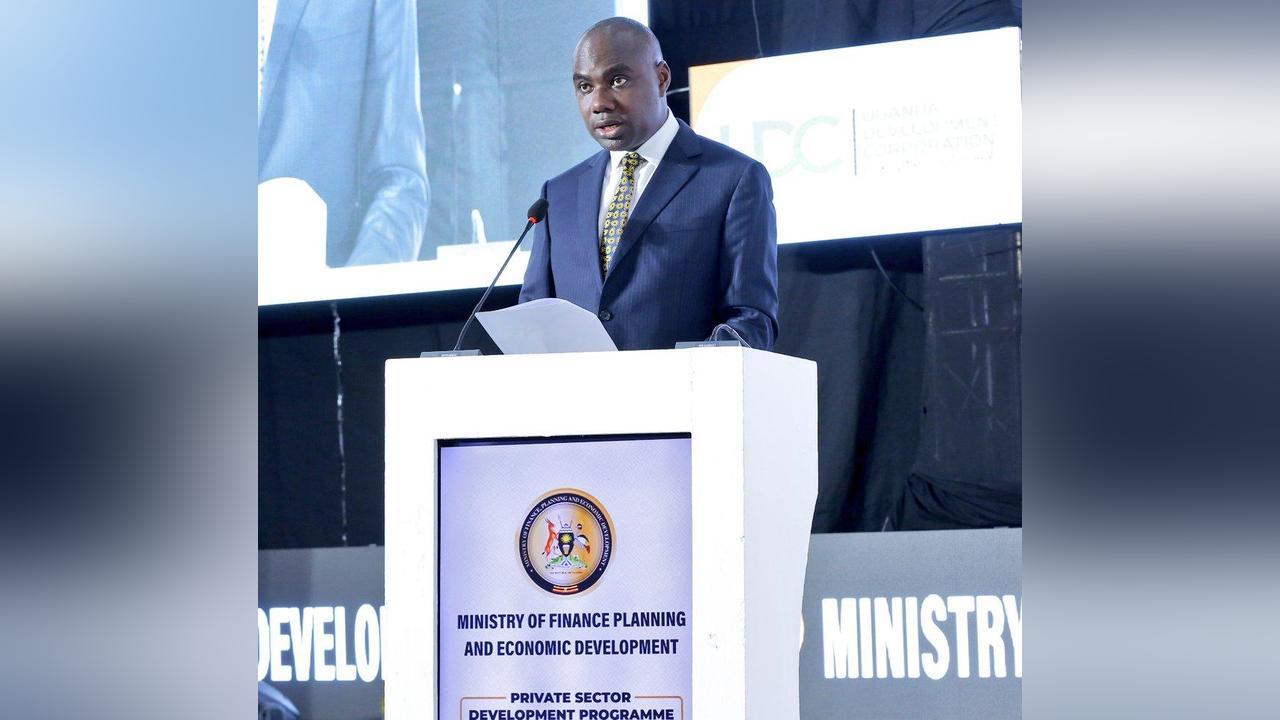
Speaking at the opening of the Private Sector Development Programme Annual Review at Mestil Hotel in Kampala, Musasizi said the country’s growth momentum reflects deliberate policy choices aimed at strengthening the productive sectors of the economy and improving the investment climate.
“Uganda is now recognised globally as one of the fastest-growing economies, with projections placing us among the top performers by 2031,” Musasizi said, noting that the economy has rebounded strongly despite global headwinds, including tight financial conditions and geopolitical uncertainty.
According to the Uganda Bureau of Statistics (UBOS), real Gross Domestic Product (GDP) grew by an estimated 6 percent in the 2024/2025 financial year, up from 5.3 percent in the 2022/2023 financial year.
The growth was driven by improved performance in services, manufacturing, construction and agriculture.
The services sector remained the largest contributor to GDP, accounting for more than half of total output, while industry growth was supported by construction and agro-processing.
Musasizi said Uganda’s stable growth outlook is reinforced by sound macroeconomic management, which has kept inflation largely within the medium-term target and preserved investor confidence.
“Key macroeconomic indicators reflect resilience and stability, making Uganda increasingly attractive to both domestic and foreign investors,” he said.
Access to finance, he added, has been a critical enabler of growth. Musasizi revealed that the capitalisation of the Uganda Development Bank has exceeded Shs1.5 trillion over the past five years, significantly expanding long-term financing for priority sectors such as manufacturing, agribusiness, tourism and renewable energy.
Government-led wealth creation programmes have also injected liquidity into the economy. Under Emyooga, more than Shs500 billion has been disbursed to community enterprise groups, while the Parish Development Model has channelled Shs3.26 trillion to beneficiaries nationwide.
The interventions are supporting micro, small and medium enterprises, expanding domestic demand and accelerating financial inclusion.
Data from the Ministry of Finance show that private sector credit growth has gradually strengthened, while non-commercial lending to key growth sectors rose to 4 percent of GDP, up from 1.5 percent in the 2018/2019 financial year, reflecting increased government participation in crowding in private investment.
Representing the Permanent Secretary and Secretary to the Treasury, Dr Ramathan Ggoobi, the Director of Economic Affairs at the Ministry of Finance, Moses Kaggwa, said the Private Sector Development Programme remains central to Uganda’s growth strategy under the National Development Plans.
He outlined five core objectives of the programme: lowering the cost of doing business, strengthening private sector institutional capacity, promoting local content, unlocking investment in strategic sectors, and improving the business environment and enforcement of standards.
However, Kaggwa acknowledged that challenges remain.
“While progress has been made in financing key growth sectors, the share of the informal sector in the economy increased to 54.75 percent from 51 percent over the same period,” he said, citing Ministry of Finance and UBOS data. The persistence of informality continues to limit productivity, tax mobilisation and access to affordable finance.
He urged stakeholders to use the annual review to draw lessons from implementation under the Third National Development Plan and make adjustments to improve performance under the Fourth National Development Plan.
As Uganda advances its Tenfold Growth Strategy, which targets expansion of the economy to $500 billion by 2040, analysts say sustained reforms, business formalisation and deeper private sector participation will be critical to translating rapid growth into inclusive and durable prosperity.