Africa-Press – Uganda. A new government report has revealed a significant expansion of Uganda’s informal economy, which now accounts for 54.5% of the nation’s Gross Domestic Product (GDP).
This surge comes despite a concerted five-year effort under the Third National Development Plan (NDP III) to slash informality to 45%.
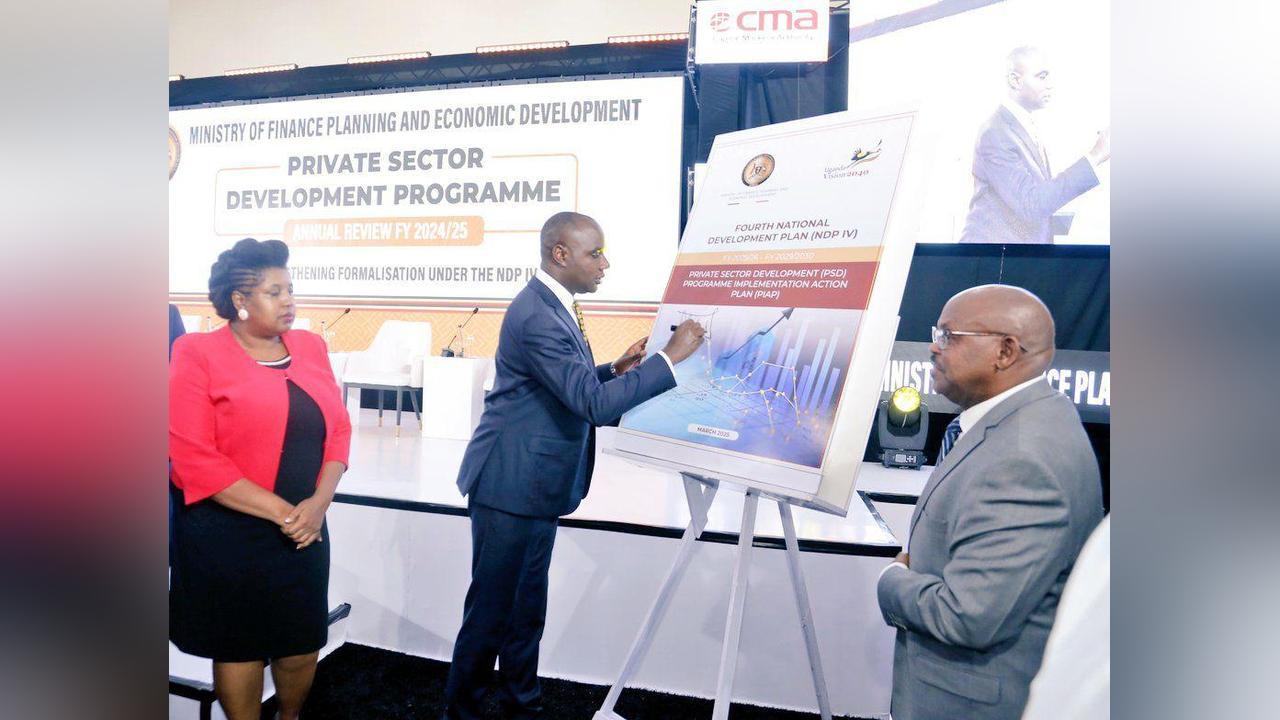
The findings were released on February 12, 2026, during the Ministry of Finance, Planning, and Economic Development’s annual review of the Private Sector Development Programme.
While the report acknowledges “post-election economic resilience,” it paints a picture of a private sector still largely operating in the shadows of formal regulation and taxation.
The informal sector’s dominance is most visible in the labor market, where it accounts for a staggering 92% of total employment.
In a speech delivered on behalf of the Permanent Secretary/Secretary to the Treasury (PSST), Commissioner Kaggwa Moses admitted that the persistent nature of the informal economy remains a major hurdle for national planners.
“While the NDP III made some strides on the performance of the private sector development programme, the informality of the private sector remains a thorn,” Kaggwa stated.
The government is now pinning its hopes on the Fourth National Development Plan (NDP IV), which targets a reduction of business informality to 45.7% by the year 2030.
The Minister of State for Finance, Henry Musasizi, noted that the strategy will shift from mere regulation to “intentional incentives” designed to make formalization attractive to micro-entrepreneurs.
The report provides a deep dive into the demographics of informal trade, revealing that it is a sector primarily driven by women and the middle-aged.
About 56% of informal businesses are women-owned. Even more striking is their revenue impact: of the Shs41.3 trillion generated by informal businesses, the report notes that “Shs29.2 trillion, which is 70.6 percent of the revenue by informal businesses, was generated by women.”
Business owners are predominantly between 31 and 54 years old. However, a lack of formal education is a significant barrier, with 75% of operators having limited schooling. Despite Uganda’s young population, youth own only 33% of informal enterprises. Technical Officer Kintu Mwanje highlighted that many of these entrepreneurs remain informal not by choice, but due to a lack of information. “The increase in informalities of business is a result of lack of awareness about the incentives to registered businesses,” Mwanje explained.
The economic cost of this “shadow economy” is immense. The report estimates that billions in potential tax revenue remain “held up” because businesses are not integrated into the formal system.
Specifically, “there is up to Shs560 billion in potential tax held up by all informal businesses,” while an additional Shs4.8 trillion in potential income tax remains untapped from the 9.8 million informal workers.
A critical weakness identified in the report is the “small linkage” between the two worlds: only 12% of informal businesses supply formal companies with inputs.
This isolation limits the ability of small vendors to scale up or access the global value chain.
As Uganda enters the implementation phase of NDP IV, the Ministry of Finance intends to use digital transformation and targeted incentives to bridge this gap, aiming to transition the country toward a more monetized and formal economy.