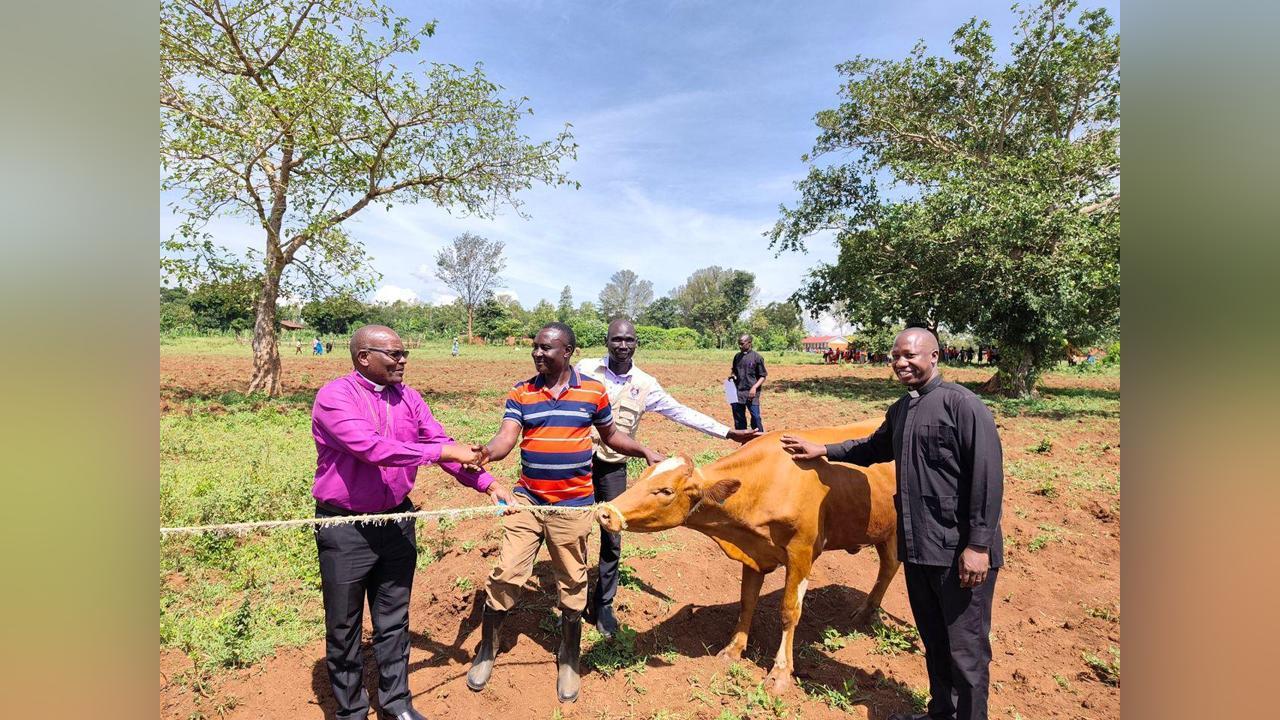
Africa-Press – Uganda. The Church of Uganda, through its Directorate of Household and Community Transformation (HCT), on Friday distributed ten in-calf heifers to selected farmer households in the Diocese of East Busoga, in a move aimed at strengthening household incomes and enhancing food security.
The distribution ceremony was held at the Diocesan Headquarters at St Stephen’s Cathedral, Naluwerere, Bugiri District and presided over by the Bishop of East Busoga Diocese, Rt Rev Paul Hannington Suubi, alongside the HCT Director, Rev Andrew Agaba.
This initiative forms part of the Church of Uganda’s broader socio-economic transformation agenda under the HCT Directorate, which focuses on five thematic areas, including Food Security and Sustainable Livelihoods.
The program is designed to support household food production, improve income generation, and build resilience among communities.
The intervention follows a comprehensive pre-distribution assessment conducted on January 28, 2026, which evaluated beneficiaries’ readiness to manage livestock effectively.
The assessment focused on key requirements such as proper animal housing, pasture establishment, biosecurity measures, and record-keeping systems to ensure sustainability and animal welfare.
The heifer project is implemented in partnership with government, targeting farmers across several dioceses including South Ankole, Busoga, Kitgum, Central Buganda, and West Lango.
The initiative provides livestock and value addition equipment to enhance agricultural productivity and livelihoods.
As part of the preparatory process, selected beneficiaries underwent training in livestock management practices, including zero grazing, record keeping, disease prevention and treatment, as well as feeds and nutrition management.
According to Rev Agaba, the verification exercise revealed encouraging levels of preparedness among beneficiaries, with most households demonstrating adequate capacity in housing, feeding, and animal health management.
“The selection process was balanced across archdeaconries to ensure inclusivity within the community. Self-driven farmers and those working collaboratively with family members showed higher levels of preparedness, pointing to stronger prospects for sustainability,” he said.
Rev Agaba commended the government for supporting the Church of Uganda’s development initiatives and reaffirmed the Directorate’s commitment to transparency and accountability in program implementation.
In his remarks, Bishop Suubi described the initiative as a practical expression of the hurch’s mission to transform lives holistically.
“These heifers are a source of sustainable income and improved nutrition for our households. I urge all beneficiaries to manage them responsibly and ensure that the benefits extend to the wider community. I encourage beneficiaries not only to sell the milk but also to consume some of it, because we want healthy Christians,” he said.
The beneficiaries were drawn from various archdeaconries across the diocese, including Bugiri, Buwunga, Namayembe, and Lwangosa.
According to Program Officer for Food Security and Sustainable Livelihoods, Emmanuel Aluonzi, the project incorporates a pass-on model to expand its impact.
Once a heifer produces its first calf, beneficiaries are required to pass on the first female calf to a second-line beneficiary identified through a diocesan selection process.
This model is expected to multiply the benefits of the program across communities, fostering shared growth, improved livelihoods, and long-term sustainability.
For More News And Analysis About Uganda Follow Africa-Press