Africa-Press – Uganda. The Uganda People’s Defence Forces (UPDF) has called for stronger inclusion of women in peace negotiations, warning that their continued exclusion undermines efforts to achieve lasting stability in conflict-affected regions.
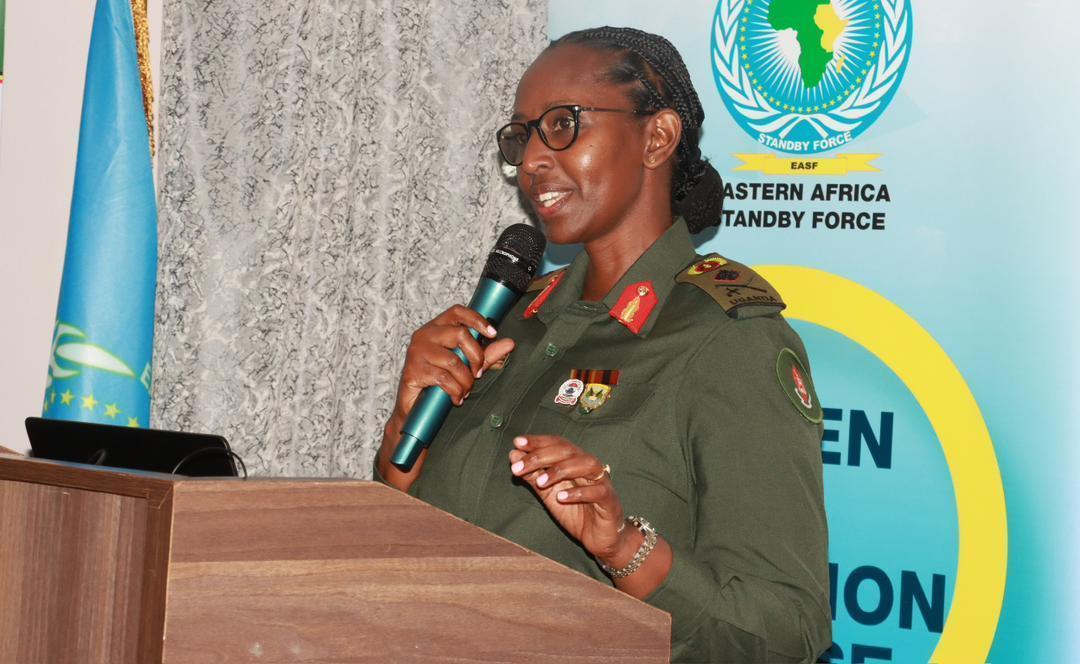
Speaking at the opening of the Women in Mediation Course in Entebbe, Director of Women Affairs in the UPDF Charity Bainababo said evidence shows peace agreements are more sustainable when women are actively involved in negotiations, despite being among those most affected by conflict.
“We are aware that women are most affected or impacted by conflict but remain excluded from resolving these conflicts yet evidence has shown that when women are included, peace agreements are more likely to be reached and peace is more sustainable,” she said.
Brig Gen Bainababo described the training as a strategic initiative aimed at strengthening regional security through inclusivity and professional mediation capacity.
“This is not merely a training programme, but a cross-border strategic initiative that reflects a collective commitment to building a professional, inclusive, and mission-ready force capable of responding to complex contemporary security challenges,” she added.
She urged participants to use the course to build professional networks that can support women’s influence in peace processes at national and regional levels.
The Danish Ambassador to Uganda Signe Winding Albjerg echoed concerns over the persistent underrepresentation of women in peacebuilding, despite international commitments to gender inclusion.
She said that although progress has been made in policy, implementation remains weak across many regions.
“We are here today for very positive but also for critical reasons. Despite strong and long-standing commitments, women remain under-represented in peace processes globally but also here in the East African region,” she said.
Ambassador Albjerg pointed to examples from countries such as South Sudan and Somalia, where women’s networks have helped sustain dialogue even during stalled formal negotiations.
“When women are meaningfully included at negotiation tables, the agenda moves forward and reconciliation becomes more achievable,” she said, reaffirming Denmark’s support through its peace and stabilisation programmes.
The Eastern Africa Standby Force Chief of Joint Staff Stephen Kashure emphasised that modern conflicts require multidimensional responses, including negotiation, prevention, and long-term transformation strategies.
“Mediation stands out as a vital tool for peaceful resolution, drawing on skills in negotiation, strategic communication, stakeholder engagement, and trust building. Women have a key role to play in fostering that trust,” he said.
He added that participants should be prepared for immediate deployment into mediation roles, given ongoing conflicts in the region.
The Head of the Civilian Component of the Eastern Africa Standby Force Monalisa Kakono Noowe thanked Uganda and Denmark for supporting the training, noting that women’s inclusion in mediation is now a core priority for the force.
Senior Civilian Advisor to the EASF Ken Albert said the training is aimed at increasing women’s direct participation in negotiations and integrating gender perspectives into peace agreements.
The 10-day programme brings together participants from EASF member states including Burundi, Comoros, Djibouti, Ethiopia, Kenya, Rwanda, Somalia, Sudan, and Uganda, reflecting a regional push to strengthen women’s role in peace and security processes.
For More News And Analysis About Uganda Follow Africa-Press