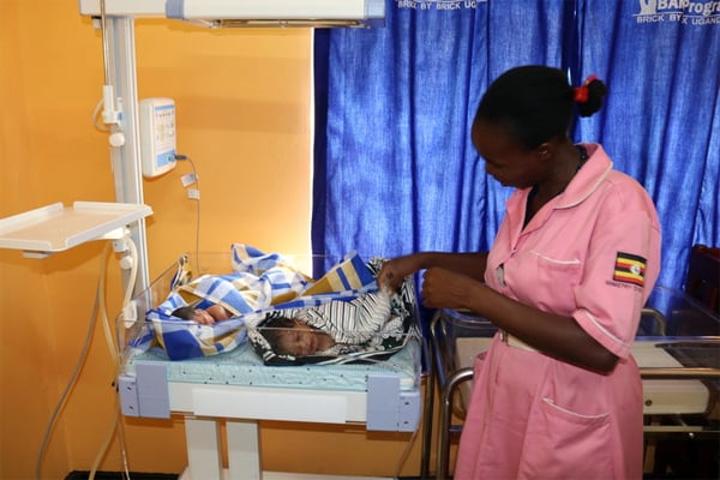
Africa-Press – Uganda. The training of health workers and medical students using technology-enhanced simulation in obstetrics is poised to reduce the maternal mortality rate in the eastern region, health officials say.
On average, about four mothers die monthly during childbirth at health facilities in the region due to, among other factors, a lack of skills and other competencies by the health workers.
In order to reequip the medical personnel, the Rotary Club of Kyambogo in partnership with the Rotary Club of Eindhoven in the Netherlands; donated simulation equipment for women and another one for babies to officials of Mbale Regional Referral Hospital at the weekend.
The equipment will be used to train health workers on how to manage bleeding after birth, high blood pressure, obstructed labour, resuscitate babies, and other medical conditions that cause the death of women and girls while in labour.
Dr Assen Kamwesigye, an obstetrician and gynecologist at Mbale Regional Referral Hospital, said simulation training model will empower health workers with life-saving skills.
“It will give the health workers an opportunity to replicate actual events on how to handle and respond to emergencies involving women in labour,” she said.
The equipment is part of activities being carried out under Training for Life Project, which has been under implementation since 2015 to improve maternal and childcare simulation skills for health workers in regional hospitals.
Dr Kamwesigye said Mbale Hospital performs 12,000 deliveries per year and 40 deliveries per day, but on average, about four mothers die per month.
According to the Uganda Health and Demographic Survey, maternal mortality reduced from 418 per 100,000 live births deaths in 2006 to 336/100,000 in 2016.
Health officials say more 6,000 women and adolescent girls die every year from preventable causes related to pregnancy and childbirth in the country.
Dr Peter Ntuyo, a consultant working with Mulago Specialist Women and Neonatal Hospital Mulago, said under the project, the simulation lab at Busitema University has been equipped to improve skills acquisition among the medical personnel.
“The training will improve skills, competencies and communication of health workers in managing obstetrics emergency cases in the labour suite,” he said.
He added that with the training, the health workers will be in a position to manage bleeding after birth and high blood pressure.
Mr Raymond Mwesigwa, the president of the Rotary Club of Kyambogo, said f women die in labour mainly because of the loss of blood. “This is why heath workers and medical students need be trained on how to avert such situations,” he said.
Mr Mwesigwa said the simulation centres have been opened at Mulago SpecialiSed Women and Neonatal Hospital, Kawempe National Referral Hospital, and Mbale Regional Referral Hospital.
“We are planning to open up more simulation centres this year in Kabale, Gulu, Arua, Nsambya and Webale in Ibanda,” he said.
STUDY
A research, which was conducted by scientists of Busitema University between April 2018 and October 2022, found out that 27 percent of children born of obstructed labour also had elevated cases of blood pressure due to reduced functionality of the kidney.
For More News And Analysis About Uganda Follow Africa-Press