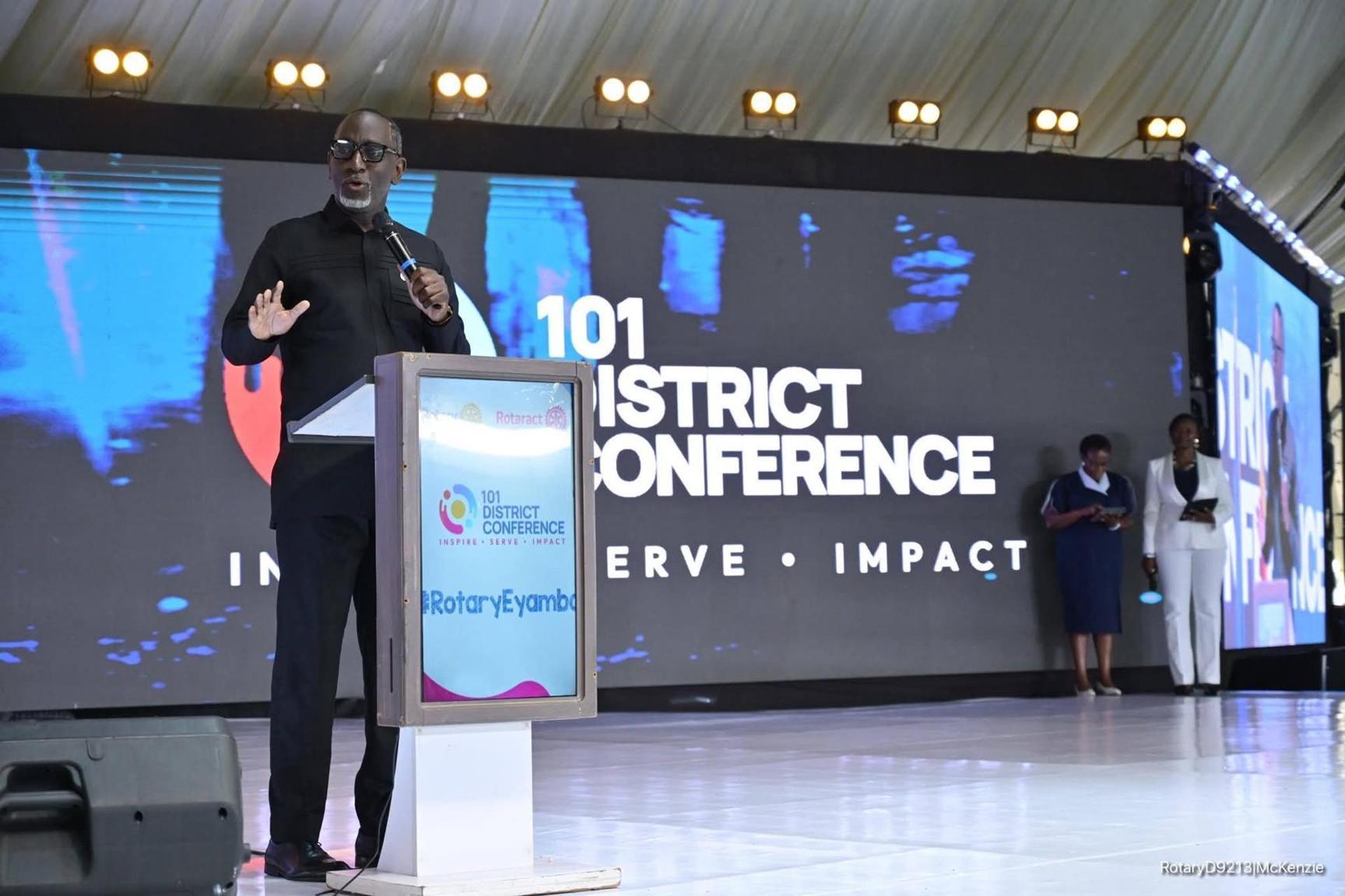
Africa-Press – Uganda. Rotary leaders across Africa are being urged to rethink the very foundation of leadership, shifting from comfort-driven administration to conviction-led transformation as the continent undergoes profound structural change.
This was the central message delivered by Robert Burale during his keynote address at the DISCON 101 conference held at Munyonyo Commonwealth Resort.
The high-level gathering, attended by Uganda’s Vice President Jessica Alupo, brought together Rotarians from across Africa at a time when shifting demographics, evolving governance models, and rising civic expectations are redefining leadership across institutions.
Burale challenged leaders to embrace what he termed a “divine disturbance”—an inner conviction that disrupts complacency and compels action toward societal transformation.
“There has to be a disturbance within,” he said. “An inner drive, an inner voice that tells you that you must make things right in society.”
He framed this internal unrest not as discomfort to be avoided, but as the foundation of impactful leadership, arguing that legacy is not built on titles or administrative efficiency, but on psychological readiness and moral clarity.
His message comes at a critical time for African institutions. With the continent projected to account for a significant share of global population growth, pressure is mounting on both public and private sector leaders to deliver measurable, structural impact rather than symbolic engagement.
Burale emphasized that the future of Rotary across Africa—including its projected growth to 70,000 members by 2028—will depend less on expansion strategies and more on the conviction of its leaders.
“Legacy is felt when you are gone, but built while alive,” he stated.
He warned that institutions driven by optics rather than purpose risk stagnation, particularly in a rapidly evolving society where youthful populations are demanding accountability and tangible progress.
Calling for what he described as “vantage-point leadership,” Burale urged leaders to elevate their thinking beyond routine execution and short-term wins.
“Stop looking and start seeing. Go to the mountain top,” he said, encouraging a shift toward long-term institutional design and strategic foresight.
He also highlighted the importance of ideological alignment within organisations, noting that growth without a shared vision can weaken institutional resilience.
“Get like-minded people who buy into the vision,” he said.
Acknowledging that meaningful reform often faces resistance, Burale stressed the need for resilience in leadership.
“Keep moving despite obstacles and naysayers,” he said, framing persistence as a defining trait of leaders capable of driving lasting change.
In redefining success, he called on leaders to prioritise societal impact over personal or institutional gain.
“Keep winning. Keep winning for humanity,” he added.
Concluding his address, Burale returned to the concept of legacy as the ultimate measure of leadership, emphasising the importance of building systems that outlive individual tenures.
“When your time is done on earth, your name will never be forgotten,” he said.
As Africa navigates a period marked by generational transition, digital acceleration, and rising civic expectations, the DISCON 101 conference underscored a growing consensus: leadership must first be unsettled internally to create structures that endure.
Burale’s address ultimately positions Rotary Africa at a pivotal moment—not merely one of numerical growth, but of psychological transformation—where the choice lies between comfortable administration and courageous, lasting institutional design.
Source: Nilepost News
For More News And Analysis About Uganda Follow Africa-Press