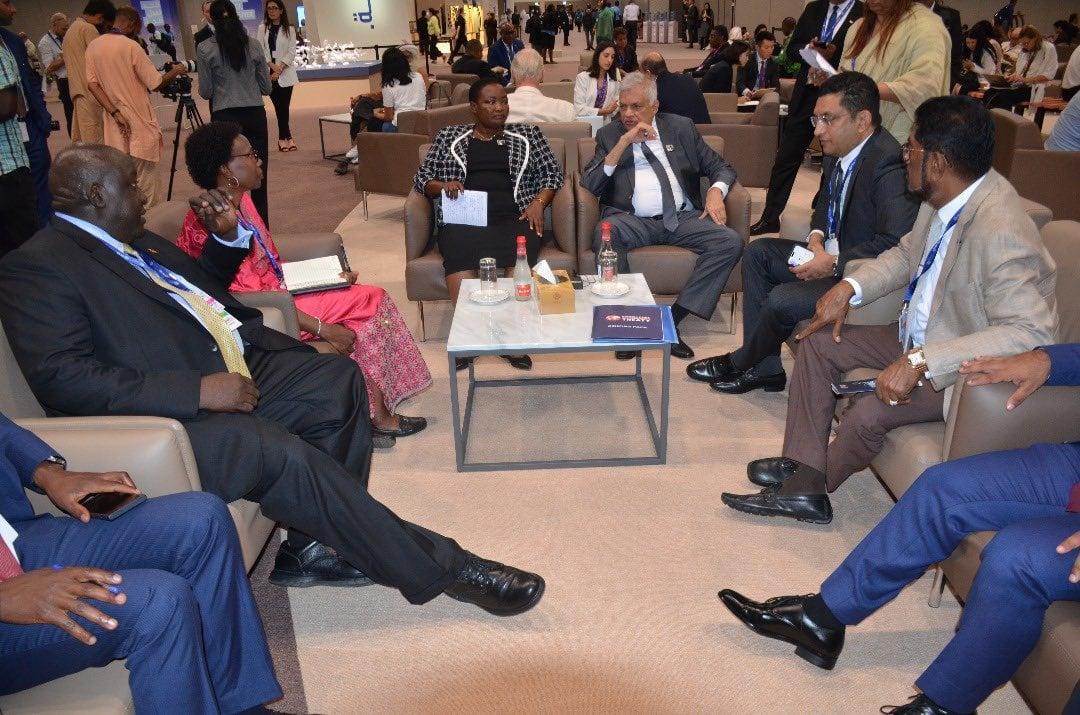
Africa-Press – Uganda. Uganda has sent a 600-strong delegation, more than half being bureaucrats, to the 28th Conference of Parties (COP28) underway in the United Arab Emirates (UAE), opening the government up for scrutiny over its spending choices amid revenue constraints.
This makes Uganda one of the African countries with the largest delegations, a few tiers below Nigeria, the second largest economy on the continent, which is being represented by 1,411 delegates.
By comparison, Morocco in North Africa (823) and Uganda’s richer next-door neighbours Kenya and Tanzania sent 765 and 763 officials, respectively.
West Africa’s Ghana has dispatched 618 representatives to Dubai for the global summit convened under the aegis of United Nations Framework on Climate Change (UNFCC), the parent treaty of both the 1997 Kyoto Protocol and the Paris Agreement of 2015.
The purpose of the three pacts, according to information on UNFCC website, is to “stabilise greenhouse gas concentrations in the atmosphere at a level that will prevent dangerous human interference with the climate system, in a time frame which allows ecosystems to adapt naturally and enables sustainable development”.
Scientists have capped that global temperature rise upper threshold for the century at no more than 1.5 degrees Celsius above pre-industrial levels to prevent existential risk to the planet and humans.
The ongoing big meet in Dubai in the Middle East, a desert outpost transformed into world-class business, luxury shopping and investment hub thanks to petro-dollars and leadership, aims to “change course and accelerate action to tackle climate crisis”.
Its theme is decarbonising the energy system of today while accelerating the buildout of the energy system of tomorrow.
COP28 has drawn representatives from governments, businesses and civil societies from the 198 state parties and organisers retail the summit the pedestal for urgent global engagement to “chart a course of action to dramatically reduce emissions and protect lives and livelihoods”.
It is to the conference that Uganda has sent 606 delegates, 375 comprising technocrats and politicians largely funded by tax payers.
The official delegation, excluding the civil society representatives and experts bankrolled by employers and other stakeholders, is led on the President’s behalf by Prime Minister Robinah Nabbanja, the coordinator of all government ministries.
We were unable to establish Uganda’s specific asking, or issues to be tabled, at COP28 which is conducted through main summit, break-out session as well as bilateral and multilateral side engagements, making expected gains for the country difficult to predict.
In Kampala, the Opposition and some civil society actors greeted news of Uganda’s 600-plus strong delegation to Dubai, whose particulars are listed on COP28 website https://unfccc.int/documents/634503, with consternation, questioning the value-for-money for the spend.
Mr Mathias Mpuuga, the Leader of Opposition in Parliament (LoP), said he did not know how the delegations were constituted, but offered that “apart from policy makers and few government officials including the MPs, I don’t expect all those climate shoppers to go for that conference”.
“We need to do an audit of their role there. Otherwise, if we find out that their role is not directly related to the activity taking place, then we should consider that as a waste. The gaps must be closed and whoever is found to be responsible for travelling must be held responsible,” he said.
Information that Uganda is being represented by more than 600 individuals, 375 of them bureaucrats, contrasts with the promise of Uganda’s 2023/24 austerity budget during whose reading both President Museveni and Finance Minister Matia Kasaija said travel abroad would only be restricted to essential engagements and officers.
Three months after the budget reading, the government suffered intense criticism after it dispatched two delegations of 70 notable officials to the United Nations General Assembly in New York, where some of the representatives were from dockets unrelated to the theme of September summit.
It is similar question being raised now, with Mr Mpuuga saying whereas some of the legislators who travelled to Dubai were sponsored by non-governmental organisations, the “focus must be on how tax payers’ money is being spent on such trips”.
“We should be interested in knowing where tax payers’ money is spent without directly being by people who are concerned with the actual work,” he said.
The actual cost of the official delegation to tax payers remained unknown, but our computations, based on costs of return tickets and per diems the officials are entitled to, puts the expenses in billions of Uganda shillings.
On the team are 13 ministers and 58 Members of Parliament alongside senior government officials.
According to the 2018 government duty facilitation allowance rates, the prime minister gets $900 for night allowance outside the country, $100 safari day allowance and $180 as out-of-pocket allowance per day, bringing the total to $1180 (Shs4.4m).
On the other hand, Cabinet ministers each pocket $850 (Shs3.2m) as night allowance when on trips outside the country while state ministers get $820 (Shs3m). These do not include other expenses.
Each MP is entitled to $720 (Shs2.7m) per diem per day when abroad, or Shs154m for the 58 lawmakers in UAE. Other members of the government delegation are each entitled to about $500 (Shs1.8m).
The COP28 opened in the Expo City on November 30 and closes on December 12, making longer the period for bureaucrats to draw cash from the public purse, thereby increasing overall expenditure on them.
Information Minister Chris Baryomunsi and Uganda Media Centre Executive Director, Mr Ofwono Opondo, as well as Foreign Affairs ministry officials, were unavailable to offer insights into what informed the government decision to send more than 300 delegates to COP28 and the expected value-for-money.
Mr Charles Odongtho, the spokesperson of the Office of Prime Minister (OPM), last evening said Prime Minister Nabbanja, as delegation head, only travelled with seven staff from her office.
These included the aide-de-camp, a bodyguard, the commissioner in-charge of policy analysis, a liaison assistant, political assistant, a personal attendant and a communications assistant acting as the camera person.
“I speak for prime minister’s office and she is the one heading the delegation of Ugandan delegated by the president who was officially invited for the COP. If there are other government delegations, I don’t speak for them,” he told this newspaper by telephone.
Officials of the Ministry of Foreign Affairs, the clearing house for Uganda’s international engagements, were unable to speak for this article.
Parliament Spokesman Chris Obore said the 58 MPs were likely drawn from the committees on natural resources committee and climate change, and the Parliamentary Forum on Climate Change, all of whose members require to understand the bigger question of climate change in order to make informed policies.
“Parliament makes climate-friendly laws and policies and the members of the committees can only plan and suggest mitigation measures when they understand the magnitude of the climate change,” he said.
Some of the legislators, according to Mr Obore, were funded for the summit by entities involved in climate change.
The institution bankrolled the trip for others, he said, because “climate change is a global policy issue and members are [supposed to be] abreast with the intricate issues of climate change”.
“We hope that they are able to suggest internal options from the knowledge they get from the conference,” Mr Obore added.
Earlier, Mr Marlon Agaba, the executive director of the Anti-Corruption Coalition Uganda (ACCU), yesterday accused government officials of exploiting international summits for making money.
“The biggest challenge we have is that most government officers look at these international conferences as avenue for making some extra money inform of per diems and other facilitations and also for them to tour the world,” he said, “I don’t think they are using these events for the purpose they are supposed to serve. When it becomes this, which means our funds are not used to do the actual work and we cannot achieve the objectives for which these conferences are organised.”
Without providing examples, Mr Agaba noted that some countries with bigger economies comparatively sent smaller delegations to canvass their positions at COP28.
Mr Julius Mukunda, the executive director of Civil Society Budget Advocacy Group (SBAG), said the Ugandan delegates should be scrutinised based on technical competence and capacity to meaningfully engage with the issues up for discussion at the climate change and greening agenda.
“What matters is whether the delegation is made of technical people or politicians and personal assistants. COP is a big thing and need people who are going to negotiate deals for the country. If the big delegation consists of people who are technical and are going to speak on behalf of the country, I have no issues. But if they are office assistants, political assistants and politicians who are just going for a tour, that is where the problem is,” he said.
For More News And Analysis About Uganda Follow Africa-Press