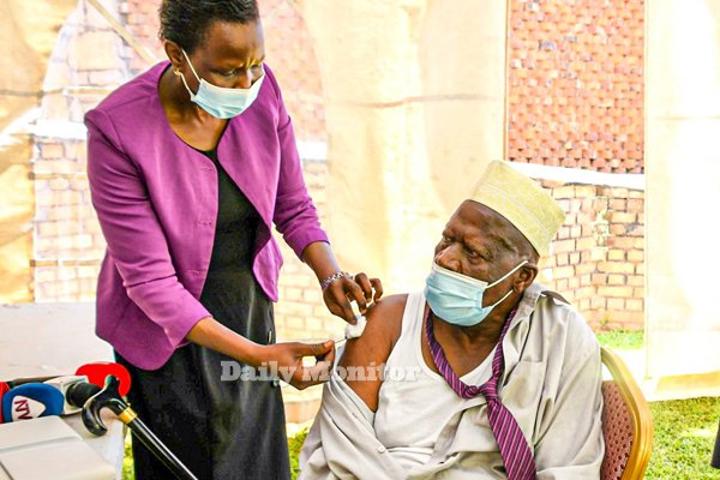
Africa-Press – Uganda. The Ministry of Health yesterday commenced the vaccination of all Members of Parliament (MPs) and staff irrespective of their age, deviating from its original plan.
The initial government plan was to vaccinate frontline workers including health workers, teachers, security personnel, persons above 50 years with comorbidities and persons above 70 years. Dr Jane Ruth Aceng, the Minister for Health, explained that MPs were placed in the high-risk category due to their age, where many are above 50 years old. She also said the MPs interact frequently with people, increasing their chance of contracting the virus.“Our analysis puts MPs in the risk population, some of them for their age group and other for comorbidities,” Dr Aceng said.Some of the MPs, who took the Covid jab from Parliament include Deputy Prime Minister Gen Moses Ali, State Minister for Sports Hamson Obua, and State Minister for ICT Peter Ogwang.Sources also told Daily Monitor that MPs-elect were also invited for vaccination.
Some Parliament reporters were also vaccinated. She added: “The majority of the population has been asking why we are vaccinating them first without vaccinating the leaders. The population demanded and we had to bring them on board to show that what the ministry is saying about the vaccine is true.” By press time yesterday, more than 400 MPs had been vaccinated.
The ministry will need about 1,000 doses to cover the 457 current members, MPs-elect and more than 500 staff, according to the acting director of communication of Parliamnet, Ms Helen Kawesa.“MPs have been working throughout the lockdown. They continued going to their constituencies and they interact with many people,” Ms Kawesa explained.
She added: “The priority groups are still being vaccinated, but because more doses have become available, the MPs were brought on board.” Asked whether the vaccination of MPs will not affect the initial priority categories by using up the vaccines, Dr Aceng explained that the vaccines have not been taken up as earlier anticipated creating an opportunity for other categories to be brought on board as the country awaits the next batch of vaccines.
Uganda received a total of 964,000 doses from the Covax facility and the government of India. At least 663,520 doses have been distributed to all hospitals but only 32,526 persons have received the first dose. Government anticipated to vaccinate 150,000 health workers by March 17. “If it had gone at the rate at which we had planned, then we would be worried but we expect the next consignment in May. So vaccines will be available for the rest of the population as is on schedule,” Dr Aceng said.
Dr Aceng also revealed that government has released Shs36b for the procurement of 2.8 million doses of the AstraZeneca vaccine from the Serum Institute of India. While giving an update on the vaccination exercise in Kampala yesterday, Dr Aceng said the private sector and organisations that wish to import vaccines for their staff should write to the ministry, and will be assessed to import through the National Medical stores.
Slow uptake
Dr Aceng explained that the low number so far vaccinated is due to distribution and logistical challenges. To date, government has not provided finances to the districts to facilitate the exercise. “The vaccination has been slow for several reasons. The distribution was completed after seven days and yet we had anticipated to do it in two days.
She added: “The other challenge has been the logistics like vaccination cards. We needed cards that are sealed and easy to detect but the process was not as quick as the demand for the vaccination. Several districts had to put their vaccinations on hold waiting for the cards. Pre-registration, which was a requirement, we realised was taking up a lot of time, it has since been scrapped as long as one comes with any form of identification.”