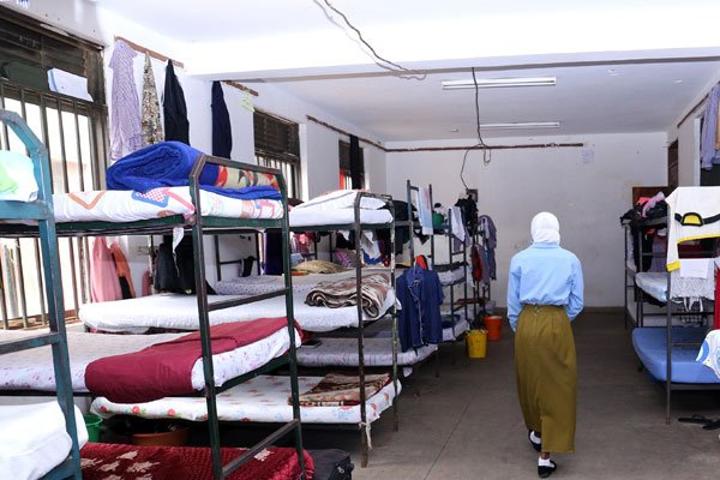
Africa-Press – Uganda. The government yesterday said their inspection has revealed that some education institutions are operating illegal boarding sections and others have turned classrooms into dormitories to accommodate learners contrary to government policy that promotes day schooling.
Dr Kedrace Turyagyenda, the director of Education Standards, said all primary schools are supposed to be day except those which have applied and obtained permission to have a boarding section and must comply with the set standards in order not to compromise on the quality of services.
She said her office received complaints from the public that some schools were already forcing parents to put their children in boarding and her impromptu visit to some of the institutions established that some had turned classrooms into dormitories.
“All primary schools apart from those which will have had express permission are actually day schools. When we sent out the guidelines and said; choose what you want to be, the category which had issues was that which had both day and boarding. The rest of the schools are supposed to operate in their formal accepted classification,” Dr Turyagyenda said.She added:
“What I have learnt is that some schools have converted some classrooms into dormitories. They have no facilities for boarding, they have no sanitation. They have no security. It is not acceptable. We are going to move out and close them. I want to request that schools get back to their original status. If you are a day school, allow all children to benefit. No child should be left behind because of a certain decision which is not authorised.”Mr Hassadu Kirabira, the private schools association secretary, yesterday asked government to review their policy on day schooling.
He said many things have changed demanding that parents take their children to boarding section at an early stage. Mr Kirabira wondered why government would come out now to close them. Mr Kirabira admitted that some of their schools are operating illegally but blamed it on what he called government’s “rigidity in demanding tough requirements” to limit them from starting boarding sections.
“Parents are not at home. It is a long time policy. Things have changed. It is time government reviews that. It is not the right time to come and close us. Where have they been all these years schools have been operating? Is this the right time when we are struggling with Covid-19?” Mr Kirabira wondered.
However, Mr James Jjuuko, the Kisugu Primary head teacher and chairperson of Kampala Primary School Head-teachers Association, asked his colleagues to ensure they have requirements before starting a boarding section to avoid risking the lives of both learners and teachers.“If you don’t have a ventilators, fire extinguishers, why shouldn’t they close you? If there is an inferno, firefighters will take long to rescue lives which risks lives,” Mr Jjuuko said.
Mr Alex Kakooza, the Ministry of Education Permanent Secretary, advised schools legally operating both day and boarding sections to ensure they separate the learners by either introducing morning and afternoon shifts or alternate days when they appear for studies to avoid mixing which could accelerate the spread of Covid-19.
Another option is to either run as a day school or boarding but not both.“Ensure that the two categories don’t interact physically,” Mr Kakooza said.
Background
Of the 800 secondary schools the Directorate of Education Standards inspected in 2018, only 30 per cent of the schools complied with the required standards. Most of them still operate without authority. Some of those with authority have continued to flout the rules and regulations.
Other sops
• Other measures include restricting entry to education premises by members of the public. • Each institution should re-arrange the sitting of learners using all available rooms within the school to ensure the required social distancing. This may include use of libraries, laboratories, dining halls, main halls where available. Where classrooms have temporary partitions, institutions should remove the partitions to create larger rooms for ample sitting and aeration/ventilation. • Where available, main halls, dining halls and other large rooms should be prioritised for use as classrooms to ensure that available teachers cater for a sizeable number of learners per class. However, there should not be more than 70 learners in a room/hall of any size for a lesson or other purposes.• A foot-operated hand washing facility shall be placed at strategic point of access to each block (and floor where applicable) used by learners and staff.• Safe temporary shelters, such as tents, may be used as classrooms.
Open air spaces, such as tree shades may be improvised as temporary venues for some classes.There shall be no group and close contact co-curricular activities in all education institutions until further notice. Nevertheless, learners should be guided to engage in physical activities while observing social distancing of at least two metre.