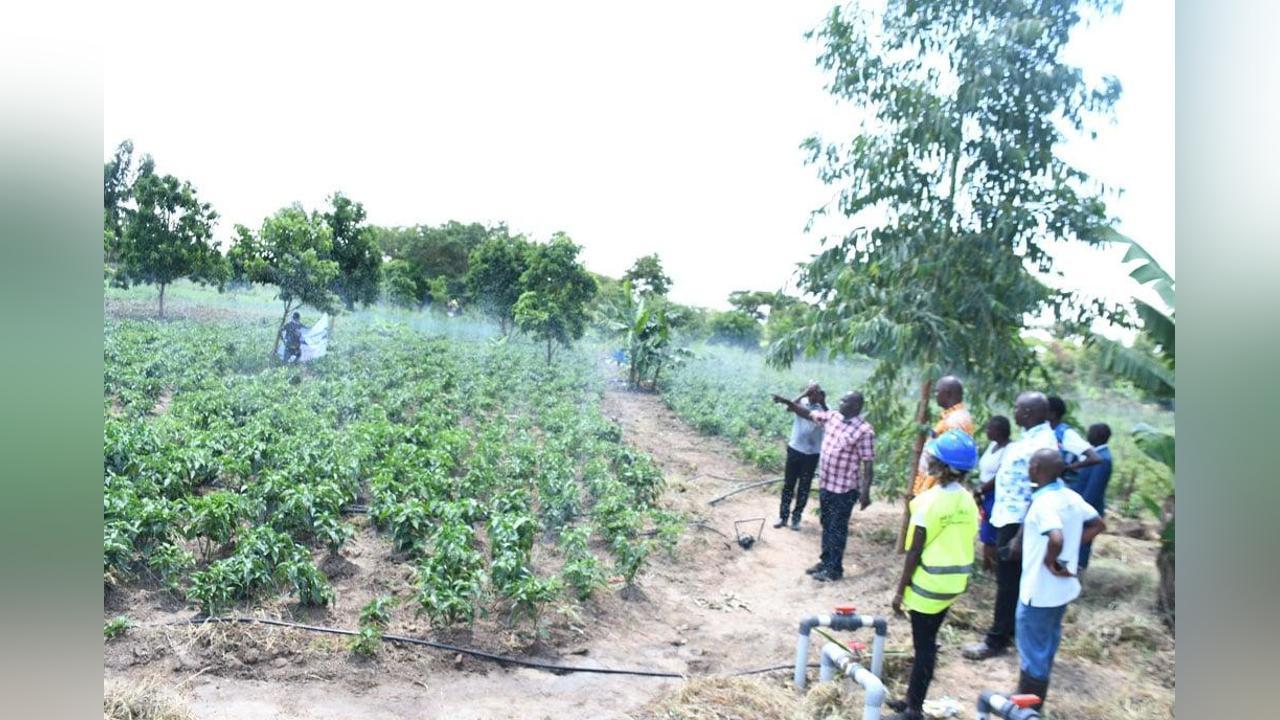
Africa-Press – Uganda. In bid to save Lake Kyoga from further degradation, the government has constructed solar-powered irrigation schemes at various land sites in Serere District to lure locals from bad fishing practices to modern farming.
Owii and Kabos irrigation schemes in Bugondo Sub-county are some of those constructed by the Ministry of Water and Environment with support from UK Export Finance at Shs1.3 billion.
For years, Lake Kyoga, which has a catchment area of about 75,000 sq. km, has been under massive degradation from human activities such as fishing, cultivation and livestock keeping.
Mr Joseph Antingu, 53, a resident of Owii Village where one of the irrigation schemes has been constructed, said fishing has become a risky venture.
“The fish stock in the lake has reduced and to make matters worse, whenever we go fishing, we are being chased. The government wants us to have standard boats and nets, which we cannot afford. We should embark on farming since we now have water for irrigating our crops,” Mr Antingu, said at the weekend.
According to district officials, Lake Kyoga used to have different fish species. But when Nile Perch (Lates niloticus) was introduced into the lake in the late 1950s, its proliferation led to the almost complete elimination of many domestic fish species, such as Synodontis victoriae, Tilapia esculenta, Tilapia variabilis, among others.
Mr Antingu, who is one of the farmers growing tomatoes, onions, egg plants, watermelon, and cabbages, among other crops, at Owill irrigation scheme, said embracing modern farming will also help in mitigating floods.
“Due to massive encroachment on the lake, when it rains this area floods everywhere and people are displaced,” he said.
Whenever water levels in Lake Kyoga rise, Bugondo, Kadungulu, Labor, Pingire, Kateta and Kyere are the most hit sub-counties.
Mr James Okwi, another farmer and a resident of Kabos, said:“We need to be trained on modern agriculture starting from the selection of the enterprise, how to treat seedlings and timing of watering for the crops for at least two years so that we master the skills,” Mr Okwi said.
Mr Okwi made the remarks at the weekend during an inspection of the irrigation schemes by officials from the Ministry of Water and Environment and by the district leaders.
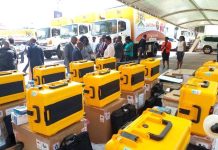
Pumps and accessories, alarm systems, transmission lines, reservoirs, garden taps and distribution lines are some of the components of the irrigation schemes.
Mr Stephen Ochola, the chairperson of Serere District, said: “As local leaders, we support any government initiatives to promote access to water for production because that is the solution to current unpredictable weather conditions.”
Mr Ochola said the government should set up irrigation schemes in other sub-counties.
Mr Patrick Okotel, the regional manager for water for production-eastern region, said the Ministry of Water would advance loans to farmers based on the kind enterprises they want to focus on.
“And after they sell, we are constituting a farm committee, which will recover the loan,” he said.
Mr Okotel said the irrigation projects are also aimed at growing the capacity of farmers to sustain themselves.
“They will compare what they harvest per half an acre with how much they get from fishing and this will help us to save the lake from bad fishing practices that have been endangering the young fish and other species,” he said.
About lake kyoga
Lake Kyoga is a large shallow lake and is located north of Lake Victoria, It is 914 metres above sea level.
The lake has fingerlike extensions with a surface of 1,720 sq. km. Its average depth reaches 3 metres, its maximum depth is 5.7 metres.
The extensions of Lake Kyoga include Lake Kwania, Lake Bisina and Lake Opeta and they are surrounded by swamp land.
For More News And Analysis About Uganda Follow Africa-Press