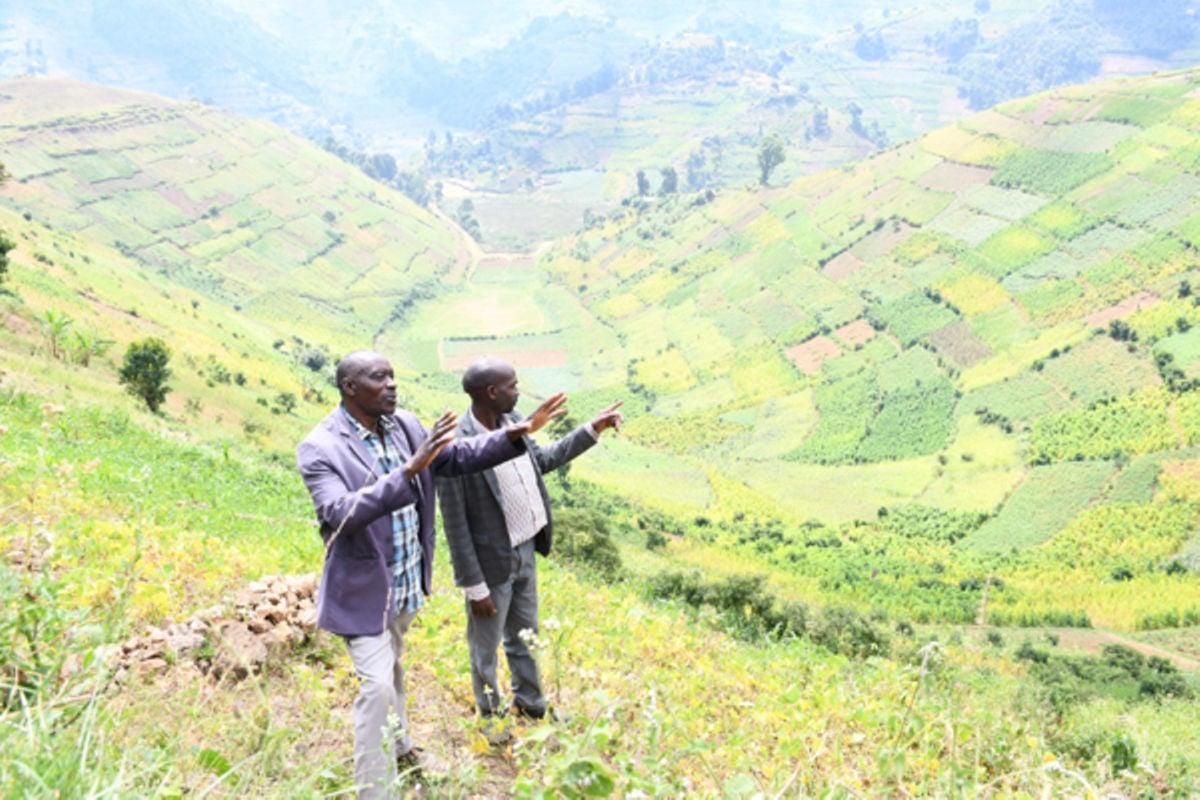
Africa-Press – Uganda. A section of small-scale farmers in the Kigezi Sub-region has adopted climate-smart agricultural practices aimed at restoring degraded hilltops and valleys.
The initiative is aimed at improving soil fertility for improved crop production.
The farmers are located in Kanaba Sub-county in Kisoro District, and Muko and Hamurwa sub-counties as well as Hamurwa Town Council in Rubanda District.
Others are in the sub-counties of Rwakarimira, Kaharo, Kitumba, and Buhara in Kabale District.
Their other activities include the opening of community access roads for easy transportation of agricultural produce to markets, restoration of degraded terraces and contours, as well as embracing zero grazing of domestic animals to get organic manure.
“After identifying that water runoff during the rainy season had become destructive to our crop gardens for several years, in June last year, we formed a group of 26 members that sought support from different government institutions and other non-governmental organisations on how to overcome the problem,” Mr Samuel Buyangye, the chairperson of Rwamahano-Nyarurambi Farmers Self-Initiative Group in Rubanda District, says.
“Common Ground Project came to our rescue by building our capacity on watershed restoration mechanisms. Since July last year, crop production has increased in this area because of the capacity building obtained from this partnership,” he adds.
Mr Buyangye explains that farmers in the area have developed local manure production technologies by utilising droppings from cows, goats, and sheep reared under zero grazing method. He adds that they feed the reared animals on grass harvested from the hedges of the established trenches in the restored watershed areas.
However, Ms Janet Tusasirwe, Ms Jolly Tushabe, and Mr Paul Biganja, who belong to the group, say while they have experienced increased food crop production during the rainy seasons, it is challenging during the dry season as most of their food crops dry up before maturity.
“Water scarcity has remained a serious challenge in the restored watershed areas on hilltops and valleys. We need support in establishing water irrigation schemes to support our agricultural activities throughout the year,” Ms Tushabe says.
In September 2017, runoff from Rwamahano- Mukanyonko-Kibaya hills in Rubanda District destroyed about 20 homesteads, claiming 14 people and destroying several gardens. In January 2022, mudslides destroyed about 50 homesteads and claimed nine lives in Nyarusiza Sub-county, Kisoro District.
Efforts
To avoid the repeat of such disasters, the chairperson of Kanaba Sub-county in Kisoro District, Mr Joseph Nizeye, says they mobilised the people to engage in climate-smart technologies that included the establishment of terraces, dams and digging trenches to block the runoff during the rainy seasons.
“Although we have about 300 hills in Kanaba, we started with Cungo Hill where commercial onion production is carried out. Now that the results are positive, we shall engage other farmers in the neighbouring villages to take up the technologies not only for environmental conservation but also for increased food crop production,” Mr Nizeye says.
Mr George Gashiringi and Ms Harriet Nyiragakiza, who grow onions and Irish potatoes, say climate-smart agricultural practices have increased their production.
“Before these climate-smart technologies, from one acre I used to harvest about 20 bags of Irish potatoes, each weighing 130kgs, and 30 bags of onions, each weighing 150kgs,” Ms Nyiragakiza says.
“After applying these climate-smart technologies my production increased to 50 bags of Irish and 60 bags of onions. It is my prayer that the government and its partners think about providing mini-irrigation schemes to all farmers so that food crop production is continuous throughout the year,” she adds.
The Kigezi regional coordinator for the Common Ground Project, Mr Francis Muhanguzi, says when they launched their activities in February 2023 in the districts of Kabale, Kisoro, and Rubanda, their target was to support community members in restoring about 7,000 acres of destroyed watershed areas besides supporting them in establishing community access roads to facilitate market linkages and accessibility.
Mr Muhanguzi says the project is also implemented in the highland areas of Rwenzori and Elgon regions.
He also reveals that his project has addressed the issue of mindset change about doing community activities.
The Kabale District Natural Resources Officer, Mr Henry Tumwesigye, welcomes the interventions in watershed restoration and other conservation efforts for the degraded landscapes.
“I am optimistic that the establishment of terraces, check dams, and trenches on hilltops and valleys will reduce the rampant cases of soil erosion and mudslides that have been destructive to crop gardens, human lives, and other properties worth millions of shillings,” he says.
For More News And Analysis About Uganda Follow Africa-Press