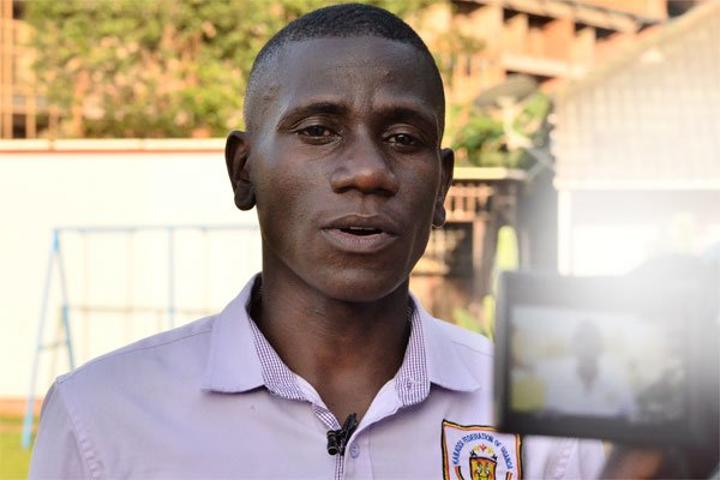
Africa-Press – Uganda. Born in Masindi to retired accountant Moses Babiiha and former Duhaga SS headteacher Jane Birungi, Mujuni is a passionate sportsman, who quit a Civil Engineering course for Sports Science. The 32-year-old is passionate about Kabaddi, a sport he built at a personal cost of a budding career in football.
Football first
Mujuni was an impressive left-sided midfielder who played for Kinyara and Nyamityobora in the top flight.Football was the specialty of Kabalega SS where he spent six years pursuing secondary education. Having attended Black Bullets Academy, he started playing for his primary school [St Francis] in Primary Five. He was also a first-team player later at Yana where he sat for Primary Leaving Examinations.
At Kabalega, the game was associated with the biggest and fittest players. The rule of the jungle prevailed, leaving him to hang around the big boys as a ball boy and kits man.But he was named on the regional team to the City Tyres U-14 tournament and later Shell U16.
Eliminated
He represented Kabalega SS at three Copa Coca-Cola Schools tournaments beginning with the 2005 championship in Masaka where they were eliminated from the group stages.Luckily, it opened doors to Kinyara where he was invited by coach Leo Adraa for trials that he passed. It was here that he met the likes of Peter Ssenyonjo and Edison Benda. In the 2006 tournament hosted by Kabalega, they ended in quarters after losing 2-1 to Mvara.
He was part of the select team that played Tanzania at Nakivubo Stadium. The team was captained by Michael Azira.
Mutebi endorsement
Burning with desire, when he returned to school, he started a junior team using knowledge he had gained from Mike Mutebi.He had impressed Kibuli SS coach Abdallah Mubiru at Nakivubo who offered him a scholarship. But he returned to Kabalega after two weeks for personal reasons.
In 2008, he played at the Copa finals in Arua where they were eliminated in the second round.He was again on the select team to Kenya with the likes of Brian Majwega, Ceaser Sapeo and Luwagga Kizito, although he missed the cut to Brazil.After Senior Six, he joined Boroboro Tigers which he helped avoid relegation.PioneerHe was offered a sports scholarship at Ndejje University becoming a pioneer player of the Fufa Big League.He went on to play for three seasons until 2012. In 2014, he played for Hope Doves under Ian Mutenda, Asaph Mwebaze and Mike Mutebi for three seasons.When Mwebaze was appointed Nyamityobora coach in November 2018, he joined him in Mbarara. “But things did not go well. When he was fired. When we were relegated, I concentrated on growing Kabaddi,” he recalls.
Kabaddi time
The word ‘Kabaddi’ invokes negative connotations relating to mugging by city gangs. But the sport, which has Indian roots, is what Mujuni prides in.It all started during an exhibition by Ndejje where he impressed retired commissioner Omara Apita, whom he had earlier worked with at Boroboro Tigers.Apita interested Mujuni to work as a volunteer at the Ministry of Education and Sports a role he held until 2012 when he was appointed Sports Clerk work in the Physical Education and Sports Department.In his role, he was handling a couple of things including coordinating federations on policy issues.
Secretary
It was here that he was the secretary for the 2014 National Council of Sports (NCS) Statutory Instrument. He was also the secretary for the committee that developed the Physical Activity Sports Bill.He used to evaluate and monitor projects in schools and some technical work at the department.
He did not renew his contract when it expired in 2016. His role as sports clerk gave Mujuni a platform as he was recruited by Dan Ntale as the administrator of Jodana Sports Management.Although Mujuni’s local reputation in sports circles was admirable, working from the outside made him realise what his full contribution to sports would be.In 2017, while on official duties of Jodana, he met Muhammad Babu who proposed to him to start the Kabaddi sport in Uganda. This meeting marked the birth of Kabaddi and a lot of work ahead. “He made me understand that there was more to just sitting in the office,” Mujuni says.
Legal process
They continued to meet as Mujuni embarked on paperwork to complete the legal process of registering with the NCS.Although Kabaddi pulsates through Mujuni’s blood, his peers had different ideas. He first contacted John Nsibambi, a former teammate who was not initially moved.“I pestered him but continued to ask for time. When he made up his mind, we strategised on how we start with friends and people around us,” Mujuni says.It is during that time that they engaged Ephraim Makubuya. Mujuni would then embark on management work while Nsibambi and Makubuya handled the technical aspects laying the groundwork within Kkungu community in Matugga.They went door to door requesting parents to allow their children to play the sport. Luckily, they managed to raise 30 players when routine training started.
Indian friends
Whenever there is no money from the government, the powers that be tell Mujuni to seek help from his “”. Indeed the Indian community has been the foundation on which the sport is laid.“My strategy was to contact any Indian person I meet,” Mujuni says.Kabaddi is a traditional Indian sport thought to have been played as a pastime activity until 1990 when it was added to the Asian Games’ programme.It is the official game in the states of Andhra Pradesh, Kerala, Haryana, Karnataka, Odisha, Punjab, Tamil Nadu, Bihar, Telangana, Uttar Pradesh and Maharashtra. Outside India it is popular in Iran, Bangladesh and Nepal. Elsewhere, it is popular where there are Indian and Pakistani communities.It was from these interactions that Thomas Binu, the director of Rainbow Pavers and Tiles, helped the association past the registration hurdle.
Highly rated teenager Olivia Nalubega (in red) makes a raid during an exhibition game at Kati Kati Restaurant in Lugogo. She is among the five players expected to go professional in India. PHOTOS / GEORGE KATONGOLE
Testing international waters
When Kenya got wind of Kabaddi in Uganda, they asked for a friendly that happened in April 2018 at the MTN Arena, Lugogo.The event was more of an exhibition as the Kenyans arrived and taught the Ugandan players most of the basics. It was like black market affairs as the UKF were yet to receive affiliation from NCS.“But this was the first real activity that opened the door for future opportunities,” Mujuni recalls.In December 2018, the team travelled to Kenya for an East African challenge. Before they left, Aziz Damani’s Shivani Mishra donated the jerseys while Vaheed Muhammad sponsored the camp feeding.
Faulty ride
Mujuni raised Shs3m which he used to hire a Coaster van. Sadly, it broke down before Kisumu.“I did not have any money on me. I called my mum in Masindi who sold some cows and sent the money we used for the repairs. It took us about 15 hours before we resumed the journey,” he says. Uganda’s first game was a win against Tanzania as the team went on to lose in the finals. But the hustle was not done.
Mujuni bought to each of the 35 members bread and milk off the Shs700, 000 Binu had sent the team for fuel. On the way, a pastor in Nakuru, [Ken Andai], a friend to his mother-in-law, asked them to stop over. He fed the team.“This was the first decent meal in many days. It was a miracle. Despite the obvious difficulties, players were happy because most had never travelled to another country,” he says.In 2019, when the women’s team was invited for the African championships in Kenya, the preparations were smoother as NCS offered them a Shs2m purse.
Wretched of the world
When you are involved in a small sport, you are less sure about just about everything. You have to be ready for plan A, B, C and even D. You risk being perceived as a beggar. Mujuni has risked it all. One memory that does not go away was in 2019 when he staked his house as security to obtain Shs9m to aid the national team travel to Iran. In November 2019, Uganda was invited to Iran for the inaugural Junior World Kabaddi Championship in Kish Island. 13 U-20 teams took part as Iran defeated Kenya 42-22 in the final. Kenya and Uganda were the only African countries at the event that was also attended by Sri Lanka, Chinese Taipei, Iraq, Denmark, Turkmenistan, Pakistan, Malaysia, Thailand, Indonesia, Bangladesh and Afghanistan.
Iran trip
But the journey to Iran was not for the faint-hearted. Mujuni was at the time still an active player with Nyamityobora and had to coordinate a lot of stuff on the phone.
Like for most first time travellers, four players and a coach did not have passports. To navigate that, he borrowed Shs1.5m to process them. But he needed much more than passports and sent a requisition to the NCS, who would give the team tickets one day to travel after the intervention of minister Bakkabulindi. “There was someone who had promised us tickets but he apologised at the eleventh hour. When I was coming from his office in Kitante, I sat under a tree and wondered what I would tell players that had been training for more than a month,” he says.
Big backer
Requiring up to Shs60m for the tickets, visas and insurance for the trip, he was bounced at NCS. Binu had cleared the visas while Rajesh Chaplot, the director of Graphics System handled other bits.The Iranian High Commission had also discounted the mandatory medical checks at the Iran-Uganda hospital.
When he met Bakkabulindi, he asked NCS to find the tickets, something he says did not go well with then board chairman Bosco Onyik and General secretary Patrick Ogwel. Thankfully, they availed 10 tickets instead of the 15.Kabaddi has seven starting players and five substitutes. So, the team would be denied depth.On the day the team was flagged off at Lugogo, the players moved straight to the airport as he put together the passports, visas and insurance in place.
Accident
A paltry $200 dollars from Binu was all Mujuni had for the team as he jumped on a boda-boda to Entebbe for the 3:45pm Qatar Airways flight.But he was involved in an accident at Abayita Ababiri enroute the airport when they collided with a taxi. He escaped with bruises. But he was late and the team missed the flight.“I called NCS for guidance to no avail. My Indian friends said they could not help either. I decided to rebook the tickets and we slept at the airport awaiting the next flight the following day,” he says.His wife, Elizabeth Mwesigwa, staked their house for Shs9.5m which was used to help the team travel. Uganda finished seventh overall.
Strategy
The schools were the progenitors of the Kabaddi sport. Even though football remains a household sport, there is an opportunity to introduce Kabaddi in schools. This is what gave birth to the National Secondary Schools championship initially held on June 29, 2019 at Lugogo MTN Arena.Bwijanga SS, Kinyara SS, Mulusa Academy, St Peter’s, Kololo High, Marvel SS took part in the inaugural tournament. Mulusa Academy were crowned champions and they have since then become vital to the sport as the centre of excellence.
Monthly stream
Rajesh, who makes a monthly contribution to the Uganda Kabaddi Federation, advised UKF to form an advisory body for sustainability purposes. This is how the Indian High Commissioner Ajay Kumar was roped in.One of the many things that Rajesh, Mujuni and H.E Kumar did was to make the sport professional in collaboration with Indian businessmen in Uganda.They decided that five exceptional players should be sent to India for professional contracts.The model, of course, was aimed at helping the sport gain strong technical and tactical roots with India. The players that await that opportunity are Olivia Nalubega, Douglas Mulaalira, Shafiq Katamba, Joel Machari and Jimmy Ssengendo. H.E Kumar also asked the Bank of India to avail Shs9m to procure the playing mat.
Pro-league
Before the coronavirus pandemic in 2020, UKF had laid solid plans to create a pro-league that would see each franchise get a sponsor.“We want a good product. We want to take our approach in a professional sustainable way. All those involved must earn professional fees,” he says.The UKF embarked on capacity building activities with umpiring and coaching as the core.“There is nothing you can achieve by sitting in one place. We are ready to walk the talk. But first, we have to do things the right way,” Mujuni says.
THE DEFINITION
Kabaddi, a combat sport that originated in India, puts two people at war. One team member has to raid into the enemy’s camp, who try to defend their territory. The intention of the raider is to touch any defender or cross the line into the bonus line and return home to earn points. There is always a struggle between the raider and the defenders. This struggle calls for tenacity and agility putting fitness levels at the fore.
PROFILE
Name: Edgar MujuniDesignation: CEO, Uganda Kabaddi FederationDate of birth: December 23, 1989 (32 years)Education: St Francis, Yana, Kabalega SS and Ndejje UniversityProfession: Sports scientistWork history: Sports Clerk (Physical Education and Sports Department), administrator at Jodana Sports Management.Playing career: Midfielder at Black Bullets Academy, Kinyara, Masindi LC, Boroboro Tigers, Hope Dove and Nyamityobora