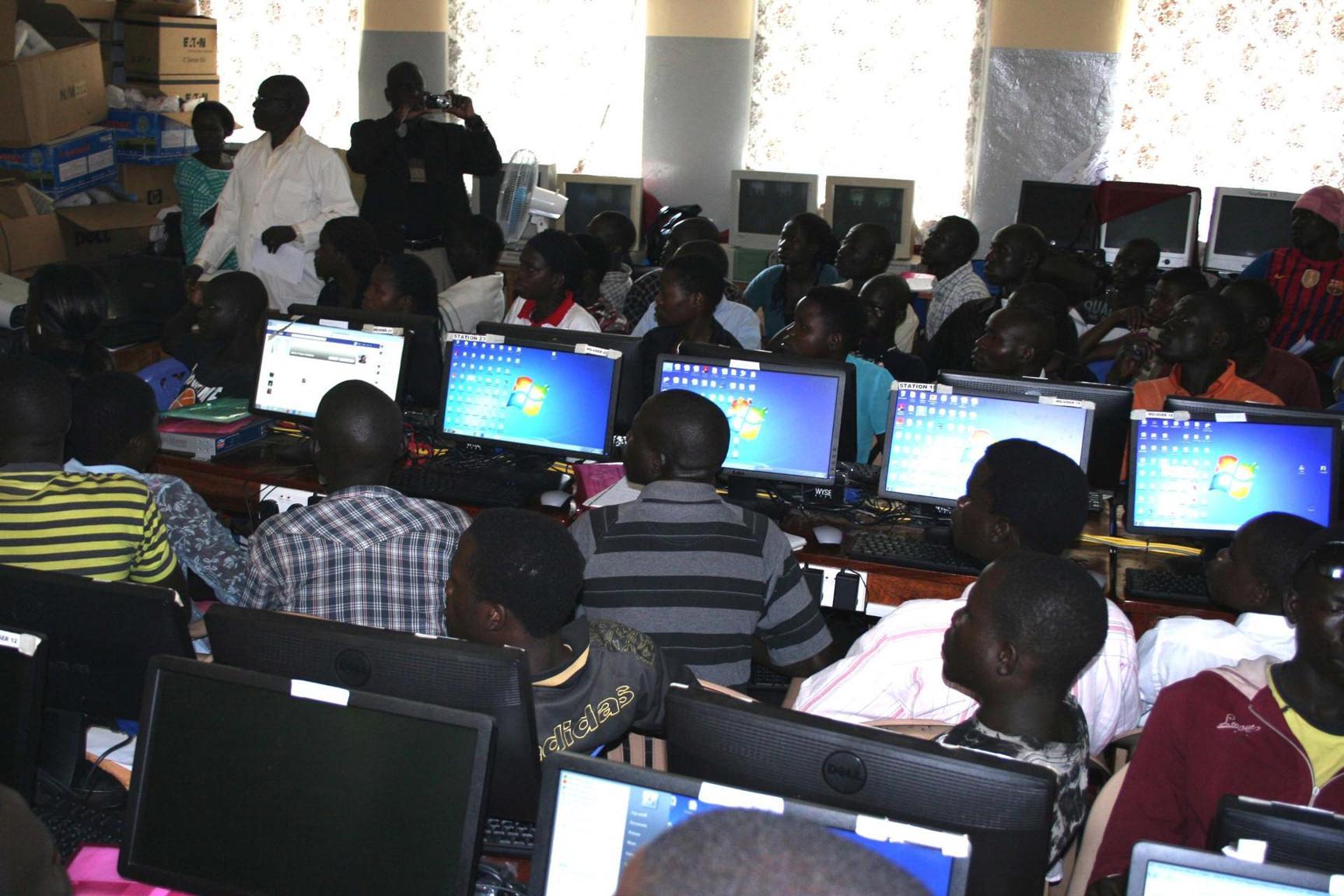
Africa-Press – Uganda. Learners in Bidibidi refugee settlement, Yumbe District, have welcomed the new lower secondary school curriculum, saying it has exposed them to the digital world albeit with limited or no resources for ICT.
Speaking to Daily Monitor on Monday, Sharon Sharah, a student of Nipata Secondary School, said in the past, she used to rely on her teachers during the learning process who would provide all the content.
According to Sharah, she would go to the library to do more research on assignments given by the teachers but she would often get stuck as the library had few books.
Sharah said the new curriculum compelled her parents to buy her a smart phone, which she says has made learning easy.
Speaking about the challenges, she added: “Our school is not connected to the power grid but we instead use solar power which sometimes disturbs us if the weather is not good. We sometimes use smart phones but getting data is a problem and the computers, tablets we have at school are not enough to cater for the big population of learners in the school.”
Another student, Muhammad Saffi of Yoyo Secondary School, said digitisation has been very helpful in promoting children’s rights but acquisition of such gadgets is a problem for most of the learners.
“Some of us don’t have parents and rely on ourselves for all the necessities. In our school, smartphones are compulsory for research and teachers give us topics and you are asked to do research on it. But acquisition of such gadgets is a problem and some of the learners end up borrowing them,” he said.
The child protection coordinator at World Vision, Mr Job Auruku, said: “Since Covid-19 struck, technology has been used to facilitate a lot of things. We are happy that schools in the settlement use digitalisation to track the different assessments, teachers’ attendance and enhance learning, especially when it comes to ICT lessons in secondary schools.”
Last week, World Vision together with UNHCR and other partners organised a children’s parliament in Bidibidi refugee settlement where the secondary school students deliberated on promotion of children’s rights through the digital era.
Mr Auruku, however, said much as technology is being adopted, it still has a lot of limitations in terms of access because the facilities are few compared to the large population of learners in the settlement.
Ms Mariam Nakasango, the assistant community services officer in the Office of the Prime Minister, said: “We are empowering the refugees to use more of the Internet but if they can’t access it, the partners, OPM and UNHCR can help so that they can access the emails, applications they need to acquire.”
The Yumbe District speaker, Mr Kassim Asiku, said there is a need for the local government and the partners to join hands together to ensure promotion of digital technology.
“We have many Internet hubs and their gadgets installed in the district to promote digitisation. The greatest challenge we have today is that we don’t have reliable power for the phones, tablets and the computers to work, so there is a need to take power to all the primary and secondary schools and other institutions in the district to promote digital technology,” he said.
For More News And Analysis About Uganda Follow Africa-Press