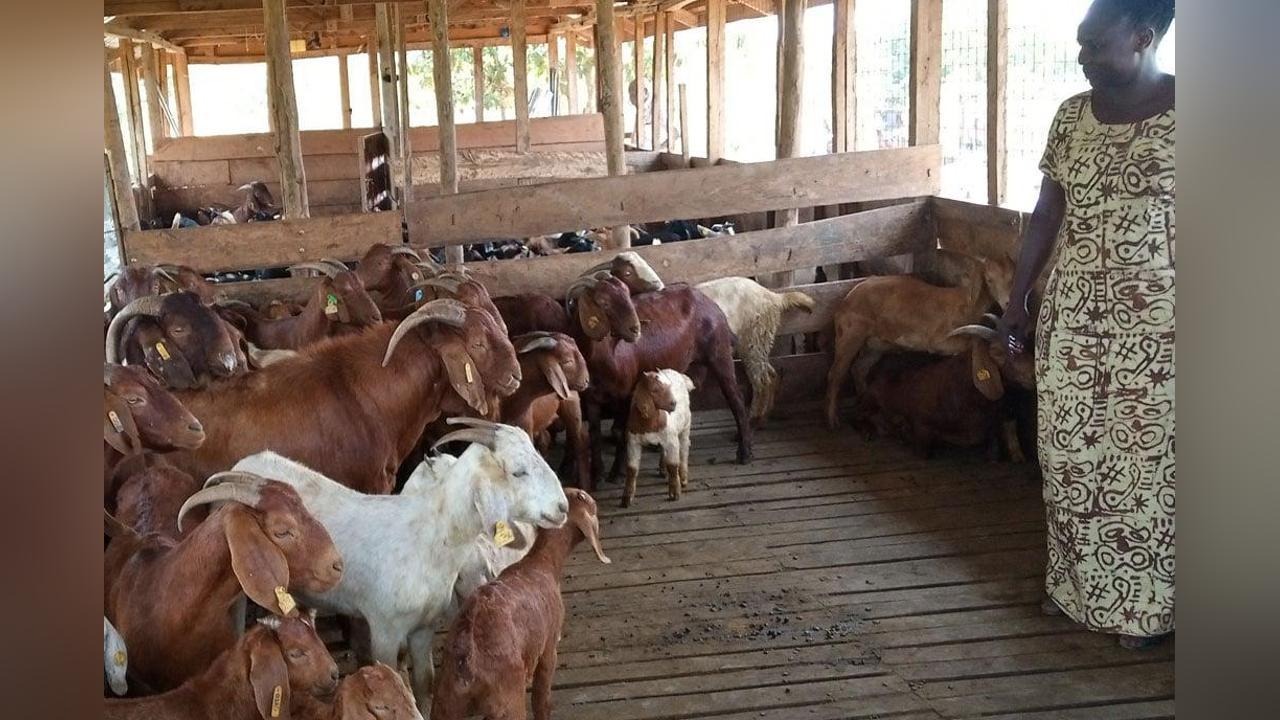
Africa-Press – Uganda. Scientists in the country have started developing the fastest-growing meat-goat breed to improve the productivity of indigenous breeds, whose body weights are often small and grow slowly.
Under the goat improvement programme being undertaken at National Livestock Resources Research Institute (NaLIRRI) in Maruzi Ranch, Apac District, Mubende, Kigezi and Small East African goats are being crossbred with Kalahari Red.
The Kalahari is a breed of goat originating from South Africa. Their name is derived from their red coat and the Kalahari Desert. They are generally used in meat production.
Dr Henry Mulindwa, the head of the goat improvement programme at NaLIRRI, confirmed the development, adding that researchers have started assembling pure lines of each of these breeds.
“We started with assembling Kalahari, which we imported from South Africa. At the next stage, we want to acclimatise them to our environment because where they are bred, the humidity is so low and yet here it is so high,” he told this publication at new NaLIRRI headquarters in Maruzi County on Monday.
Dr Mulindwa added: “So, we wanted them to first acclimatise to our environment here and also do multiplication to generate as many bucks breeding males as possible.”
He explained that the National Agricultural Research Organisation (Naro) recently delivered Mubende females, which have been assembled at a goat breeding facility at NaLIRRI.
Justification for crossbreeding
The Mubende goat is an indigenous breed from Kabale and Bundibugyo districts of Uganda. This breed has shiny, straight hair that is normally black or a mixture of black and white. Its meat is of high quality, as is its skin, which is used as leather in the tanning industry. Males have manes, and usually are hornless.
The Mubende goat’s coat is adapted to reflect the sun’s radiation to keep the goat cool in its natural environment. This breed also survives well during times of drought and can go a few days without drinking water.
Meanwhile, Kigezi goats are found mainly in south-western Uganda with some in Ankole and other bordering regions. The colour of this goat is black and the hair is long.
Dr Mulindwa said Kigezi Goat breed is more on the milk line than the other indigenous goats.
“Kalahari grows a little bit faster. It attains 40kgs in eight months, whereas the Mubende attains the same kilogrammes in about two years,” the head of the goat improvement programme, explained.
Dr Mulindwa added: “So, we want to reduce that time by doing a cross-breeding programme in the short-term to generate crosses but in the long-term to come up with our own stabilised breed using the Mubende, Kalahari and the Small East African Goat.”
He said the country is taking advantage of the benefits of these breeds.
“You find that the Kalahari grows very fast but when it comes to high heat areas, it doesn’t perform very well, and yet the Mubende, much as they grow slowly, but they are adapted to our environment.So, we want to have all these traits in one breed that we are going to develop in the long-term.”
Progress of research
Dr Mulindwa indicated that they are at the stage of developing pedigree – looking at the father, and the mother, and they will also start collecting performance data of these animals in terms of growth, and weight.
“The country will be in a position to generate crosses within a period of one to two years…But in the long-term – that is about five generations, we will have come up with a new stabilised breed, which will be registered as our own, and given out to either the National Animal Resources Centre & Data Bank (NAGRC& DB) or other agencies and farmers for multiplication,” Dr Mulindwa said.
Economic sense
Goat genetic resources play an important socio-economic role in many rural parts of the world in contributing to food and nutrition security. They are a source of income for the sale of animals and their products, including skins, meat and milk for home consumption, and manure, besides playing intangible roles like being insurance against emergencies and as an investment.
Goats can adapt to and utilise marginal forage, and survive under harsh conditions, which makes them a very valuable asset for subsistence farmers.
However, goat farmers in Uganda who want improved varieties usually import bucks from South Africa to mate with females. One imported male costs about Shs4 million, a price that leaves smallholder farmers out, according to the Alliance for Science.
There are also stringent cross-border livestock protocols that prohibit individual farmers from importing animals.
Dr Mulindwa said the ambitious goat improvement initiative will be the answer to such challenges being faced by the farmers.
During a supervisory visit to NaLIRRI on Monday, established that a modern goat research facility is being constructed there to facilitate systematic breeding of these animals.
The facility has four different units; one for Kalahari, another for experimenting with the crossbreeding Kalahari and Mubende goats. The third unit will be for crossbreeding Kalahari and Small East African goats and the last one for crossbreeding Kalahari and Kigezi goats.
Whereas the country is said to be demanding milk-producing goats, the programme constitutes only a meat breeding pipeline for goats.
Other livestock researchers have suggested there should also be another pipeline focusing on milk production for the goats.
Dr Yona Baguma, the director general of Naro, told specialists at NaLIRRI “At the starting point, what we need is to develop a national goat improvement plan or strategy and then after that, we start designing breeding programmes that are going to answer to the strategy.”
For More News And Analysis About Uganda Follow Africa-Press