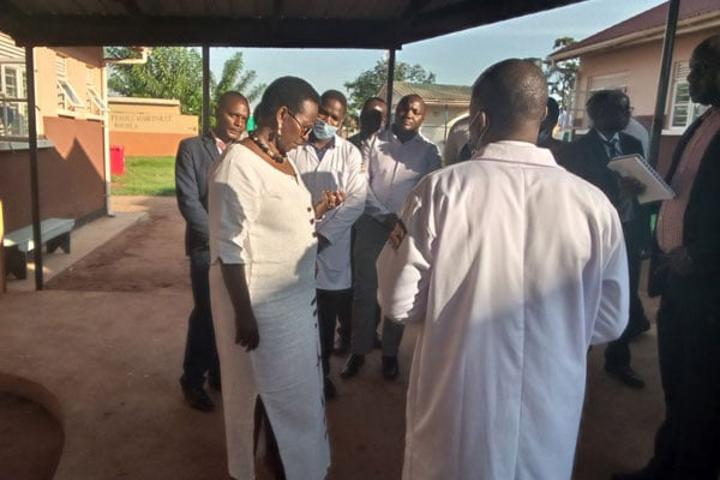
Africa-Press – Uganda. Over 300 Community Health Workers (CHEWs), including 168 from Mayuge District, are expected to start working at Parish level under the supervision of Village Health Teams (VHTS) after a government project was rolled out on November 1.
Dr Richard Kabanda, the commissioner Health Services in-charge of Health Promotion, Education and Health Communication, whose department is coordinating the pilot project, said about $500,000 (around Shs2b) was spent on training CHEWs in Mayuge and Lira Districts.
“The VHTs will be based at Village level, while the CHEWs at Parish level. The CHEWs will supervise the VHTs and will ensure that communities are well educated on health issues, early referrals and timely linkage to the health system,” he said in a telephone interview.
According to Dr Kabanda, each CHEW will earn a monthly salary of Shs150,000, payable by the government, after which their respective Districts will take over the payment.
In 2015, the Ministry of Health evaluated the performance of VHTs and among other challenges, the report pointed out issues of inadequate training, low levels of education, inability to read and write among some VHTs, and low capacity to report frequently.
The ministry then embarked on a process to have a better trained force that can educate people on health issues in their local languages, promote health in communities as well as advance Disease Prevention Initiatives.
“As a department, we were instructed to pilot the strategy and the ministry (of Health) and USAID availed the resources to pilot the strategy through its Regional Health Integration to Enhance Services (RHITES) activities,” Dr Kabanda said.
He added that Mayuge and Lira Districts were selected because they had partners who were doing a lot of community health work, so it was easy to pilot in those Districts since some work had been undertaken especially on preparing community structures.
He, however, added that as a ministry, they expect better educated communities on health issues, reduced maternal child mortality, empowered communities, reduced attendance to health facilities on preventable diseases and increased attendance to antenatal care clinics.
Dr Diana Atwine, the Ministry of Health Permanent Secretary, says they are convinced that if this strategy is implemented, it will be the beginning of revolutionizing healthcare.
“If we implement it well, it will be a springboard in implementation of our strategy within the communities. Majority of diseases can be defeated if we focus on prevention at household level,” Dr Atwine said.
Dr Henry Mwebesa, the Director General Health Services in the Ministry of Health, said 168 CHEWs in Mayuge District have undergone six-month training and will be dispatched to each of the 84 Parishes.
He, however, urged them to tackle the disease burden by working with nearby Health Centre IIIs in their catchment areas, and not going beyond their mandate.
“Do not start operating pharmacies and big clinics because you have been trained as CHEWs,” he said, adding that the Ministry has approved the community health strategy which will guide their operations.
Bishop Frank Tibagendeka, the Mayuge LC5 chairman, said most of the trainees have been “idle” in their Villages, but have now got jobs and are going to be paid when they take on their new roles effective November 1.
“The project has also brought about a mindset change; the team has learnt a lot for the past six months and they are going back totally changed and are going to change the communities,” he added.
Ms Emirine Naisu, one of the trainees, said she was at home when the opportunity beckoned; but since she enrolled on May 3, she has learnt how to test for malaria, identify “dangerous signs” in a newborn baby, adding that she is ready to serve her community.
Mr Henry Musasizi, 24, another trainee, said throughout the six months, he has learnt how to administer first aid and formulate plans to treat sick people.
For More News And Analysis About Uganda Follow Africa-Press