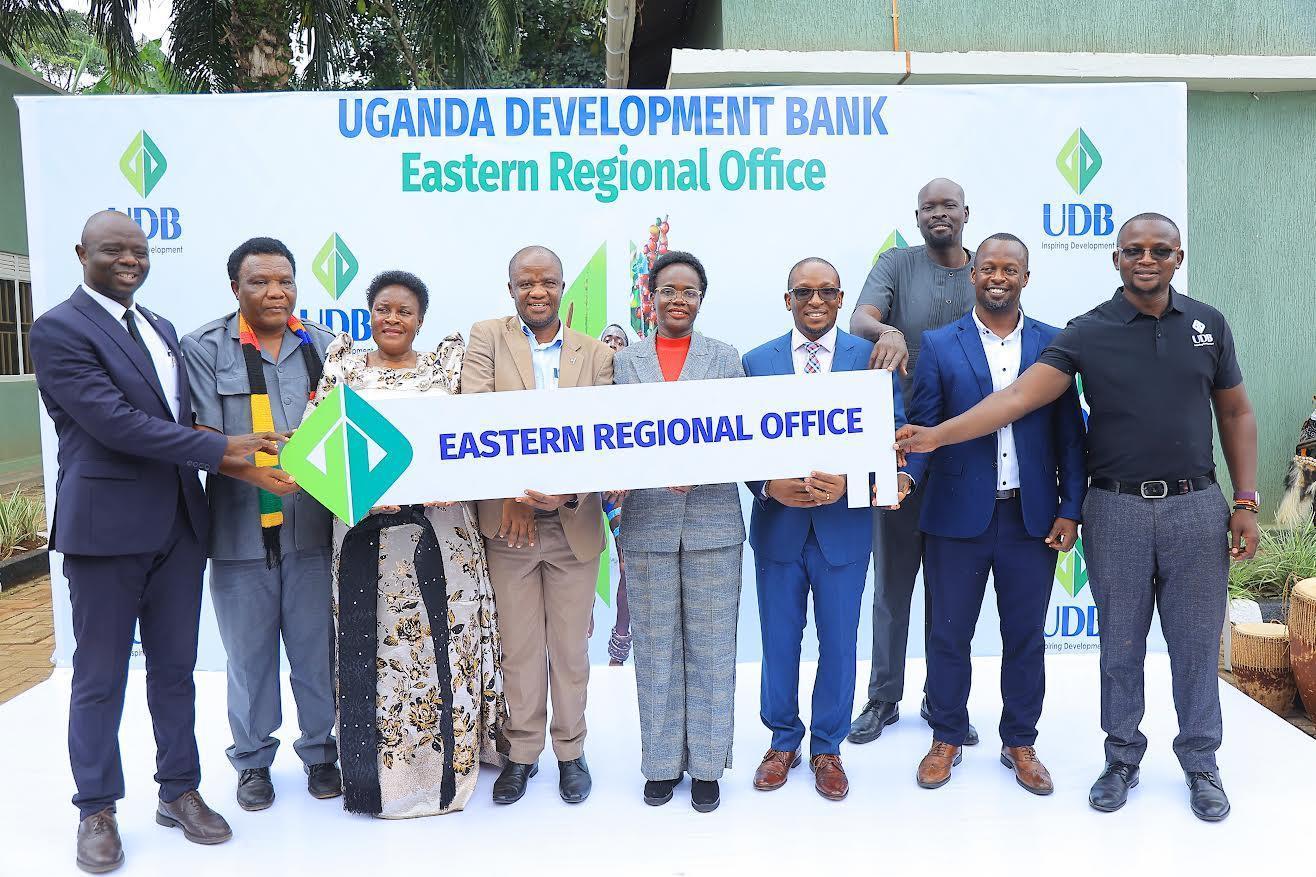
Africa-Press – Uganda. Uganda Development Bank (UDB), the country’s Development Finance Institution (DFI), has officially launched a regional office in Mbale City to better serve the Eastern region of Uganda.
Located at Plot 1, Masaba Road in Mbale City, the Eastern Regional Office will act as a liaison point for sub-regions including Elgon, Teso, Bukedi, Busoga, and Karamoja.
The office is expected to enhance UDB’s capabilities in addressing both the financial and non-financial needs of the local business community, thereby promoting financial inclusion and equitable economic development in Eastern Uganda.
“Establishing this regional presence reinforces the Bank’s mandate as Uganda’s National Development Finance Institution and improves our ability to unlock investment opportunities across the country,” said Dr. Patricia Ojangole, Managing Director of UDB, during the launch ceremony.
“Eastern Uganda presents immense economic potential and UDB sees opportunities to enhance production and productivity in key agriculture value chains, develop rail transport to facilitate cargo movement, and diversify tourism opportunities,” Dr. Ojangole added.
Aligned with its mission to accelerate socio-economic development through sustainable financial initiatives, the office will support private sector projects with potential socio-economic benefits in primary agriculture, industry—including agro-industrialization, manufacturing, knowledge-based industries, and extractives—services such as health, tourism, education, and technology, as well as infrastructure development.
Muhammad Mafabi, Mbale District Chairperson, described UDB’s expansion to Eastern Uganda as a milestone for regional socio-economic transformation.
“Eastern Uganda predominantly relies on agriculture for livelihoods, with coffee as the main cash crop. The region has numerous organized farmer groups and cooperatives facilitating bulk marketing, input access, and technical support. However, limited access to modern pulping and washing stations results in inconsistent coffee quality, with much of the crop sold as low-value or semi-processed,” Mafabi noted.
“The establishment of UDB’s Eastern Regional Office provides farmer groups with access not just to affordable credit for inputs, mechanization, and expansion, but also to non-financial services to improve farming techniques, business management, and financial literacy.”
He further encouraged manufacturers, often limited by lack of affordable patient capital, to utilize UDB’s loan tenors of up to 15 years to boost working capital, acquire machinery, or expand operations. Mafabi also urged the business community to use UDB funds productively and repay loans promptly, ensuring other enterprises can benefit.
Previously, UDB operated offices in Kampala, Gulu, and Hoima. To deepen financial inclusion and improve efficiency, the Bank is establishing three additional regional offices in Mbale (Eastern Uganda), Arua (West Nile), and Mbarara (Western Uganda).
In 2025, UDB’s total assets grew 24 percent to close at Shs 2.28 trillion from Shs 1.75 trillion in 2024, supported by new funding of Shs 438 billion, comprising drawdowns from lines of credit and Government of Uganda capital contributions.
During the same year, the Bank approved 120 projects projected to create 33,610 jobs, mainly for youth, when fully implemented. These projects are expected to generate an additional Shs 5.2 trillion in output value, Shs 2.76 trillion in profits, approximately Shs 918.7 billion in corporation tax, and Shs 2.79 trillion in foreign exchange.