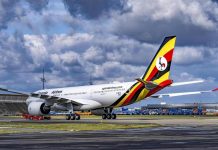
Africa-Press – Uganda. Aviation and outer space expert Arnold Agaba has called for steady leadership, strategic fleet expansion, and careful political navigation as Uganda Airlines undergoes a management transition.
Speaking on the future of the national carrier, Dr Agaba emphasized that Uganda Airlines must be treated as critical national infrastructure, comparable to roads and maritime transport systems.
“That airline is part of the infrastructure of the country. It’s just seen as a road. There is no difference between that airline and a road or the ships that are put on the water to make sure that goods and people move from place to place,” he said.
Dr Agaba stressed that the most important priority for the airline’s owners — the Government of Uganda — is ensuring competent leadership.
“The most important practice is to make sure the airline has a steady hand at the head,” he noted.
“You are dealing with a highly sensitive technical piece of infrastructure that must be run by people who understand its sensitivities and also understand global market dynamics.”
He called for a smooth leadership transition and urged staff to support interim management as the process of recruiting a substantive CEO continues.
Global Industry Headwinds
Agaba observed that Uganda Airlines is operating in unprecedented times for global aviation, marked by shortages of aircraft spare parts and delayed deliveries.
“Right now, you have a global shortage of spare parts, but you also have a delay in delivery of new aircraft. That means airlines may not meet the technical specifications required and may struggle to replace grounded aircraft.”
He noted that many airlines worldwide are resorting to leasing aircraft to maintain operations, suggesting Uganda Airlines consider similar short-term solutions.
With a limited operational fleet serving multiple regional and intercontinental destinations, he warned that delays and aircraft downtime are affecting customer confidence.
“At any given time, you might effectively be operating far fewer aircraft than what is on the books. That affects turnaround time, passenger experience and reliability.”
“If passengers lose confidence that they will move from point A to point B at the scheduled time, you are essentially marketing for other airlines.”
Dr Agaba said fleet growth is inevitable but must be approached strategically given global supply chain constraints.
“There is no question that there will be a need to grow the fleet. The debate is how you grow it in an environment where aircraft deliveries are delayed.”
Beyond expansion, he stressed the importance of crisis management and restoring confidence among passengers, service providers, and staff.
“The airline is dealing with fuel suppliers, catering services, pilots, fleet managers — all of whom depend on predictability. Contracts must be honored. Payments must be timely. Confidence must be restored.”
He underscored the importance of putting technically competent professionals in charge.
“If you hand over a referral hospital to a witch doctor, they will order calabashes instead of syringes. The same applies here. You need trained aviation professionals who understand the nuances of this industry.”
Cargo: The New Gold?
On whether cargo operations should become a major strategic focus, Dr. Agaba acknowledged the sector’s potential, especially for African economies driven by agricultural exports.
He referenced how carriers such as Ethiopian Airlines benefited significantly from cargo operations during the Covid-19 pandemic but advised caution.
“Management needs to fill the passenger seats first and then fill the bellies of the planes. It is useless to invest in cargo planes if you do not have the cargo to provide.”
He emphasized that cargo growth must be supported by broader government action to open international markets for Ugandan agricultural products.
“Before a farmer can send avocados to Europe, that market must be opened. That responsibility lies with government policy, not the airline.”
While he supports long-term investment in dedicated cargo aircraft, he warned that global delivery timelines now stretch to the end of the decade.
On route expansion, Dr. Agaba said growth is necessary but must be data-driven.
“Every airline has to expand routes. But you don’t wake up in the morning and decide to expand. You must ask: Is there consistent demand? Can the route sustain itself in peak and off-peak seasons?”
He cautioned that poorly planned routes can quickly become financial liabilities.
“If routes are not carefully planned and supported by good marketing and PR, they will fall — and when they fall, they fall to the detriment of the airline.”
He added that new management may review existing routes and potentially drop underperforming ones.
“It is a question of numbers. It is not fiction. It is numbers.”
Navigating Politics
Dr Agaba acknowledged that politics and national carriers are inseparable, noting that the airline industry has been politically influenced since its emergence after World War II.
“Politics and airlines go hand in hand. The question is whether that influence will be positive or negative.”
He argued that Uganda Airlines plays a broader national security and economic role.
“This airline creates jobs and supports economic stability. When people are economically stable, they are focused on productivity rather than unrest.”
Ultimately, he said the success of Uganda Airlines will depend on competent leadership, strategic planning, political goodwill, and coordinated national support.
“If the right people are given the right tools and the right support, the airline can become a strong and growing concern for Uganda,” Dr Agaba concluded.
Source: Nilepost News