Faridah N Kulumba
Africa-Press – Uganda. Last week the Top United States army generals for the U.S Africa Command met with the African Union Transition Mission in Somalia (ATMIS) commander, Lt Gen Sam Okiding, weeks after al-Shabaab attacked Uganda’s forward operating base and killed 54 soldiers.
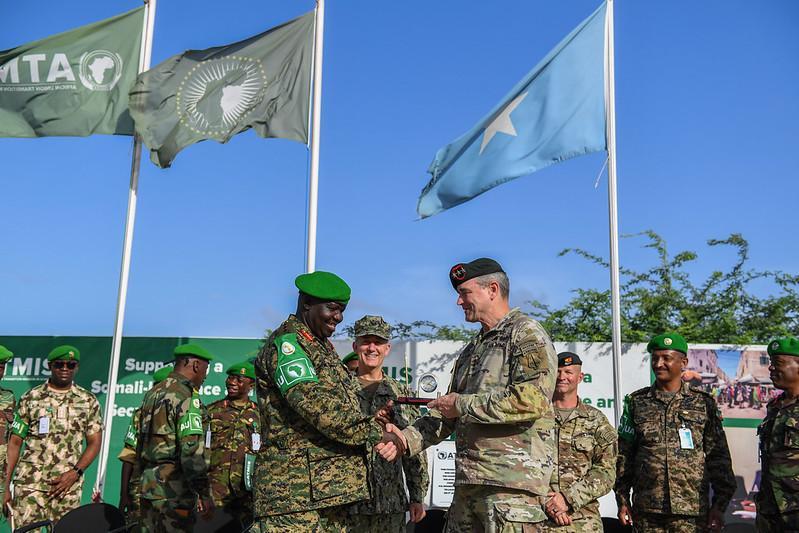
The meeting followed Gen Michael Langley, the commander of the U.S Africa Command, meeting Lt Gen Okiding and other senior military officers and discussing “areas of mutual collaboration.”
Two days later, another team of US army generals led by Lt Gen Jonathan Braga, the commander of the US Army Special Operations Command and Rear Admiral Jamie Sands, the U.S Navy commander of Special Operations Command Africa, visited Lt Gen Okiding and his team in what the US generals described as United States’ commitment to the partnership with ATMIS and support for Somalia in fighting against the al-Shabaab militants.
On 26 May of this year, Uganda People’s Defence Forces (UPDF) soldiers deployed under the African Transition Mission in Somalia (ATMIS) came under attack by al Shabaab at Buulo Mareer, a base in Lower Shabelle, killing at least 54 and many injured.
The attack followed the Somali militant group al Shabaab overrunning Buulo Mareer Forward Operating Base (FOB) in coordinated attacks using car-laden explosives and gunfire and carried out a massacre of Ugandan troops. The attackers reportedly detonated four to six explosions, including improvised bombs in vehicles driven by suicide bombers.
Uganda is one of the troop-contributing countries to the ATMIS battling terrorists in Somalia. Others are Burundi, Djibouti, Kenya, and Ethiopia.
What was discussed in the meeting
According to Lt Gen Okiding’s statement released by ATMIS, the two parties discussed salient issues. He explained that the U.S is one of Uganda’s international partners. They have also injected a lot of resources into this mission.
Lt Gen Okiding also revealed that they are in the transition process as ATMIS exits at the end of next year. The mission is hoping that by then the Somailie will be able to take charge of their country’s security.
The back-to-back meeting happened after the President of Uganda Yoweri Kaguta Museveni accused the U.S army, which operates armed drones in Somalia for not responding during the attack on the Ugandan military base leading to al Shabaab militants overrunning it and making off with weapons.
After the attack happened the government of Uganda deployed more land forces to Somalia under the leadership of Lt Gen Kayanja Muhanga, the commander of Land Forces to devise the way forward.
Uganda’s President Gen Museveni who is also a commander in chief of the UPDF issued a statement saying that the Chief of Defense Forces, Gen Wilson Mbadi set up a probe team to beef up the investigation into the attack. In his first statement, Mr. Museveni warned the Al-Shabab militants that the operations are continuing and that they will regret their actions.
In a statement Museveni shared on his Twitter account a day after the incident he blamed the attack on the UPDF’s poor performance. He elaborated that during the attack some of the soldiers did not perform as expected and panicked, which led to disorganization and the al-Shabaab took advantage of that to overrun the base and destroy some of the equipment.
Uganda;s presence in Somalia
In 2007 Uganda became part of the African Union Mission in Somalia (AMISOM) which ensured Somalia was liberated from al Shabaab Islamic insurgents. Uganda was the first country to send troops to Somalia and this opened the way for other African countries including Djibouti, Kenya, and Ethiopia to also deploy in the mission which was at one time dubbed as “dead on arrival” until UPDF’s arrival.
In March 2022, the Peace and the Security Council of the African Union issued a communique detailing the mandate of the African Transition Mission in Somalia (Atmis). It said the new mission which replaced the African Union Mission in Somalia or Amisom, would continue to fight the al Shabaab militant group and develop the capacity of Somali Armed Forces (SAF) t take over security.
The Amisom has had some successes but also failures. The mission’s successes can be noticed especially when viewed against the state Somalia was in before some African countries were deployed in the country.
Amisom’s existence in Somalia has tried to help fix the country’s security challenges by reducing the threat caused by al Shabaab militants and other armed opposition groups while also providing security to drive Somalia’s political process and efforts at reconciliation, according to Effectiveness of Peace Operations Networks (EPON) a consortium of more than 40 research institutions studying the effectiveness of peace operations.
The Amison has succeeded in certain areas but it is still facing the challenge of defeating the al Shabaab yet its their major role.
For More News And Analysis About Uganda Follow Africa-Press