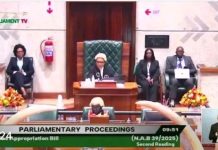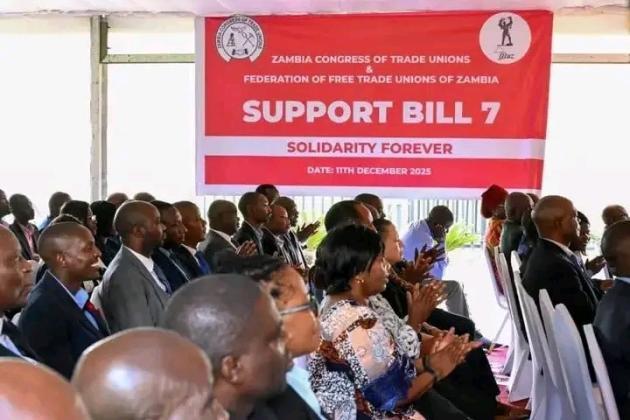
Africa-Press – Zambia. Monday has closed with Parliament delivering a decisive verdict on Constitution Amendment Bill No. 7, sending shockwaves across Zambia’s political spectrum while exposing deep fractures across party lines. After hours of high tension, procedural standoffs, and public lobbying, the House cleared the Bill’s Second Reading with 131 votes and proceeded to the Third and final Reading with 135 votes, comfortably above the constitutional threshold.
By close of business, Parliament adjourned indefinitely. The Bill now awaits presidential assent.
The vote unfolded under extraordinary pressure. Opposition leaders had urged a boycott. Court challenges were filed in parallel. Social media lists circulated naming MPs accused of planning to “sell out.”
Inside the Chamber, Speaker Nelly Mutti enforced procedure with a firm hand, rejecting attempts to table unverified documents and warning Members against legal interpretations outside their remit. The temperature rose. It did not change the arithmetic.
By afternoon, jubilation erupted within UPND-aligned spaces, with supporters hailing the outcome as a structural reset of Zambia’s democracy. Senior government figures framed the vote as a mandate for inclusion, delimitation, and electoral reform.
Outside Parliament, opposition media and PF-aligned tabloids descended into open recrimination. Accusations of betrayal dominated the discourse. Names trended. Alliances cracked.
The scale of cross-floor voting stunned even seasoned observers. More than 20 PF MPs and several independents voted in favour, defying public commitments and party pressure.
Among those reportedly to have voted YES were MPs from Eastern, Muchinga, Northern, Luapula, Lusaka, Central, and Copperbelt provinces, including Sunday Chanda (Kanchibiya), Christopher Shakafuswa (Lusaka), Anthony Mumba (Kantanshi), Golden Mwila (Mufulira Central), Allan Banda (Chimwemwe), Mike Katambo (Masaiti), Sibongile Mwamba (Kasama Central), Musonda Mpankata (Lupososhi), Chewe Taulo (Lubansenshi), Leevan Chibombwe (Bahati), Solomon Mwale (Nchelenge), and Paul Chaala (Chipili), alongside a string of independents.
The breadth of the breakaway vote rewrote the opposition’s internal balance overnight.
PF’s reaction was immediate and raw. Miles Sampa, who had earlier walked out of the Chamber, wrote that “the real sell outs of the people [have] been exposed,” adding, “Unbelievable what money can do to some.” In a separate post, he said he had gone straight to the Constitutional Court, insisting the process remained illegal and accusing the State of defying the judiciary.
Nkana MP Binwell Mpundu captured the mood inside PF ranks, writing, “There’s nothing as painful as betrayal… not abantu tulya nabo.” The language was personal. The anger was public.
But the numbers tell a colder story. The governing bloc entered the day with a firm base of 97 votes from UPND MPs, nominated Members, and ex officio votes. Independent support and cross-floor defections did the rest. The opposition’s strategy of abstention and litigation failed to blunt the momentum. Calls to “warn MPs” did not translate into votes.
The floor decided.
As the dust settled, President Hakainde Hichilema moved to lower the temperature. In a statement issued via his Facebook page, the President said, “The greatest winners in this process are the people of Zambia and our democracy itself. The people have spoken through their duly elected representatives, and as a nation committed to democratic principles, we must respect both the outcome and the collective resolve it represents.”
Hichilema urged a pivot to national development and unity, invoking “One Zambia, One Nation.”
Notably quiet have been institutions that had led the resistance in recent weeks. The Oasis Forum, sections of the Catholic clergy, and the Law Association of Zambia issued no immediate response as the votes were counted and confirmed.
Their silence stand in contrast to the volume of earlier interventions and underlines the finality of the parliamentary decision.
By sunset, the political map had shifted. Bill 7 survived the courts, the boycott, and the threats. It passed on the floor. The governing party celebrated a legislative victory. The opposition entered a period of reckoning, with adoption decisions, internal discipline, and credibility under scrutiny.
The Constitution will now change. The politics already have. This is Evening Wire!
© The People’s Brief | Ollus R. Ndomu
For More News And Analysis About Zambia Follow Africa-Press