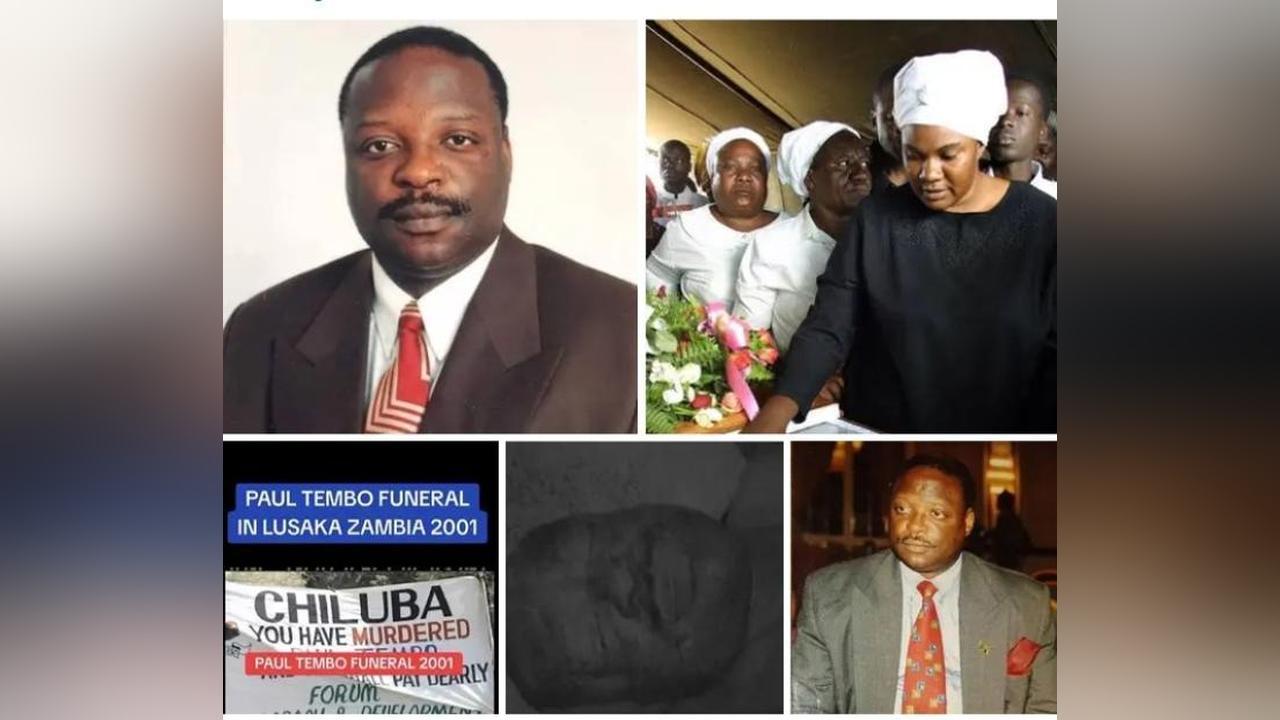
Africa-Press – Zambia. Paul Tembo occupies a unique and troubling place in Zambia’s political history. Trained as a lawyer and gifted with a sharp, confrontational intellect, Tembo rose to prominence in the 1990s as a Member of Parliament and later Deputy Minister under the Movement for Multiparty Democracy. In the early years of the MMD government, he was regarded as part of the new democratic elite that had defeated one-party rule. Over time, however, he evolved into something far more dangerous to those in power: an insider who refused to remain silent.
By the late 1990s, Tembo had fallen out with the leadership of his own party. He accused senior figures in government of corruption and abuse of office, and unlike many politicians who trade outrage for survival, Tembo persisted.
Tembo started his journey to speak only the truth between June 15 and 18 2001, Paul Tembo took quick steps out of politics of deceit to join the ranks that had broken away from the MMD to defend the country’s democracy and constitution.
He apologized to the nation over the mistakes he made while in MMD.
Announcing his resignation from the MMD to join the Forum for Democracy and Development (FDD), at a press conference at the Mulungushi village in Lusaka, Tembo said:
“To the church, especially through the three mother bodies: the ZEC, CCZ and EFZ, to the labour movement and civil society at large. To all, I seek your forgiveness and kind understanding for what I may have wrongly done and failed to do in the course of my duty.” (The Post, No. 1756-Monday June 18, 200, Paul Tembo asks for forgiveness)
Among the reasons he gave for his resignation was that the “MMD was finished beyond redemption as it had destroyed the very fundamental values on which it was founded and in its present form was moving down a dead road that can lead to national disaster.”
“The new culture has now degenerated into a culture of manipulation, trickery, deceit, hatred, mistrust and credibility of the ruling party.”
His legal background made him methodical, and his parliamentary experience made him credible. When a tribunal was established to investigate corruption involving senior ministers, Tembo was expected to testify. Those who knew the political climate of the time understood what that meant. His evidence was anticipated to be direct, informed, and potentially devastating.
On the night of 6 July 2001, Paul Tembo was killed in his own home in Lusaka. The manner of his death immediately set it apart from ordinary crime. Armed men entered the house, ordered Tembo and his wife to lie down, and shot him execution-style in the back of the head. Nothing was stolen. There was no sign of panic, no struggle for valuables, and no attempt to disguise the purpose of the visit. The killers came for one man and one outcome. Tembo was eliminated.
The government moved quickly to deny political involvement, describing the murder as criminal rather than political. Yet the official explanation struggled to convince the public. Tembo’s death occurred at a moment of intense political tension, with elections approaching and corruption investigations threatening to expose powerful figures. The killing removed a central witness and sent a chilling message to others who might have considered speaking out. In Zambia’s political culture, such timing has never been regarded as coincidence.
Months later, police announced that an ex-convict had confessed to killing Tembo. The confession was presented as evidence that the case was being solved, but it raised more questions than it answered. The public never saw a detailed trial that fully tested the confession, and no widely documented final conviction emerged that conclusively closed the case. Even more striking was the absence of any serious judicial pursuit of those who might have ordered the killing. Responsibility appeared to stop at the level of alleged gunmen, leaving the political context untouched.
It is at this point that the Tembo case takes on an even darker dimension. Over the years, claims have circulated that key suspects or witnesses connected to the murder later died in a road accident while in police custody or under police escort. According to these accounts, the deaths occurred before the suspects could testify in court, effectively terminating the case. These stories are deeply unsettling, not only because of what they suggest, but because of the silence that surrounds them. Major contemporary news outlets did not thoroughly document such an accident, and accessible official records are thin. The result is a fog of uncertainty in which allegations cannot be conclusively proved, but also cannot be dismissed.
This absence of clarity is precisely what keeps the Tembo assassination alive in Zambia’s political memory. A man about to testify against powerful interests is killed in a targeted execution. The investigation produces a confession but no transparent legal closure. Allegations then emerge that potential witnesses or suspects die before the truth can be established. Whether each of these elements is fully accurate is almost secondary to the larger issue they expose: the failure of the system to provide answers.
More than two decades later, Paul Tembo’s murder remains officially unresolved in the public mind. No court judgment has laid out the full chain of responsibility. No authoritative account has explained who ordered the killing, why the investigation stalled, or what truly happened to those allegedly connected to the crime. In that vacuum, suspicion thrives.
Paul Tembo did not die because he was an ordinary politician. He died because he was a witness, a dissenter, and a threat to entrenched power. Until Zambia confronts his assassination with full transparency, his case will remain a symbol of how truth can be silenced not only by a bullet, but by decades of unanswered questions.
For More News And Analysis About Zambia Follow Africa-Press