Africa-Press – Angola. The country needs a total of 62,444 teachers to fill the existing deficit in the sector, revealed this Tuesday, in Luanda, the national director of Human Resources at the Ministry of Education, Laudemira de Sousa.
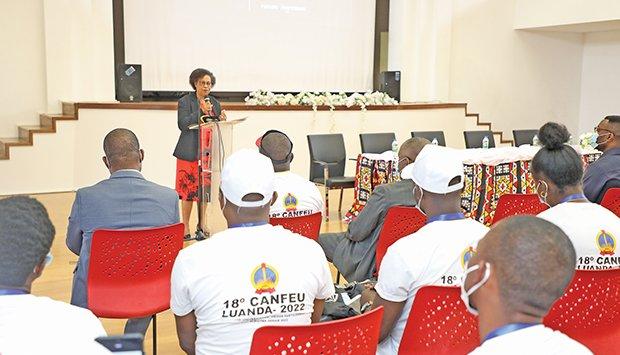
The official, speaking during the presentation of the Teacher’s Career in the Education Sector, within the scope of the 18th National Holiday Camp for University Students (CANFEU), stressed that the number, presented in this way, seems an exaggeration, but it is a reality, having taking into account that the Executive has built many school infrastructures.
Laudemira de Sousa explained that mobility in the sector, which is equally large, especially with the situation of retirements, deaths, transfers and secondments, is another factor influencing the need for more teachers.
However, the national director advanced that, in order to occupy these posts, candidates must have a certain profile, which is established in Decree nº 60/18, of 3 June, which defines that the primary education teacher must be trained in Instruction primary. He said that, in this matter, the country is at a stage in which the sector does not need adaptation, although it has lived through stages of adaptation, in which it was enough to know how to read and write to be a teacher.
Laudemira de Sousa considered that, over the years, the country has trained good staff, and that there is, therefore, a sufficient number of candidates for primary and first cycle education vacancies. “We have many professionals trained in the specialties to teach the subjects in question, especially Mathematics and Physics”. , and there are few cadres who want to leave their professions to be able to exercise exclusively as a teacher.
Laudemira de Sousa said that the sector has exceptional authorization to hire engineers, who work as collaborators, a situation that helps to fill the vacancies of professional technicians.
Projected Actions
The Minister of Education, Luísa Grilo, referred to six projects in the sector: Reference Schools, “Todos Uni-dos Pela Primeira Infância” (TUPPI), Learning Project for All (PAT II), Youth and Adult Education, CAPPRI and Xilonga.
As for Reference Schools, Luísa Grilo said that the country has 58 schools and training centres. She said it is a project, an initiative of the President of the Republic, which aims to create human, material, financial and administrative conditions to improve the quality of education throughout the territory.
For its proper functioning, a management committee was created, coordinated by the Minister of Education and composed of other government entities.
The TUPPI pilot project, which has already benefited, across the country, 31,490 children from zero to six years of age and involved 20,013 families. Luísa Grilo explained that TUPPI, carried out in partnership with Unicef, is a community project aimed at early childhood development, and is being implemented, in this pilot phase, in the provinces of Bié, Cunene, Huíla, Luanda, Moxico and Uige.
The minister also referred to the Learning for All Project (PAT II), estimated at US$250 million. It is developed within the framework of cooperation with the World Bank and benefits around six million Angolans. PAT II aims to reinforce the professional skills of school managers, teachers, different educational agents and technicians from the central, provincial, municipal, district and communal structures of the Education sector.
He also underlined that PAT II is also directly and indirectly framed in the empowerment of girls in the reduction of poverty in teaching and learning with scholarships.
Thousands Of Hires
The Minister of Education mentioned that, since the first public tender, in 2018, 45,000 teachers and 7,500 cleaning assistants have been hired. The hiring of this last group is not the responsibility of the Ministry. Luísa Grilo highlighted that, in the same period, the Education sector promoted 181,624 teachers and, currently, there is a process of promotion for the general career of teachers, where the time of service counts from the year of the degree.
As for school textbooks, the minister said that the Education sector printed 48,628,614 books to be distributed in the next academic year. “They have not been used now, because of the review they underwent”.
Luísa Grilo explained that the schools built, from 2018 to 2022, benefit from 2,304,985 desks, having ensured that there are no schools without this furniture.
For More News And Analysis About Angola Follow Africa-Press