Africa-Press – Angola. In all, 4,030 young people from different parts of Huíla province are formalizing their own businesses in different areas, to put into practice the knowledge acquired in an intensive training cycle, promoted by the National Institute of Employment and Professional Training (INEFOP).
Most young people preferred to train in the areas of plumbing, locksmithing, decoration, carpentry, cooking and pastry, computerized accounting, civil construction, welding, renewable energy, IT, electricity, mechanics, hairdressing and barbering.
The minority chose to learn trades such as turner, event decoration, master of ceremonies, barber, pedicure and manicure. The short courses were taught by national technicians with recognized experience.
The director of the National Institute of Employment and Professional Training (INEFOP), Alberto Bartolomeu, explained that adherence to technical courses has been increasing in each training cycle, due to quick access to the labor market, creation of one’s own business and short-term income. and medium term.
In all, 1,231 candidates were enrolled this year, surpassing last year’s number, however undisclosed. “Demand is increasing every year and there is no longer a capacity to respond to demand”, he admitted.
Alberto Bartolomeu highlighted the success of all the courses given, as well as the practical load that young graduates are subjected to. “I would like to take this opportunity to praise the support of various hotel and catering companies for making their service areas available during school hours”, he stressed.
He informed that INEFOP’s various professional education infrastructures have contributed significantly to the process of framing new candidates for different courses, noting that of the 1,593 enrolled at the Lubango Training Centre, 550 went to the Arts and Crafts Pavilion from the municipality of Cuvango, 506 in Chicomba, 230 in Capelongo, 219 in Cidadela de Sucesso da Matala and 152 in Chicomba.
Alberto Bartolomeu justified the considerable increase in young people interested in a trade to the opening of the market, as well as the increase in the capacity of the rooms. “In the various groups of young people from various parts of Huíla, conversations have become much more constructive, everyone wants to learn and do something in life,” he said.
Distribution of kits
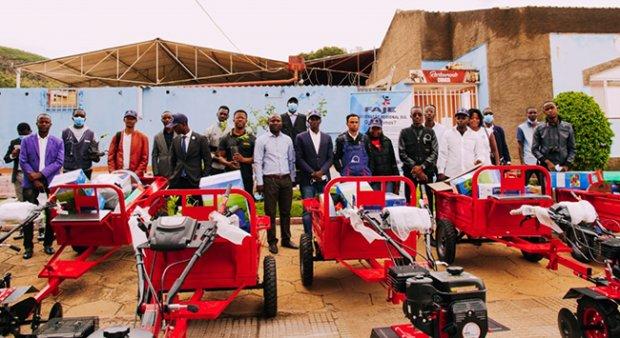
The promotion of self-employment has been boosted for approximately three years with the free distribution of more than 8,000 professional kits from different areas, as well as cattle and goats to encourage breeding and aid in the preparation of agricultural fields.
Included in the bulk of work artifacts distributed to young people organized in various municipalities are materials for civil construction, electricity, hairdressing, handicrafts, shoe shiners and motor-pumps to encourage the practice of agriculture.
In some locations in the municipalities of Lubango, Humpata, Chibia, Cacula and Matala, over 900 young people are involved in various profitable actions that are improving the livelihood of families, projecting the expansion of businesses and placing other young people in useful work for society.
The representative of the Caconda Youth Council, António Francisco, acknowledged the useful actions carried out by various young people for society. “Currently, many young people who found themselves adrift are busy with something useful for the family and society, with the delivery of professional kits”, he said.
In the parallel markets, he noted, it is visible to observe several young people busy with the concert of broken motorbikes, bicycles, generators, cars and others with stalls selling various products grown in the respective mines.
Ex-soldiers in coffee production
More than 20 former soldiers are affiliated with ESCOFA and ASPAR and women belonging to small cooperatives are dedicated to the cultivation of Arabic coffee in the municipalities of Caconda and Caluquembe, in the north of Huíla province, which, in addition to being profitable in the national and international market , withstand cyclical droughts.
The group joined the more experienced coffee growers who have already released more than 60,000 plants in about 50 hectares. “We plant Arabic coffee as well as several native species, including cavua, cativua, soromon, sumatra, tupi and borbon.
One of the members of the peasants’ association of Caluquembe, Gonçalves Tchombo, valued the coffee crop for its constant demand in the main world markets and for not giving work in terms of care, since, after growth, treatment actions are minimal.
Gonçalves Tchombo referred that the current concern of several producers has to do with the climate changes registered in several countries, including Angola. “We now have to worry about the alternatives, which is why he embraced agriculture after being demobilized in 2003”, he said.
He valued the delivery of different work kits to young people without the conditions or time to attend a university, for including them in productive activity, working in something socially useful and organizing their own family lives.
For More News And Analysis About Angola Follow Africa-Press