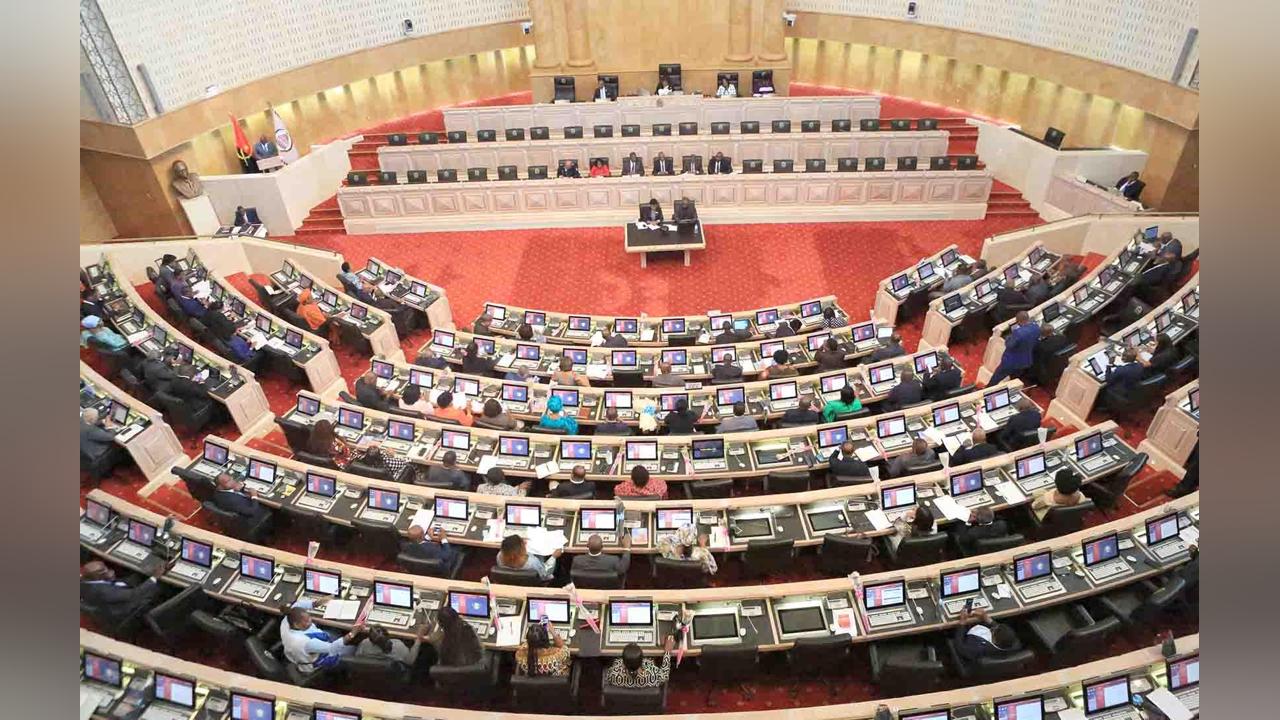
Africa-Press – Angola. The National Assembly (AN) recommended the Executive to improve the State’s financial management reporting mechanisms that lead to a positive and transparent assessment of public accounts.
The recommendation is expressed in the General State Account (CGE) for the 2020 fiscal year, whose Draft Resolution was approved this Wednesday, in the hemicycle, with 111 votes in favour, 61 against and two abstentions, during the 5th plenary meeting ordinary of the National Assembly.
The document was presented in the hemicycle by the Secretary of State for Budget and Public Investment, Juciene Cristiano de Sousa.
Parliament recommended to the Executive that all institutions with administrative and financial autonomy be able to send, in the documents that they include in the CGE, the independent audit opinions related to the respective financial statements.
The AN also recommends that the Government continue to implement measures that aim to improve the indicators of the evaluation of the good business environment “Doing Business”, to boost the activity of the non-oil sector and provide a higher level of collection of non-oil tax revenues, in in favor of economic growth strongly influenced by the leverage of the private sector.
The deputies expressed the need to intensify the implementation of the Program to Support Production, Diversification of Exports and Substitution of Imports (PRODESI), within the scope of the Credit Support Program (PAC) and to adopt faster mechanisms that make the conception of credits possible national producers of goods considered essential, especially those projects included in the chain of production and commercialization of basic basket goods and that help to reduce imports.
They also emphasized the need for the Government to proceed with the implementation of fiscal policy measures, within the scope of the Public Finance Sustainability Law, to contain and reverse the growth trend of the fiscal deficit, in order to reduce the public debt ratio on GDP to a value equal to or less than 60 percent.
They also recommended that the Executive continue with actions to recover public investment projects that are at a standstill, especially in the field of education and health, as well as the rehabilitation of the main roads in the country, taking into account the direct influence on quality of life. of populations.
They encouraged the government to continue with the contingency plan to combat the drought of the populations in the southern provinces of Angola and the program of direct income transfers to needy families, “in order to mitigate the effects of the still relatively high levels of poverty in the country”.
They urged the Executive to prioritize actions aimed at implementing the justice reform and modernization programs and strengthening the fight against economic and financial crime and corruption, as well as the projects registered under the public investment programme.
The deputies recommended, on the other hand, the Executive to monitor more rigorously the collection of revenue and the execution of expenses by provincial governments and municipal administrations, to provide balance in the management of the treasury and to broaden the tax base to all taxpayers, aiming at greater collection, transparency and fairness in the optimization and use of financial resources.
The AN also wants the creation of conditions to provide the national private sector with the resolution of issues that condition commercial banks to grant loans more quickly, such as documentation referring to the ownership of furniture, land rights and the legal situation procedures in case of non-compliance.
The deputies asked the Executive to find a mechanism for settling the tax on income from work (IRT) and the payment of social security, in order to relieve public institutions from paying survival allowances, in particular Rádio Nacional de Angola ( RNA), TPA and November Editions.
Findings
The 2020 CGE was carried out in a recessive context in which the national economy slowed down as a result of the prolonged drop in the price of a barrel of oil on the international market and the Covid-19 pandemic crisis.
The inflation rate for the period under review was 25.1% above the 25% inflation rate defined in the Revised OGE/2020.
The oil sector registered a production of 463.9 million barrels, which corresponds to an average production level of 1.27 million barrels per day.
The average oil export price showed positive signs of recovery, having registered a value of 41.30 USD/Bbd, which represents a surplus of 8.30 USD in relation to the fiscal price of 33.00USD foreseen in the Revised OGE-of 2020;
The real GDP growth rate recorded a contraction of 5.60%, standing below the GDP rate forecast in the Revised State Budget for 2020, estimated at (-3.60%).
The GDP rate of the oil sector, including LNG, recorded a worsening contraction of 8.3%, standing below the projection of the Revised State Budget for 2020, estimated at (-7%).
The GDP rate of the non-oil sector registered a contraction of (-4.7%), standing below the projection of the Revised State Budget for 2020, estimated at (-2.1%).
Contributions from oil sector revenues were 31.38%, higher than contributions from non-oil sector revenues, which reached 28.05%;
The current revenues collected in the amount of 7,105,372 million kwanzas, exceed the current expenses incurred by 5,688,860 million kwanzas. It appears that part of the capital expenditure was carried out using current revenue, in the amount of 1,416,512 million kwanzas.
On the other hand, the stock of public debt recorded a balance of 44.2 billion kwanzas, equivalent to USD 68 billion, which corresponds to a 29% increase over the same period last year.
The external debt corresponded to 29.7 billion kwanzas, equivalent to USD 47 billion, while the internal debt was 11.6 billion kwanzas, equivalent to USD 17.9 billion.
The debt of public companies: represented 2.9 billion kwanzas, equivalent to USD 4.5 billion, which corresponds to an increase of 20.8% compared to the 2019 financial year.
The Revised OGE for the 2020 Financial Year estimated revenues and set expenses in the amount of Kz 13,455,305,790,365.00 (thirteen billion, four hundred and fifty-five thousand, three hundred and five million, seven hundred and ninety thousand, three hundred and sixty-five five kwanzas).
This fact represented a reduction of 15.75% compared to the initial OGE-2020, which estimated revenues and set expenses in the amount of Kz 15,970,605,826,135.00 (fifteen billion, nine hundred and seventy thousand, six hundred and five million, eight hundred and twenty-six thousand, one hundred and thirty-five kwanzas).
For More News And Analysis About Angola Follow Africa-Press