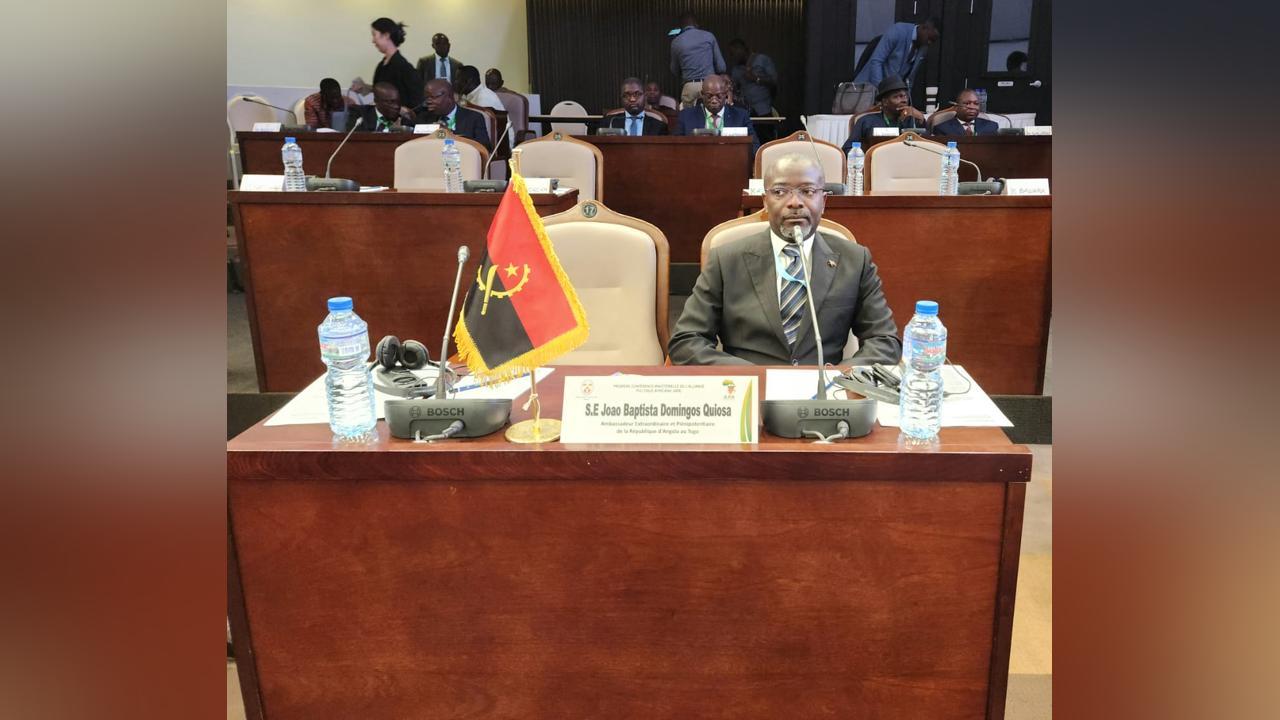
Africa-Press – Angola. The Angolan ambassador to Ghana, João Quiosa, this week encouraged Angolan businessmen to take better advantage of the opportunities offered by that country, mainly in the sectors of Agriculture, Mining Industry, Fisheries and Fashion.
In an interview the diplomat said that the Ghanaian market could be a strategic route for the circulation of national products in other African states, especially in the African Continental Free Trade Area (AfCFTA).
According to the source, the exchange could also be boosted by the opening, this August, of the air connection between the capitals of the two countries, through the ASKY Company, which will facilitate the exchange of goods and services.
During the interview, the ambassador stated, on the other hand, that bilateral cooperation had slowed down in recent years, because of the Covid-19 pandemic.
Regarding the Angolan community in Ghana, João Quiosa informed that it is considerably small, that is, there are around 150 citizens registered in the Consular Services of the Embassy, mostly students.
Here is the full interview:
Mr Ambassador, what assessment can you make of the current state of bilateral relations between Angola and Ghana?
João Baptista Domingos Quiosa (JBDQ): Bilateral relations between the Republic of Angola and the Republic of Ghana have lasted for more than 4 decades. For some time now, work has been carried out with the aim of defining lines that reinforce the friendship and solidarity between the two States, manifested through the signing of new agreements in various areas and cooperation protocols.
The recent official visits of the two Statesmen to their respective countries, which culminated in the signing of agreements in the areas of Agriculture, Defence, Fisheries, Training and Education, Transport and Mining Industry, reiterates, to a great extent, the positive interest in strengthening and expanding these relations. With the pandemic, there was a significant setback, which forced us to realign the perspectives that guide us to a New Era. Angola is a member of the African Continental Free Trade Area (AfCFTA) and aims to circulate its products among African countries.
What can Angola and Angolans expect, in the near future, in terms of bilateral cooperation between the two countries?
JBDQ : New agreements are being prepared to be signed between the parties which, consequently, will be reflected in the lives of Angolans and Ghanaians. With the reopening of an air connection, through the ASKY Company, which will shorten the distance between the two countries in just over 5 hours, with a stopover in Lomé/Togo. In this way, entrepreneurs are once again looking for opportunities, bringing and taking business and investments in various sectors.
What are the sectors of greatest interest to Ghanaian businessmen?
JBDQ: Much because of the coincidence of the natural riches between the two countries of the continent, such as the seas, the climate, the culture, the history, the arable soils rich in minerals, the sectors of Fishing, Oil, cocoa production and Tourism are the ones that arouse the greatest interest from businessmen, despite the fact that there are indicators of new sectors of interest, such as, for example, fashion.
In 2019, the two countries signed a memorandum in the field of Education, for the mobility of teachers and researchers in higher education institutions and scientific research centers. Are there already practical results from this agreement?
JBDQ : In fact, we have already started to show signs of work in this direction. In May 2022, the Minister of Education of Angola, Luísa Grilo, traveled to the Republic of Ghana, where, in addition to participating in conferences, visiting training centers for higher education teachers and schools, she met with her counterpart ghanense, Yaw Osei Adutwm, which was marked by the reciprocal interest in carrying out the exchange of teachers and students of technical-professional education. On the other hand, proposals are being negotiated between training institutions in both countries, in the field of linguistic and cultural exchange.
Angola has a vast community spread around the world. What is the estimated number of Angolans residing in Ghana?
JBDQ : The migratory phenomenon is a worldwide fact and the reasons for this effect are of various kinds, whether personal forum or force majeure. The Angolan community in Ghana is considerably small, around 150 citizens are registered with the Consular Services of our Embassy. It is mostly made up of young students, who have chosen Ghana for its language and culture. There are also Angolan women who have signed marital commitments with Ghanaian citizens, forming families and finally those who are allocated, for reasons of contractual work, in foreign companies.
What are the main concerns presented by Angolans and what kind of support is provided by the embassy?
JBDQ : The reasons for emigration are of various kinds. What many find in the countries they choose sometimes does not meet expectations, so social situations and missing their respective families are the main concerns.
In this sense, the Diplomatic Mission adopted the policy “Embassy, my house my Mother”, where everyone is invited to attend without hesitation. We invite citizens who are interested to work in the mission, some have responded and are now employed, we provide diplomatic assistance to those who request our support, we create fraternization meetings, which helps to make coexistence between Angolans a cohesive and united environment. In short, one of the responsibilities of the Diplomatic Representation is fulfilled, as far as possible.
Mr Ambassador, to finish. What message does it leave for Angolans residing in Ghana.
JBDQ : The Angolan community in the Republic of Ghana is a family. In opportune circumstances this interaction of friendship, respect and affection is visible. I just have to reiterate what is already in the public domain: we are a whole family and we are together. We must continue to work towards intensifying and improving what already exists. After all, we are all Angolans and that is what matters most.
Bilateral cooperation has lasted four decades
Angola and Ghana, which share a common history in the struggle for national independence, initialed the first legal and cooperation instruments in 1976.
In 2019, the two countries signed a Memorandum in the field of Education, with a view to the mobility of professors and researchers in higher education institutions and scientific research centers.
In the same year, a memorandum of understanding was signed on the operation of the Bilateral Cooperation Commission and on the suppression of visas in diplomatic and service passports.
In another agreement, the two States defined the lines for strengthening cooperation in the areas of agriculture, defence, fisheries, training and education, transport and the mining industry.
The first and only cooperation agreement between the Republic of Ghana and Angola was signed in 1981.
Available data show that the volume of business between the two countries, in 2020, was estimated at 6 million dollars.
ANGOP
For More News And Analysis About Angola Follow Africa-Press