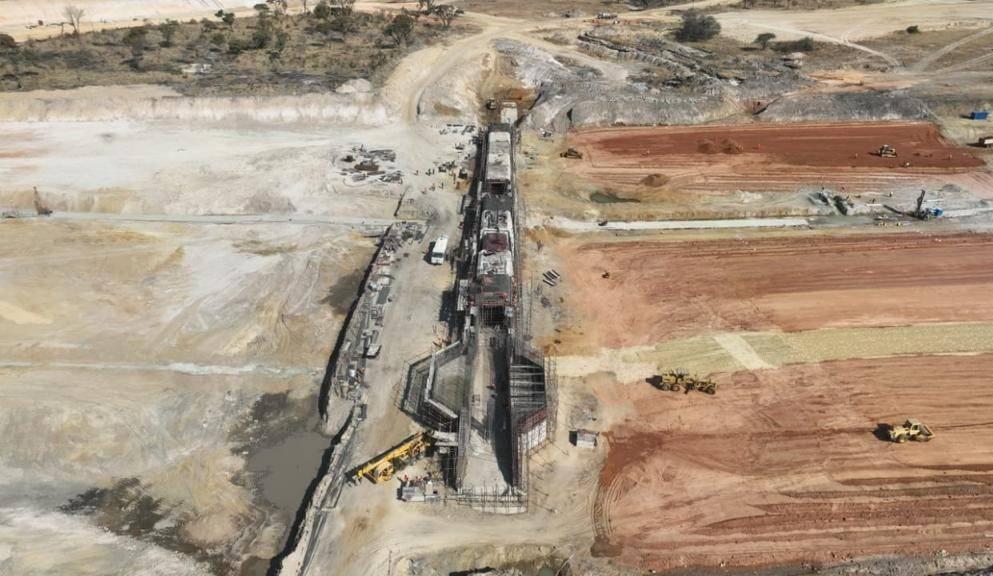
Africa-Press – Angola. The President of the Republic, João Lourenço, confirmed this Friday the level of execution of the construction works of the Ndúe and Calucuve dams, in Cunene, two structuring projects within the framework of the fight against drought in the region.
These are lots 03 and 05, which include the construction work on the Ndúe dams on the Caundo river, and Calucuve dams on the Cuvelai river.
On site, President João Lourenço received detailed explanations about the progress of the works already carried out and those that are in progress.
On the occasion, the Secretary of State for Energy, António da Costa, said that in percentage terms the physical execution of the Ndúe dam is 23 percent and financial 21.53 percent.
As for the Calucuve dam, execution, both financial and physical, is around 16 percent.
He informed that, at this time, work was underway on lot 05 of the Ndúe dam to place the concrete for filling the diversion gallery, excavations upstream and downstream of the flood spillway and the return channel.
António da Costa said that the infrastructure being built in the Cuvelai basin, in the area of the Ndúe river, for 30 months, is being implemented in an area of 17.14 square kilometres.
As benefits, the Ndúe dam will improve access, supply water to 55,000 inhabitants, 60,000 head of cattle, irrigate an area of 9,200 hectares and create 591 direct jobs.
The Ndúe dam will be 23.51 meters high and have a storage capacity of 170 million cubic meters of water and will comprise a 75-kilometer network of canals leading to the municipality of Namacunde, passing through the communes of Cubati (Cuvelai) and Oshimolo (Cuanhama), as well as 15 chimpacas.
Cunene, specifically in the municipalities of Cahama and Curoca, also has the execution of projects for lots 07, 08 and 09 on the right bank of the river Cunene, with emphasis on the Cova do Leão dam.
In April 2022, the President of the Republic João Lourenço, inaugurated the Canal do Cafu, which consists of a system for capturing and transferring water from the Cunene River to several villages, through a 160 km pipeline, along which 30 chimpacas (places for watering cattle) were built, with a capacity for 30 million liters each.
The Project, which consumed 44 billion, 358 million and 360,651 kwanzas, is benefiting an estimated population of 235,000 inhabitants, watering 250,000 animals and irrigating five thousand hectares of agricultural fields.
For More News And Analysis About Angola Follow Africa-Press