Africa-Press – Angola. Avenida Deolinda Rodrigues The clock shows 8 o’clock. Hundreds of pedestrians move from one place to another, a movement that has become routine in this area of Luanda, the country’s capital. At the same time, along the avenue, several motorbikes, light and heavy vehicles circulate from one side to the other. Traffic is quite fluid.
Also known as Estrada de Catete or Estrada Nacional 230, the road has the particularity of having several pedestrian crossings, one of which goes towards the building materials sales company, nicknamed by the citizens themselves as “Pedestrian of Fermat” .
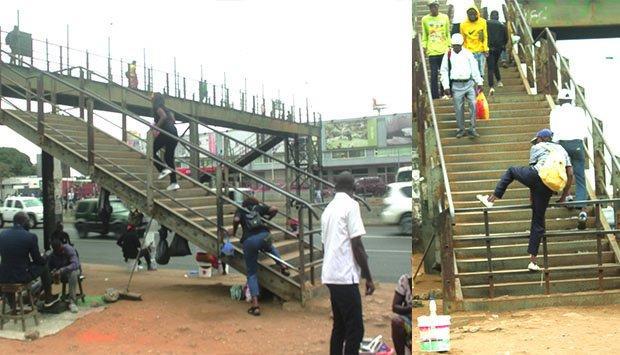
For months now, the pedestrian crossing has become a risk to the lives of users, due to its state of degradation. Loose and rusty sheets, holes in the joints of the steps, in addition to frequent shaking due to the movement of vehicles. In short, it became a pedestrian area unsuitable for passers-by with heart problems.
Constantly used by citizens residing in Filda buildings, in the neighborhoods of Cazenga, Cuca, Capolo, Palanca, among other parts of Luanda, its degradation has increased fears and, consequently, the number of complaints from those who had to do the work there has increased. crossing.
However, despite the prohibition sign placed at the two main crossing points, namely around the initial steps, both rusty and with cracks, clearly indicating the prohibition on their use, people ignore the warning, risking their lives even in the face of of the various alerts.
At the location, around the pedestrian crossing, a concentration of people, from street vendors, motorcycle taxi drivers, taxi drivers, traffic and public order regulators, and also passengers, waiting for transport to Viana, Zango and Mercado do 30.
On the opposite side, the presence of taxi drivers and passengers who continued their journey in the opposite direction, more specifically towards Cazenga, Cuca, Kikolo and the city center, was also notable. However, they both agree on the importance that the “Fermat Pedestrian” has come to have in their lives.
“Even after the competent authorities identified the danger at the site, the population continues to ignore the serious risk to life that the pedestrian crossing now represents. The danger is lurking and any movement made otherwise will be fatal”, considers young Joaquim Alegria, pointing out that some points of the pedestrian walkway are completely damaged by rust, with many holes, loose and dented sheets.
Visibly saddened by the image that the pedestrian mall now presents, Joaquim Alegria fears that a tragedy could happen if pedestrians insist on making use of the degraded infrastructure.
With each step, he says, the metalwork of the steps, consumed by time, largely due to lack of maintenance, sometimes produces a frightening sound. For this reason, he suggests that authorities take stricter measures to prevent the movement of pedestrians, including children, who, whether out of innocence or ignorance, turn a blind eye to danger signs. They circulate normally.
Difficulties and challenges
Resident in the Tala-Hady neighborhood, municipality of Cazenga, Pedro da Costa is one of the thousands of users of the “Pedestrian da Fermat”. As a citizen, he considers the current state of the structure that supports him to be regrettable and, for this reason, calls for prompt intervention by the authorities, mainly due to the rainy season and for the better comfort of those who depend on it, to cross from one side to the other, along Avenida Deolinda Rodrigues.
Maria Domingos, 63 years old, shares the same thought. The elderly woman, who lives in Nzamba 1, has had serious difficulties getting up and down the pedestrian steps. Although she knows that the structure is closed, she justifies her attitude by not finding an alternative, as she avoids risking her life when crossing the road.
“I know it is out of use, but I had to take the risk of going over the bridge, whose steps are holey”, said Maria Domingos, aware that a false step on the metal structure could be fatal. In addition to expressing that we are facing certain danger , Maria Domingos adds her voice to that of the majority of users who call for immediate intervention from the competent authorities, to avoid further damage.Leonardo da Silva, 29 years old, lives in the Madeira neighborhood. The young man who has been working as a motorcycle taxi in Largo da Filda, does not understand the delay in recovering or replacing the metal infrastructure.
“I’ve lived here for 5 years. The pedestrian walkway was good and if they carried out regular maintenance it wouldn’t be in this state. It’s rusty and there’s a big hole up there. A pedestrian walkway with so many holes and no maintenance obviously poses a great danger to those who use it ”, he emphasizes.
Leonardo da Silva says that due to the dilapidated state of the pedestrian crossing, very recently, in an attempt to cross the road, a young man was run over and broke his leg.
“They closed the bridge, but at least they had to put in a pedestrian crossing or create another alternative to make life easier for pedestrians. I suggest that the pedestrian bridge be restored as quickly as possible, so that we can use it again”, he said. aware of the time that the pedestrian crossing has endangered the lives of users, Elisabeth Quindai, who lives in Estalagem, states that the state of the infrastructure is critical and puts the physical integrity of the population at permanent risk. “Some parts of the structure, such as nuts, screws and steps were removed by unknown people”, he laments.
Risk crossing
Upon arrival at the location, Press caught a group of citizens who, in their eagerness to reach their destination, broke the dividers and fence wires that separate the limits of the ascending and descending directions of Avenida Deolinda Rodrigues.
“I’ve already witnessed a sad moment, when some people were walking along the already closed pedestrian path and at the top they slipped and almost fell. At least there had to be police officers here helping pedestrians cross the road”, said taxi driver Simão João.
Alice Jaconda, 49 years old, sells fried bombó, roasted banana and roasted ginguba, and other delicacies, close to one of the main pillars that supports the metal structure. The woman says that, five years ago, practically no one could have predicted that the “Fermant Pedestrian” would be in this state.
“The bridge was good and we passed without difficulty, but now there is a hole in it that prevents me from going to the other side without taking the business bathtub off my head. Also, because of the weight and the condition of the bridge, I have to ask for help to whoever is passing by, so I can get down safely,” he said.
Imprudence of pedestrians and motorists
At the scene, a traffic regulatory agent on duty explained that, as a consequence of the deterioration of the pedestrian crossing, there are several cases of being run over, some of which are fatal, from pedestrians being run over, vehicle collisions and other types of accidents.
Placed working for more than a year along Avenida Deolinda Rodrigues, very close to “Pedonal da Fermat”, the National Police agent warns of the need for motorists and motorcyclists to pay extra attention to that point of the road. structure and the recklessness of pedestrians who cross the road, disregarding the rules of the Highway Code and, therefore, causing embarrassment to drivers, he mentions, constitutes a puzzle for drivers.
“The majority of accidents occur due to the indiscipline of pedestrians and the recklessness of drivers. When crossing the road, pedestrians often challenge vehicles, putting their lives at risk”, said the traffic regulatory agent, then appealing to prudence between the parties and the prompt intervention of the Provincial Government of Luanda.
Coincidentally at the scene, young Abdulhay, 42 years old, born in Guinea-Conakry, who was driving a vehicle, was involved in a road accident. He ran over a citizen in the vehicle lane near “Pedonal da Fermat”. Fortunately, despite the blow, Justo Cajolola got up. He seemed to be doing very well and went home.
For More News And Analysis About Angola Follow Africa-Press