Africa-Press – Angola. The foundations for the “construction” of the democratic system in Angola “lay” in the early 1990s, more specifically in the years 1991 and 1992, a period marked by changes to the Constitutional Law, with a view to the “birth” and consequent organization of a Democratic State and the Rule of Law.
The changes introduced in March 1991 through Law no 12/91, resulting from the first partial revision of the Constitution, were mainly intended to create the constitutional premises necessary for the implementation of multi-party democracy, the expansion of recognition and guarantees of rights and fundamental freedoms of citizens, as well as the constitutional enshrinement of the basic principles of the market economy.
The advent of a “democratic society” was seen as a kind of “green light” to boost, beyond the party political scene, the economic prosperity and social well-being of a country that was looking for the best paths to internal stability, after 16 years of civil war.
The new reality then allowed the emergence of several actors in the national political panorama, from parties, associations, non-governmental organizations, among other pressure groups.
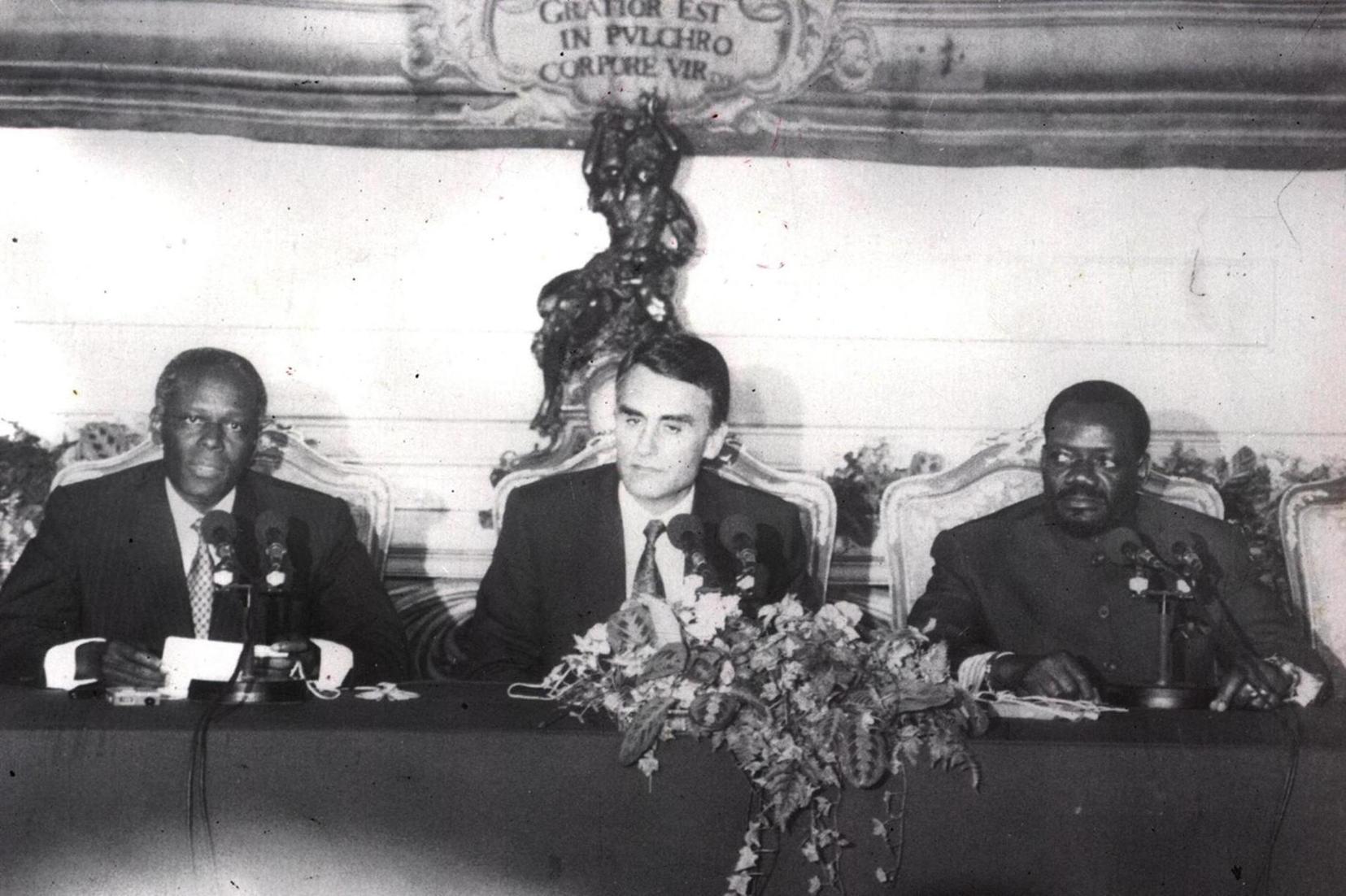
The promising climate that prevailed also led to the signing of the Bicesse Peace Agreements (Portugal), on May 31, 1991, between the Government and UNITA, one of the main prerequisites for the continuation of the democratic process.
Among other commitments inherent to the country’s future, the agreements defined, for September of the following year (1992), the holding of the first multiparty general elections in the country’s history, based on direct and secret universal suffrage, to choose the President of the Republic and of deputies to the National Assembly.
Until then, the process was moving towards the normal course.
The election took place on the 29th and 30th of September, which declared the MPLA and its candidate, José Eduardo dos Santos, winners, with the United Nations (UN), supervisor, declaring the elections “fair and free”.
But the “embryonic” phase of the process would be marked by negativity, as the rejection of the electoral results and consequent return to war, by UNITA, compromised the transition to a new system.
The expected process faced 10 years of armed conflict (1992/2002), a situation quite adverse to its implementation, taking into account that the consequences were felt in all quadrants of the administrative apparatus.
However, the achievement of “definitive peace”, in April 2002, and the signing of the Luena (Moxico) Memorandum of Understanding, complementary to the Lusaka Protocol (1994), brought new encouragement to “relaunch” the democratic challenge.
Free and democratic elections began to be held regularly in the country. The legislative ones took place in 2008, followed by the general ones in 2012, 2017 and 2022.
According to the UN, freedom, respect for human rights and the principle of organizing honest and periodic elections are values that constitute essential elements of democracy.
However, data indicates that, in recent times, the Angolan Government’s commitment to consolidating the foundations of the democratic State and the rule of law has been visible.
The steps to reorganize the judicial system, guarantee fundamental rights and freedoms, as well as increasingly improve the functioning of public administration and sovereign bodies are noticeable in the progress of the “young” process.
Likewise, efforts to improve the socioeconomic situation, education, health, energy, water, transport, access to basic social services, and greater openness to the private sector in several areas, with emphasis on the economy, commerce, hotels and tourism.
The process, as a general rule, is marked by transformations linked to the consolidation of a more integral, plural and prosperous society, although the changes may, eventually, not yet correspond to the ideal.
In this context, one must take into account the need to better adapt to the new reality, on the part of all the nation’s living forces, with a view to strengthening the bases.
angop
For More News And Analysis About Angola Follow Africa-Press