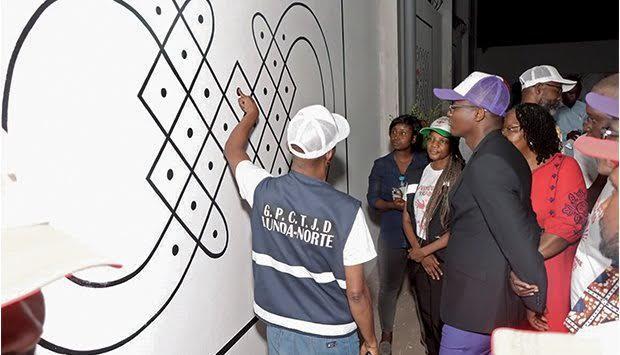
Africa-Press – Angola. Dozens of young people from the city of Dundo, Lunda Norte province, came this Sunday, to Mussungue square, to ask questions and learn about the ethnomathematical art “Sona”, a symbol of Tchokwe culture, which constitutes an educational process for the people of the eastern region.
During the visit to the stand where the engraving is on display, young people received detailed explanations about the drawing process, the meaning of the lines and geographic codes.
With the graphic signs of “Sona”, the Lunda people learned to transmit geographical positions, tracing the cardinal points, such as North, South, East and West, including teaching arithmetic geometry and traditional games.
Sona, which means writing in the sand, was a form of communication of the ancestors of the eastern region of the country, predominated by the Tchokwe people, who wrote messages through engravings on the walls of houses, trees and on the ground (sand) in the villages, to be deciphered by the other members of the community.
These engravings (Sona), which are difficult to understand, are currently found in the Dundo Museum, and in a book that addresses Bantu culture and has already been portrayed in a feature film “The Water Gods”, in a co-production between Argentina and Angola, in 2013.
Research carried out recently indicates the existence, at the time of recording the feature film, of just one elderly man, an employee of the Dundo Museum, who still practiced Sona and who was one of the local actors in the film.
Currently, there are more than 10 scientific works, published in various parts of the world, portraying the Sona and none in Angola.
In 2021, Sona art was elevated to national heritage. It contributes to its elevation to world heritage status.
For More News And Analysis About Angola Follow Africa-Press