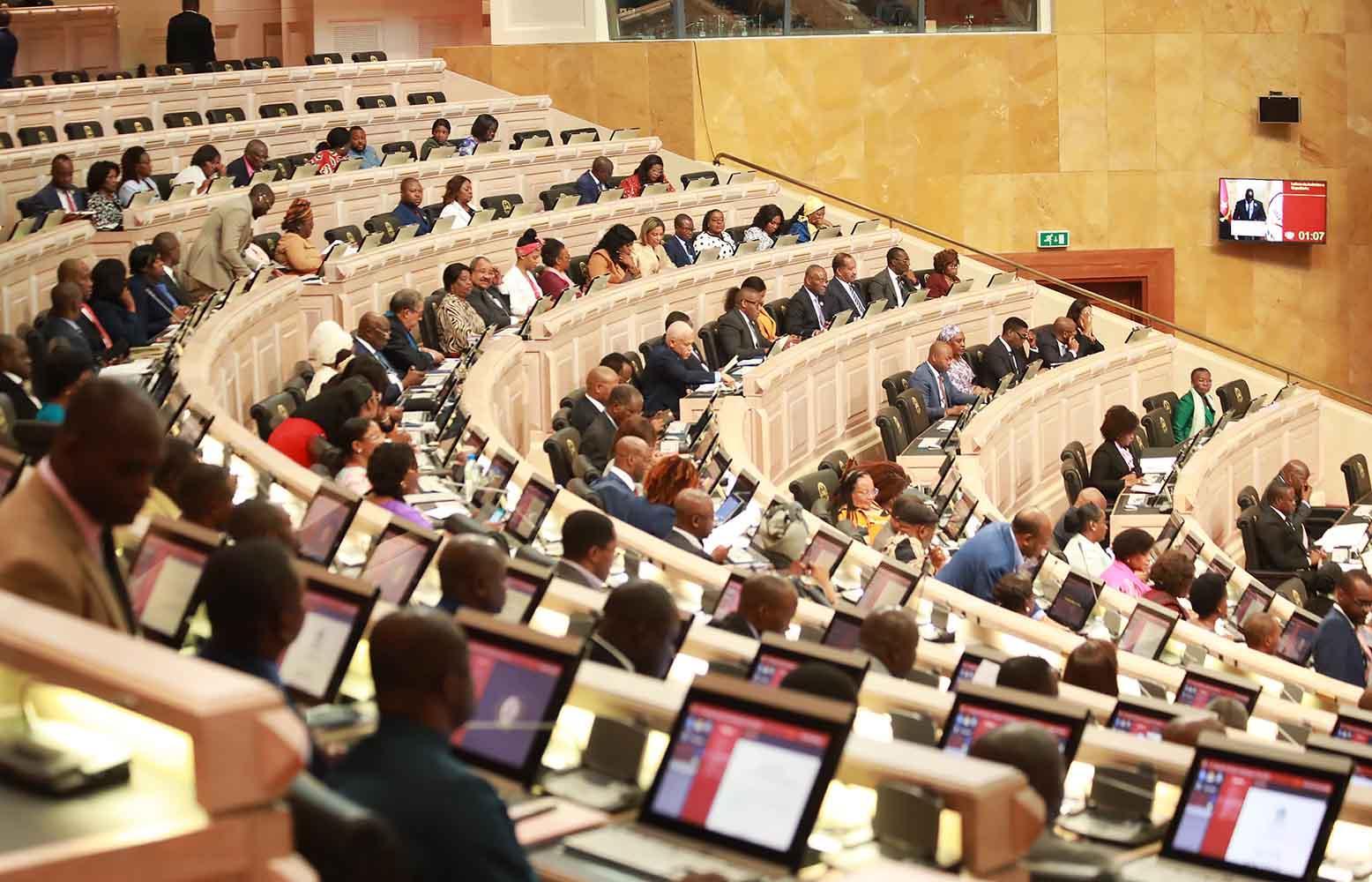
Africa-Press – Angola. The National Assembly (AN) will, this Wednesday (28), discuss and vote, in general, on the Proposed Law on the Political-Administrative Division (DPA), which provides for the creation of another 20 provinces and 325 municipalities.
The Proposed Law on the Political-Administrative Division aims, on the one hand, to promote the balanced development of the territory, bring public services closer to citizens, guarantee the full occupation of the territory and, on the other, rationalize State administration services, increasing its effectiveness, efficiency and equity.
The Executive’s legislative initiative foresees the creation of two new territorial units at provincial level, which will result from the division of the province of Moxico (thereby becoming two: Moxico and Cassai-Zambeze) and Cuando Cubango (thereby becoming two: provinces of Cuando and Cubango).
The Proposed Law also provides for the suppression of some sub-municipal districts and the elimination of the distinction between Urban Districts and Communes.
Some of these units rise to municipal level, taking into account geographical and demographic conditions and the need to guarantee effective control of national borders.
If approved, the new Political-Administrative Division of Angola will consist of 20 provinces, 325 municipalities and 375 communes.
The provinces of Uíge, Malanje and Lunda-Norte will have the largest number of communes to bring populations even closer together.
In the case of Luanda, the DPA foresees the creation of new municipalities, namely Kilamba, Estalagem and Calumbo, the latter which will bring together the neighborhoods of Zango 1, 2, 3 and 5.
From an economic and social point of view, this proposed law provides for some benefits such as the reduction of inequalities and poverty rates within the population.
The Proposed Law on the Political-Administrative Division has a preambular part and a dispositive part, systematized into 22 chapters, 40 sections and 514 articles.
Opposition against
Heated debates are expected in the hemicycle this Wednesday, due to the fact that the opposition is against the legislative initiative and demands that local elections be held in 2024.
Representative Mihaela Weeba, from UNITA, considered the Proposal to be “expense-intensive” because it will increase the costs of the OGE and the State’s administrative machinery “and will not reduce regional asymmetries; on the contrary, it will worsen them”.
In his view, the Proposed Law “has the political purpose of delaying the effective institutionalization of local authorities”.
In contrast, deputy Milonga Bernardo, from the MPLA, understands that the opposition’s narrative in relation to the DPA Bill “is nothing more than a distracting political speech”, which he considers serious.
For the deputy, the proponent’s intention is to increasingly bring public administration closer to citizens and effectively occupy the national territory, as well as having the ability to safeguard national sovereignty.
He recalled that it was the MPLA that introduced, on the national agenda, the need to implement local authorities.
Traditional authorities and associations suggest changing names
Traditional authorities questioned the motivation for changing the names of some municipalities and communes, within the scope of the DPA, as they understood that the current names of these locations have a historical and representative basis for the people of those regions.
In the meeting that Queen Nhakatolo Ana Bela Ngamba Kaumba held with the first vice-president of the National Assembly, Américo Cunonoca, she suggested changing the name Kassai Zambeze to Moxico Leste or Oeste, within the scope of the new DPA.
Likewise, the 4th Commission of the AN, which deals with State Administration and Local Power, met with the Association of Natives and Friends of Gangula (ANAG), a commune in the municipality of Sumbe, in the province of Cuanza- South that the new DPA defines will have another name in which natives do not see themselves as it.
Dissatisfied and concerned with the new name provided for in the DPA Project, they question the motivation for changing Gangula to Kuvu, since the current name is historically based and represents the people of that region.
Anti-Doping Law in Sports
Still on Wednesday, the Plenary of the National Assembly will proceed to the final global vote on the Proposed Law on Anti-Doping in Sports.
The proposal for an Anti-Doping Law in Sport, whose joint expert opinion report was unanimously approved, results from an urgent request made by the Executive, for Parliament to comment on the issue.
The Legislative initiative, with six chapters and 74 articles, establishes the Legal regime against Doping in Sport, in harmony with the rules established in the World Anti-Doping Code.
The Minister of Youth and Sports, Rui Falcão, recognizes the need for legislators to definitively approve this document, which is of capital importance for the country in sports.
Cryptocurrency mining
The Plenary will also proceed to the final global vote on the Proposed Cryptocurrency Mining Law and other virtual articles and the one amending the Organic Law of the Courts of Appeal.
Likewise, it will discuss and vote on draft resolutions for the ratification of protocols linked to SADC, namely on Statistics, Tourism, the Mining Sector, Youth Empowerment and Protection of new seed varieties.
At this meeting, deputies will discuss and vote on the draft Resolution that occasionally changes the direction of the AN’s first specialized working committee, due to some adjustment that occurred at the level of this committee, on Constitutional and Legal Affairs.
ANGOP
For More News And Analysis About Angola Follow Africa-Press