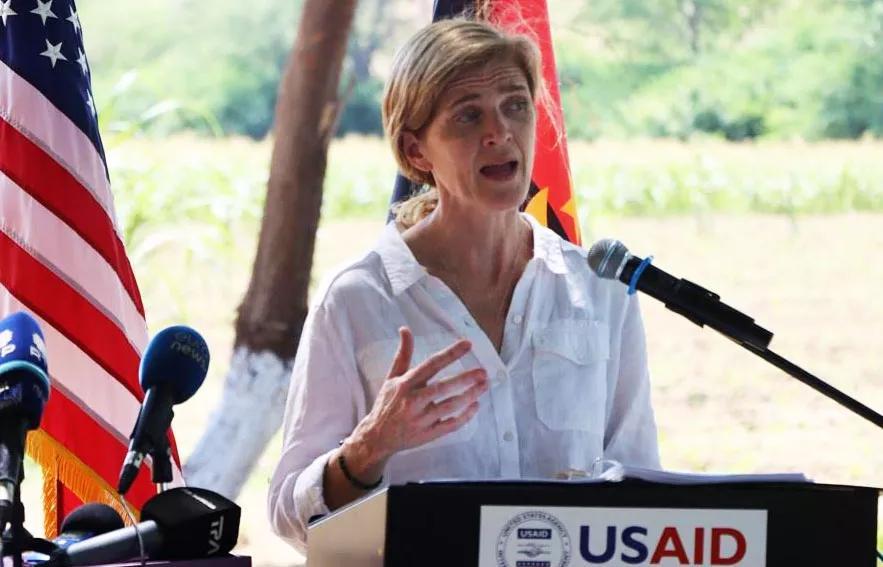
Africa-Press – Angola. The North American Agency for International Development (USAID) launched, this Thursday, in the province of Benguela, the expansion phase of the Project to Support Women in Agriculture in Angola, which will allow it to reach 20 thousand beneficiaries.
This project aims to empower rural women farmers to be technically and commercially successful, increasing productivity and connecting them to large buyers, in addition to removing economic, social and cultural barriers.
Until now, the project covered six provinces, namely Cuanza-Sul, Huíla, Cuanza-Norte, Luanda, Malanje and Namibe, with six thousand drink beneficiaries, being implemented by the NGO Ajuda de Povo para Povo (ADPP/Angola).
In this new phase, budgeted at five million dollars, women farmers from the provinces of Benguela, Huambo and Bié, located along the Lobito Corridor, in addition to Cuando Cubango, will benefit.
With this initiative, USAID and partners (ExxonMobile, Azule Energy and Grupo Simples) intend to ensure that investments in the Lobito Corridor support Angola’s main development objective, that is, economic diversification, attracting private investments to the region.
The Women Farmer Support Project is a public-private partnership that empowers rural communities to increase their livelihoods and food security, thus turning beneficiaries into leaders in the sector.
According to USAID administrator, Samantha Power, despite having abundant fertile land and abundant water resources, Angola imports more than half of its food needs, at an annual cost of around three billion dollars, a situation that needs to be reversed.
The official welcomed the efforts of the Angolan Government to reverse this situation, focusing on increasing domestic production and gradually reducing imports.
He considered that, Angola is on a new path, with the rehabilitation of the Lobito Railway and its connection to Zambia, to Tanzania, which will result in the first trans-African railway line and which has the potential to reverse this context.
From his perspective, this initiative is much more than railway lines, as it will connect farmers with markets where they can sell their products, as well as expanding access to inputs such as fertilizers, improved seeds and equipment for the agricultural sector.
In the same vein, he said that it will also help reduce the costs of these inputs and increase farmers’ profits.
For Samantha Power, farmers will be able to sell their products at a good price and Angola will be able to take the production of these communities to other parts of the world.
However, he argued, to achieve these objectives, farmers need training in techniques to increase productivity, financial resources and access to capital, in order to be able to purchase seeds, equipment and fertilizers.
But that is not enough, he said, they also need access to documents, such as the Identity Card, basic skills such as financial literacy, as well as connection to buyers.
“For this reason, the Angolan Government has invested hundreds of millions of dollars to help family farming, highlighting the creation of the Agricultural Development Support Fund, which will expand access to agricultural credit by six percent over the next three years ”, he said.
He also highlighted the commitment of Grupo Carrinho, a USAID partner, which will work, in the coming years, with 150 thousand farmers, connecting them to 17 factories that will buy the products when they are harvested.
The USAID administrator also referred to the signing of a partnership agreement with Africel, valued at 4.8 million dollars, in order to increase, over the next two years, the digitalization of financial transactions.
Samantha Power said that USAID has created partnerships with local NGOs to launch an Agricultural Technical Institute, to train farmers, especially women, aiming to increase skills and techniques, resulting in increased production.
Grupo Carrinho reaffirms its commitment to national products
The Chairman of the Board of Directors of Grupo Carrinho, Nélson Carrinho, reaffirmed that it will continue to invest in purchasing production from Angolan farmers.
He welcomes USAID’s “transformational” initiative, because, for the first time, he sees in Angola a non-governmental entity with a different vision, which goes far beyond subsistence agriculture, and strives for market creation.
“Working in the field, with 150 thousand producers, of which 45 percent are women, has been a very enriching experience. Being able to live with these families allows us to learn more than teach and that is why change is in their hands,” she said.
He reaffirmed Grupo Carrinho’s commitment to the 2030 vision, in which they plan to add two million Angolan producers and be 100 percent self-sufficient in their entire industrial career, fed exclusively by Angolans.
For More News And Analysis About Angola Follow Africa-Press