Africa-Press – Angola. The first two-day official visit of President João Lourenço to Côte d’Ivoire was marked by a high level of reception and hospitality, which made clear the West African country’s desire to begin a new story in relations between the two States..
The first sign that the host, Alassane Ouattara, did not want to attribute a common meaning to this moment occurred after the Angolan statesman disembarked in Abidjan, the economic capital of that country, on the 26th, when, accompanied by his wife and several members of his Executive , decided to go to Félix Boigny International Airport to personally receive his counterpart, who was also accompanied by his wife Ana Dias Lourenço. The gesture caught everyone’s attention and warned that João Lourenço’s first official visit to Côte d’Ivoire would not go unnoticed.
History shows that there are few or almost no cases of Presidents who have gone to the airport to receive a counterpart, given the security incidents that have occurred in the past with some entities when they have gone to these places, hence the appointment of other people responsible for the task, whose choice generally falls to the Minister of Foreign Affairs.
Once the reception ceremony at the airport was over, it was time for the Angolan statesman to get into his vehicle and head to his accommodation. As he was leaving the airport, another notable fact caught his attention: the Angolan flag was flying alongside the host on several main avenues in Abidjan, recalling the setting for a country hosting an international event.
This fact, as explained by the Angolan ambassador to Ethiopia and Permanent Representative to the African Union, in an interview, means, in addition to welcome, the value that Côte d’Ivoire wants to give to Angola, as well such as the satisfaction they felt upon receiving President João Lourenço on their soil.
“The raising of the Angolan flag on the avenues of Abidjan is a very strong signal, because the flag is a very important symbol of a country’s sovereignty. This demonstrates the acceptance of Angola in Côte d’Ivoire, both from the point of view of political society and civil society, because everyone gets to know Angola, which ends up being instilled in the culture of that country, that is, the citizens of Côte d’Ivoire get to know Angola better”, explained the ambassador, for whom this gesture goes beyond the political dimension.
Miguel Bembe, who was previously director of the Africa, Middle East and Regional Organizations Directorate of the Ministry of Foreign Affairs, said that the initiative also symbolized the Ivorian statesman’s desire to see the two Nations united, whose relations, in the past, had been weakened.
“Angola is an important country in terms of investment opportunities and also has all the indispensable assets for projecting power and, as a result, today, there is practically no country that does not want to establish friendly and cooperative relations with Angola. I feel this as an ambassador of Angola accredited to the African Union and the United Nations Economic Commission for Africa (UNECA)”, he highlighted.
Credibility and acceptance
For political scientist and university professor Osvaldo Isata, the raising of the Angolan flag along the main avenues of Abidjan, during João Lourenço’s official visit to that country, was synonymous with credibility and acceptance of the country in that State.
“From the point of view of political diplomacy, this gesture means that we are with you. Angola is a State that the world respects”, highlighted the academic.
Key to the City of Abidjan
The following day, reserved for the official start of the visit, another sign is given by the Ivorian Government to honor the presence of President João Lourenço in that territory.
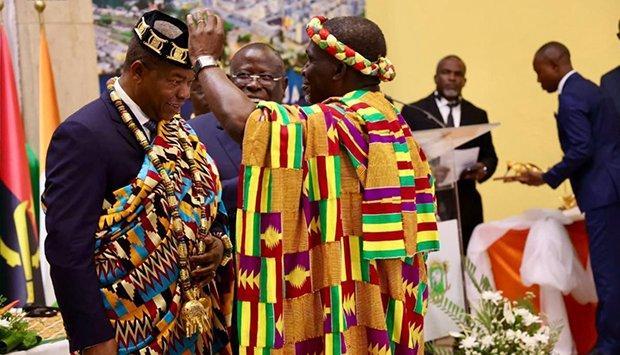
The Council of the Autonomous District of Abidjan decided to honor the Angolan Head of State, on behalf of the people of that region, with the attribution of the key to that city and the status of honorary citizen of Abidjan.
In the same ceremony, marked by several cultural moments, the Angolan statesman received a traditional name, which means, in the culture of the people of that area, a very strong warrior and became part, in a symbolic way, of the Atcham ethnic group, prominent in the history of Côte d ́Ivoire for having been invincible over time, in defending the city of Abidjan against successive attacks from other groups.
“I must thank you for this very significant gesture, which leads me to quote President Agostinho Neto, when he said: we will return to our culture and our traditions”, declared President João Lourenço, stressing that the gesture is proof that “we are one people, we are Africans”.
It wasn’t all about the tributes. In the evening of the same day, President João Lourenço is surprised, during dinner hosted by his counterpart Alassane Ouattara, with the “Grand Cross of the National Order”, the highest distinction used by the Ivorian Government for personalities it intends to award. At the same ceremony, the First Lady of the Republic, Ana Dias Lourenço, was also honored with the title of “Commander of the National Order” of Côte d’Ivoire.
jornaldeangola
For More News And Analysis About Angola Follow Africa-Press