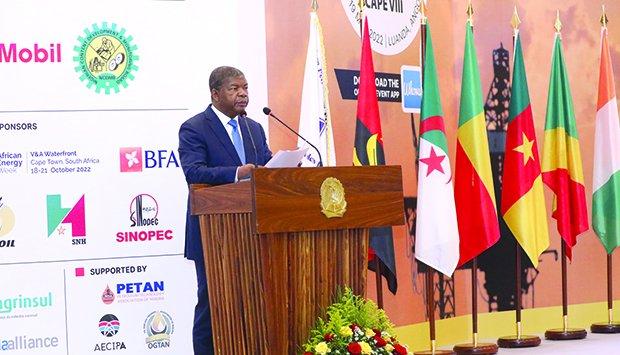
Africa-Press – Angola. The President of the Republic defended, this Monday, in Luanda, the creation of an African market capable of absorbing a larger share of the oil and gas produced in Africa, justifying the fact that a “significant part” of people on the continent do not have access to electricity and no other form of modern energy for domestic use.
Speaking at the opening of the Oil and Gas Congress and Exhibition, João Lourenço highlighted the fact that, historically, African oil and gas have been explored and produced, above all, to meet the external demand of industrialized countries in Europe, America and Asia, and warned of the risks of the continent being left without a market in the near future.
The President of the Republic also defended a gradual energy transition on the continent (from fossil to renewable energies), to avoid hunger and misery for the populations of countries whose main source of foreign exchange is oil and gas exploration.
“We are all obliged to adhere to the energy transition to save planet Earth. In the medium and long term, fossil fuels are condemned to be permanently banned, as one of the measures to protect the environment and, consequently, the planet”, recalled the Head of State, at the opening of the 8th African Oil and Gas Congress and Exhibition, taking place in the Angolan capital.
While the energy transition process is underway, the President of the Republic recommended that the States speed up the diversification of their economies, making the most of oil revenues for the continent’s industrialization, recognizing that the task is not easy due to the short time that remains.
“We have no other choice if we don’t think that, because it is necessary, it must be possible”, he said.
João Lourenço, urging observers and all stakeholders in the oil and gas industry of APPO member countries to commit to addressing the challenges of the oil industry in Africa.
The Head of State called for the cohesion of the continent to prevent more than 125 million barrels of crude oil and more than 500 trillion cubic feet of gas (proven reserves on the continent) from going untapped forever.
He recalled that, for several decades, African oil industry projects in the three stages of development were financed exclusively with foreign capital, a situation that can be changed with the global paradigm shift from fossil fuels to renewable energies.
“If the institutions in which we have relied heavily for several years decide to end investment in our countries’ main source of income, we must jointly find an internal solution that allows us to take advantage of our energy resources”, said the Head of State, pointing out as a solution, the reform of the APPA fund for international cooperation and the work being carried out with the African Bank, for the creation of an energy bank on the continent.
The Head of State praised the evolution of APPO, from the Association to the African Organization of Petroleum Producers, noting that the achievement emphasized the organic structure of the members. He mentioned that
the organization’s mission and vision were “profoundly” changed to prepare the continental organization for the challenges of the energy transition.
The President of the Republic highlighted the “great importance” of the oil and gas problem on the African continent, because, despite the ongoing efforts to “decarbonize” the economies, these energy resources will continue to play a prominent role in the coming decades world and African economies.
He underlined that the theme chosen for the congress “Energy transition: Challenges and opportunities in the African oil and gas industry” demonstrates the intention of the leaders of African producing countries to deliberate on the challenges and opportunities of the energy transition and the future of the industry of these resources energy on the continent.
João Lourenço guaranteed support from the Executive for the holding, in the near future, of the first summit of Heads of State of the Organization of African Petroleum Producing Countries (APPO). “Angola supports this initiative, as the challenges that Africa faces in the field of oil production must be addressed at the highest political level,” he said.
Reforms To Improve The Business Environment
The Head of State said that the reforms initiated in the oil sector in 2018 serve to improve transparency and eliminate possible conflicts of interest.
He underlined that such reforms culminated in the creation of the National Agency for Petroleum, Gas and Biofuels, the creation of the Regulatory Institute for Petroleum Derivatives and the restructuring of the Angolan oil company Sonangol EP, with a view to repositioning and focusing on the oil and gas value chain. Natural.
João Lourenço acknowledged the “sharp decline” of oil production in the country since 2016, pointing out the lack of investment in exploration as the main cause.
To reverse the downward trend in oil production in the country, the Head of State said that the Executive has been promoting initiatives to relaunch exploration activity, improve operational efficiency, optimize costs, as well as promote local content.
The President of the Republic said that, for Angola to become an exporter of crude oil and also a seller of refined products, the Executive chose, among its priorities, the construction of the refineries in Cabinda, Soyo and Lobito, including the requalification of the one in Luanda to guarantee , in total, the future daily refining of 400 thousand barrels of crude oil.
João Lourenço stressed that the Executive also decided to increase the storage capacity of fuels and lubricants, as well as the network of gas stations across the country, relying on the private sector. The Executive also took the decision to promote the transparency of the extractive industry, having constituted the National Coordination Committee as a collegiate body, to encourage good governance and improve transparency in the management of revenues from mineral resources, in general, and petroleum resources, in particular. .
In view of climate change and the need for an energy transition to a low-carbon economy, the Head of State said that the Executive has guided the promotion of sustainable exploitation of fossil energy resources and, gradually, create opportunities for the development and use of renewable energy sources, such as solar, wind, biomass and hydrogen, and some concrete actions and projects are already underway in this direction.
For More News And Analysis About Angola Follow Africa-Press