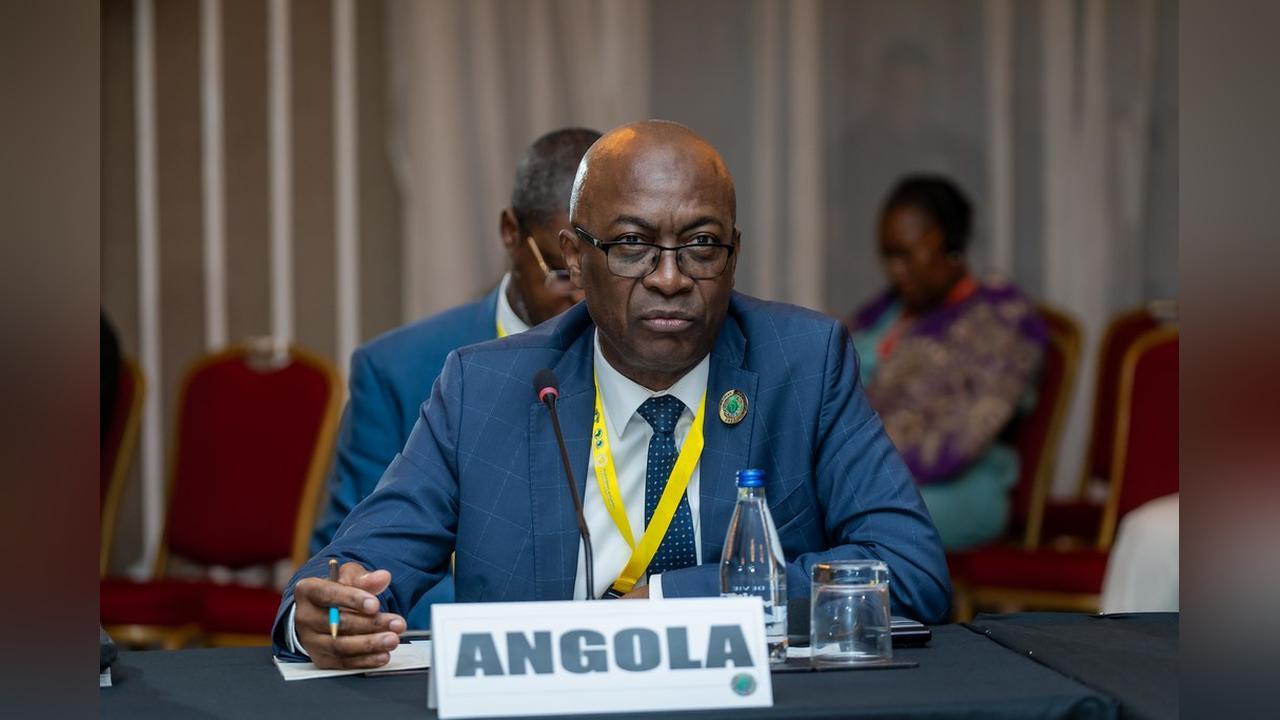
Africa-Press – Angola. The minister of Planning, Victor Hugo Guilherme, on Thursday in Luanda reaffirmed Angola’s high-level political commitment to a regional agenda focused on economic integration, institutional cooperation and the mobilization of structural investment.
Speaking at the Opening of the Coordination Meeting on the Lobito Corridor, organized by the Angolan Government and the World Bank (WB), under the guidance of the Head of State, João Lourenço, the minister stressed that the Government has been promoting sustainable investments, with particular emphasis on economic infrastructure, economic diversification and strengthening the foundations of inclusive growth.
He clarified that these actions are framed within the Long-Term Strategy and the National Development Plan, which establish a vision of structural transformation of the economy, based on competitiveness, the enhancement of the private sector, and the deepening of regional integration.
The government official stated that the Lobito Corridor occupies a central position in this strategy, as it constitutes a fundamental instrument for economic connection between Angola, the Democratic Republic of Congo (DRC) and the Republic of Zambia.
The minister highlighted that the project’s success depends on a coordinated regional understanding, alignment of public policies, regulatory harmonization, coherence in planning and the coordinated execution of essential investments along the entire corridor.
In this regard, he pointed to the “Engine Room” initiative as it was prepared as a transitional mechanism to align policies, investments and technical assistance between the three countries, as well as to operate as a strategic planning platform to reduce risks of fragmentation and maximizing the impact of current and future investments.
The government representative reinforced Angola’s commitment to an integrated regional understanding, based on cooperation, predictability, and the equitable sharing of benefits, expressing his conviction that the Lobito Corridor will consolidate itself as a stimulus to economic diversification, regional integration, and sustainable development.
The aim of the meeting is to define strategic priorities and strengthen coordination between the three African countries and their technical and financial partners.
The meeting’s agenda will focus on stimulating the implementation of structural projects in crucial sectors such as railways and integrated logistics, trade facilitation and infrastructure modernization, sustainable energy, development of agricultural and mineral value chains, as well as promoting economic and social development along railways.
The Lobito corridor is recognized as one of the most promising logistical and economic platforms in Southern and Central Africa and is assuming an increasingly crucial role in the continent’s economic connectivity.
It is expected that this meeting will open a new era of more structured and regular collaborative work, aimed at transforming the Lobito corridor into a true engine of regional integration, attracting private investment and creating economic and employment opportunities for the region.
The Lobito corridor is a strategic multimodal infrastructure that extends from the Port of Lobito in Angola, crossing the country and connecting to the transport networks of the DRC and Zambia.
Its development is seen as fundamental to unlocking the economic potential of the interior of Central and Southern Africa, facilitating access to international markets and promoting intra-regional trade.