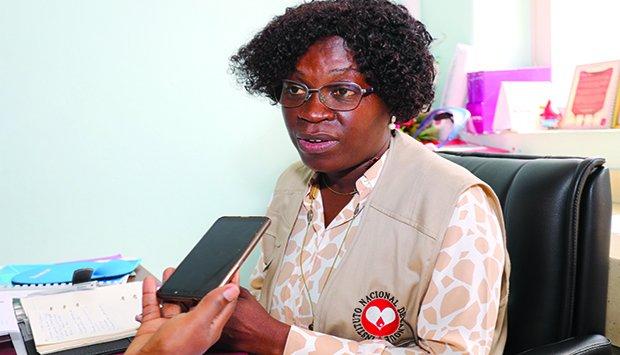
Africa-Press – Angola. The National Blood Institute (INS) only collects, on average, about 80 to 85 bags of blood per day, numbers considered insufficient to meet the demand in the country’s health units, as its director considered.
Deodeth Machado, who was speaking as part of the commemorations of the World Blood Donor Day, which is being marked today, highlighted, for example, that the province of Luanda alone, the country’s capital, consumes more than 300 units of the product daily.
The director of the INS said that the 80 or 85 units have been made available, mostly by family donors, far from the target indicated by the World Health Organization (WHO), which argues that at least one percent of the population of a country must be a voluntary donor.
The INS official informed that the country currently has a total of 16,650 blood donors, including 10,000 family members, corresponding to 83%, and 6,650 volunteers.
This deficit of voluntary donors in the country is largely due to the lack of culture of blood donation. “Therefore, the INS has been working closely with the media to alert the population about the importance of this gesture in reducing many deaths, which occurred in hospitals, centers and health posts in the country.
“Only humans can and should donate, and those who do so, on a regular basis, help to save more than one life”, emphasized Deodeth Machado, adding that it is important to mobilize more voluntary donors, as these are the ones who almost always comply. with all the requirements established by the WHO.
Regarding the requirements, the director of the INS highlighted being over 18 years old, weighing more than 60 kilos, being in good health, without risky behavior, not being drug users, nor anemic.
As for the regularity of donation, the specialist in Hemotherapy explained that men should donate at least quarterly and women every four months times a year. In the case of ladies, they cannot be pregnant or breastfeeding.
“Often, these requirements are only fully met by voluntary donors, because they are people who donate without pressure, in a relaxed way and do it from the heart, because they do not know who they are going to donate to, it is simply a good deed”.
The specialist in Hemotherapy explained that the limit established by the WHO for each person to donate blood is 450 milliliters per donation session. And each blood unit or bag can be used to transfuse four patients if they are adults and five if they are children.
Distribution In Health UnitS
Asked about the distribution process to the various units in the country, Deodeth Machado explained that Angola has 193 hemotherapy services, the head body being the INS, which, in addition to harvesting, to a large extent, carries out screening for malaria, hepatitis A, HIV. / AIDS and other sexually transmitted diseases.
The INS supplies blood and directly supplies the David Bernardino, Américo Boavida, Josina Machel and Geral de Luanda Pediatric hospitals, as well as the National Oncology Center, as they are units with many valences, they perform highly complex surgeries and need more grants. of blood.
The other provincial hemotherapy centers work independently, although there are some hospital units that also provide this blood collection service and only take the product to the centers to be properly tested.
The same is happening with Hospital Américo Boavida, which, little by little, has already taken its own blood samples. “Therefore, we are training more Hemotherapy technicians and improving some working conditions, so that tasks start to be decentralized and decrease demand at the INS, which, thus, can have a stock considered to meet peak situations”.
Problems Of Selling In Hospitals
Regarding the process of marketing blood in several health units, the doctor said it was a very complex issue to address, taking into account that, despite the existence of the problem, she never officially reported it to the INS.
“We did not receive, either institutionally or individually, even anonymously, any complaint about the sale of blood in hospitals carried out by a technician”, said Deodeth Machado.
The director stressed that the institution can only act with complaints and evidence of the existence of the problem. In this way, people who practice such actions would have already been referred to the competent authorities to be held criminally responsible.
“It is a crime, because a careless blood transfusion can be a channel for someone to die or be infected by various diseases”, he called attention, adding that “only a product that has been properly tested and that has respecting the window period, to avoid the transport of any infection”.
Street Blood Not Recommended
During the window period in the blood donation process, the director explained that it takes a certain amount of time to see if nothing escapes. “If any product has been infected and is donated, today, this interval must be respected, because some diseases manifest themselves. If not, the person who receives the blood, even if it is primarily negative, runs serious risks of being contaminated”.
Therefore, in disregard of this set of procedural rules, Deodeth Machado considered that blood bought on the streets is a great risk for those who receive it.
Due to the possible existence of blood to be sold and in inappropriate places, the director stressed the importance of having informed and voluntary donors, aware and responsible for the act they perform.
“It’s not just out of the blue that in the most developed countries, donors are 100% voluntary”, highlighted the doctor.
More About The Date
World Blood Donor Day is celebrated annually on June 14th, with the aim of honoring all blood donors and raising awareness among non-donors about the importance of this act, which is responsible for saving thousands of lives.
The date was created at the initiative of the WHO in 2014, and the day chosen is a tribute to the birth of Karl Landsteiner (June 14, 1868 – June 26, 1943), an Austrian immunologist who discovered the Rh factor and several differences between the different blood types.
Function Of Blood Components
The director of the INS explained that the four blood components are isolated from donated blood, namely cryoprecipitate (Crio), fresh frozen plasma (PFC), platelets (CP) and erythrocyte concentrate (CH), which is the last one most requested for transfusions.
Deodeth Machado stressed that each component extracted from blood has its validity period. The cryoprecipitate lasts for 24 hours. Fresh frozen plasma lasts for two years, platelets have an interval of five days, and erythrocyte concentrates last for 42 days. All these must be discarded when they reach their validity period.
The official clarified that patients will not always need all blood components, as it depends on what is most lacking in their body. But, as a rule, a person who has suffered some trauma and lost a lot of blood, may need the first unit to contain all the components.
“But, as the body reacts, what else is missing will be analyzed, in order to be able to transfuse, because each blood component has its own function”, stressed the director of the INS.
Cryoprecipitate, for example, continued the doctor, is indicated to control or prevent bleeding related to the decrease in fibrinogen and diseases such as hemophilia type A (factor VIII deficiency).
In relation to fresh frozen plasma, which has this name because it is stored in specific chests at very low temperatures, the doctor said that it serves to prevent major bleeding during invasive procedures in patients, and greatly helps the body in the clotting process.
The erythrocyte concentrate, on the other hand, highlighted that it has the function of restoring hemoglobin levels and replacing blood losses, hence being the most socialized among the components. “This is one of the few treatments that adequately restores tissue oxygenation when demand exceeds oxygen supply.”
Afterwards, Dedodeth Machado spoke about platelets, which have the function of interrupting blood flow through a vessel, promoting the repair of vascular injuries and preventing the occurrence of hemorrhages.
For More News And Analysis About Angola Follow Africa-Press