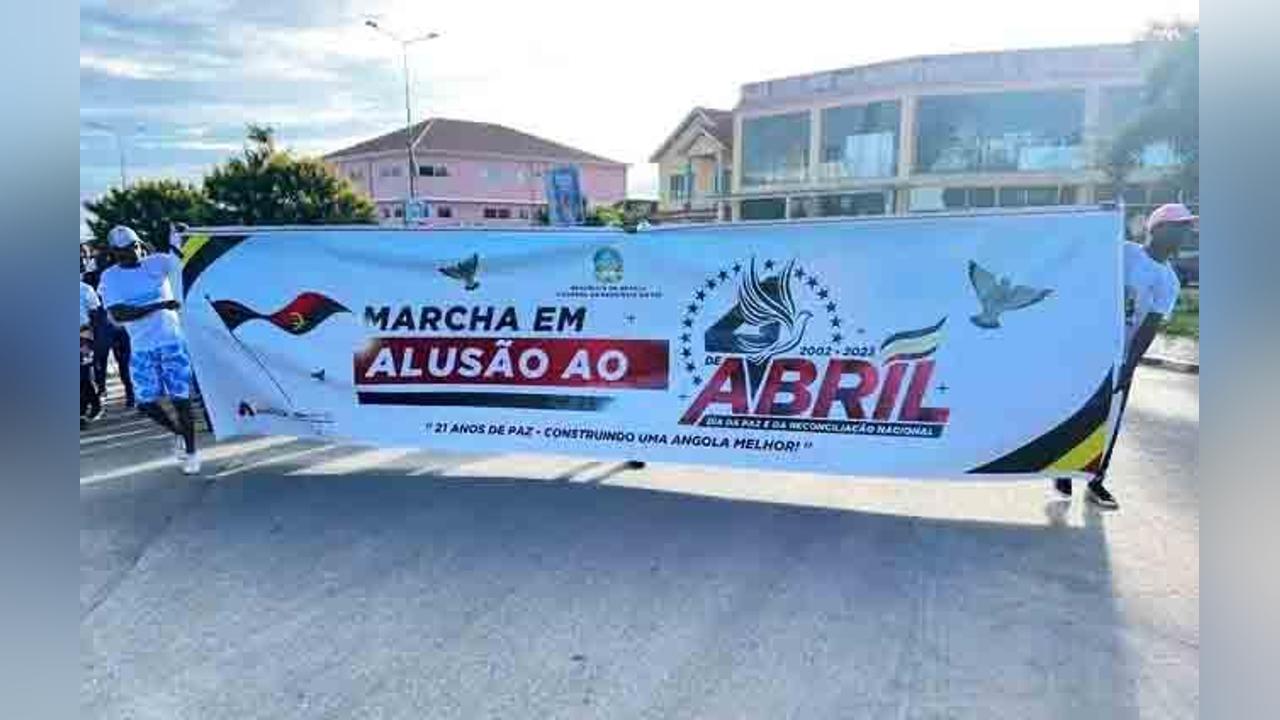
Africa-Press – Angola. The population of Bié province welcomes the gains of effective peace, 21 years later, especially in the domain of the socio-economic sector, national reconciliation and political and democratic stability.
Speaking to press, in the framework of the 4th of April, Day of Peace and National Reconciliation, citizens were unanimous in considering Peace the second greatest achievement of Angolans, after National Independence.
For the elderly Adão Pedro, 77 years old, with the conquest of effective Peace, the province of Bié, one of those that suffered most from the civil war for 27 years, is completely transformed, both by the investment that the Executive employs, and in the field of national unity and reconciliation.
Adão Pedro pointed out that the social sector gained the most, with the entry into operation of several health units, with emphasis on the Hospital Dr.Walter Stranguay”, the increase in educational institutions, both general and university education, as well as the offer from employment to youth.
On the other hand, he defended the need for the Government to invest seriously over the next five years in the recovery of factories in Bié province, to reduce the unemployment rate, as well as strengthen the fight against crime and poverty within rural communities.
Domingos da Silva, 63 years old and former FAPLA, highlighted the investment that the Government made in the recovery of the Cuito/Chitembo, Cuito/Chinguar and Cuito/Andulo roads, now defending the resumption of completion of the Cuito/Cuemba road.
Domingos da Silva also considered positive the commitment that the authorities have been making in the agriculture sector, encouraging the Executive to continue supporting small producers, as well as improving assistance to ex-soldiers, through various social programmes.
Meanwhile, the young Rafael António, 28 years old, in addition to praising the opening of the Mediateca Abel Abraão, Centralidade do Cuito and Andulo, the maximization of jobs that the Executive has given in the areas of education, health and economy, requested more incentives from the State to the private sector, in order to offer more jobs to the youth.
Rafael António also noted, in 21 years of effective peace, especially in the province of Bié, the way in which the bonds of brotherhood and national unity are registered, both between political parties and between ordinary citizens.
Therefore, he recommended the strengthening of such ties, in favor of well-being and social and economic development.
Gains from peace in Bié
In 2019, Joaquim Kapango Airport, the largest airport infrastructure in the province, underwent expansion and modernization. The works, valued at more than USD 40 million, included widening the airport’s runway by over 200 meters in length and 45 meters in width, allowing it to receive Boeing 737-700 aircraft.
Thus, the province began to receive small, medium and large aircraft, including the Boeing 777-700, giving new impetus to Bié’s productive life.
water sector
In the water sector, the province has collection, treatment and distribution systems in the municipalities of Cunhinga, Cuemba, Nhârea and Cuito, where there are three systems, while the other localities have small systems and others are under construction.
The three systems of Cuito, namely, Cuquema I, Cuquema II and the Cunje commune regularly supply drinking water to more than 30,000 homes.
In this sector, the Executive has in its portfolio the expansion of over 15 thousand new home connections, to be made in a short time, with financing from the World Bank.
At the moment, more than 5,000 home connections are being made in the Cantíflas, Cangote, Catemo, Cangalo, Sousa, Caluco and Chissindo neighborhoods, also with financing from the aforementioned bank, in order to benefit over 30,000 inhabitants.
For this year, the authorities are going to hand over the collection, treatment and supply system in the municipality of Chitembo, located 150 kilometers south of Cuito, with more than 1,500 home connections.
It also plans to start work on new systems in the municipalities of Andulo, Camacupa, Catabola and Chinguar, as the Executive seeks funding for them, aiming to cover an approximate number of 500,000 inhabitants.
Energy
In the field of energy, the province has 80 megawatts (MW) since March 2019, coming from the Laúca Dam (Malanje), power that joins 14 others produced in the thermal power stations of Huambo and Cuito and two others from generator sets.
Energy from Laúca made it possible to install 80 megawatts in Cuito, when demand is just 20 MW.
For this reason, the Ministry of Energy and Water is beginning to interconnect the municipalities of Bié, in the short term, with energy from the Laúca dam.
The project, which already started this year, specifically in the eastern region of Bié, where, in a first phase, it reached the commune of Chipeta, a 250 KVA Transformation Station (PT) and 140 public lighting poles were installed, as well as covers 200 home connections, out of the 1,200 planned.
With the arrival of energy from Laúca to Chipeta, government entities want to expand as quickly as possible throughout the eastern region of the province, namely Catabola, Camacupa and Cuemba.
The municipalities of Cunhinga, Andulo and Nhârea will be connected from the Cunje commune, while, along the same path, Chinguar, Chitembo (Bié) and Cachiungo (Huambo) will benefit from the Cuito power plant.
For this purpose, sector technicians are already committed to removing the old expansion network made by the settler, since it is obsolete, thus replacing it with the low and high voltage network, aiming to cover a greater number of consumers.
With regard to the city of Cuito, more than 12 thousand new families will benefit from this asset, with the expansion of the low and medium voltage network.
In the first half of the current year, the Government carried out more than two thousand new connections in the Catemo, Ndôngua, Boavista and Licimo districts, on the outskirts of the city of Cuito, in an undertaking included in the project to expand the medium-low voltage energy distribution network .
It also installed, in the Biena capital, more than 500 concrete and wooden public lighting poles, aiming to reduce the crime rate in these neighborhoods, at a cost of 300 million kwanzas, within the scope of the Integrated Program for Intervention in Municipalities (PIIM) .
In 2021 alone, 3,379 new families in the municipalities of Cuito, Camacupa, Chinguar and Chitembo will benefit from electricity, under the Neighborhood Electrification Programme.
Also completed this year was the medium and low voltage network in the municipality of Cuemba, located 162 kilometers east of Cuito, which is ensuring, in a first phase, public lighting and 1,500 new home connections.
Also in 2022, the Government proceeded to hand over to the population of Chitembo, 150 kilometers from the Biena capital, a new thermal power plant of over 1,000 KVA, which also benefits over 1,500 families, despite further expansion in the residences of the headquarters. of the municipality.
The distribution network controlled by the National Electricity Distribution Company (ENDE) has, in this part of the country, 26 thousand and 14 customers, 16% of which with the metering system and 2 thousand and 666 prepaid customers.
Housing
In the housing sector, the province has two centralities, one in Cuito and the other in Andulo, as well as a social project with 500 residences, located in the Caluco neighborhood (Cuito), reducing the deficit of habitability.
Health
In health, Bié has, since 2020, a third-level hospital, Dr. Walter Strangwai, inaugurated by the President of the Republic, João Lourenço.
The Hospital Dr. Walter Strangwai is, in these terms, the largest health unit in the province, with a capacity of 230 beds. There are more than 20 services there, such as pediatrics, medicine, outpatient consultation, cardiology, nephrology, general and plastic surgery, dermatology, physiotherapy, stomatology, gastroenterology, gynecology and obstetrics, clinical analysis, orthopedics, hemodialysis, traumatology, X-ray, urology, pathological anatomy and others.
The infrastructure often serves patients from the provinces of Luanda, Benguela, Huambo, Huíla, Cuando Cubango, Cuanza Sul, Moxico, Malange, especially in the area of hemodialysis.
The infrastructure has over 1,600 employees, including doctors, nurses, administrative staff and cleaning assistants.
In addition to this reference unit, Bié has second-tier hospitals, located in Cuito, Cuemba, Nhârea and the Catholic missionaries and the Congregational Church in Angola (IECA) of Vouga, Chissamba, Chilesso, Camundongo, among others.
Education
In the province of Bié, the education sector was the one that gained the most in the last five years, where approximately 100 schools were built, either within the scope of the PIIM, or in the Combat against Poverty and social partners (Churches, Non-Governmental Organizations) , with a total of 500 classrooms.
The establishments, with seven, 12 and 24 classrooms, now total 782 schools from scratch in operation in this central/southern region of the country, where almost 700 thousand students attend classes, assured by 15 thousand 745 teachers, in the various teaching subsystems, against 400 thousand in relation to the past five years.
These students annually receive three million and 580 thousand books of various titles, free of charge, mainly from initiation to sixth grade, with a view to ensuring the normal teaching and learning system in this academic year, while 20 thousand children from Cunhinga and Chinguar are inserted in the School Lunch Program.
The Government of Bié also plans to build, in the period 2022-2027, two hundred schools in this region, with 12 and 24 classrooms, with a view to inserting most of the children who are still not studying, estimated at 102 thousand.
As for Higher Education, the province has five institutions, including two public, namely the Escola Superior Pedagógica do Bié (ESPB) and the Instituto Superior Politécnico (ISPB), and three private ones, the Universidade Internacional do Cuanza (UNIC), inaugurated in 2021, by President João Lourenço, the Higher Polytechnic Institutes of Cuito and “Ndunduma”.
The two public units have already placed more than a thousand graduates in different courses on the job market in the last five years.
Communication ways
the Government leveled almost 800 kilometers of road that connects the capitals of the municipalities with the communes with greater agricultural, economic productivity and beyond, as part of the Integrated Plan for Intervention in Municipalities (PIIM).
It also completed the asphalting of the Cuito/Andulo road and the 12 kilometer Nhârea headquarters, as well as the asphalting of the first phase of five kilometers of the 10 planned for the municipal headquarters of Cunhinga, Catabola, having already been handed over to the populations. from Chitembo, Camacupa and Cuemba.
Cuito benefited from more than 10 kilometers, in the urban core, especially the road section SME- Nosso Super, city/district Caluco and district Câmara/Monumento, with four and two lanes, public lighting and the appropriate vertical and pavement signaling , in an investment of over two billion kwanzas.
In the area of public transport, Bié is well connected with the Benguela Railway (CFB), which goes to the municipality of Munhango (Cuemba), bordering the neighboring province of Moxico.
Currently, in addition to air transport, the province has for the first time more than 60 public buses, each with a capacity of 62 passengers, operating in the urban area of Cuito and in the Cuito/Chinguar, Cuito/Chitembo and Cuito/Andulo.JEC /PLB
For More News And Analysis About Angola Follow Africa-Press