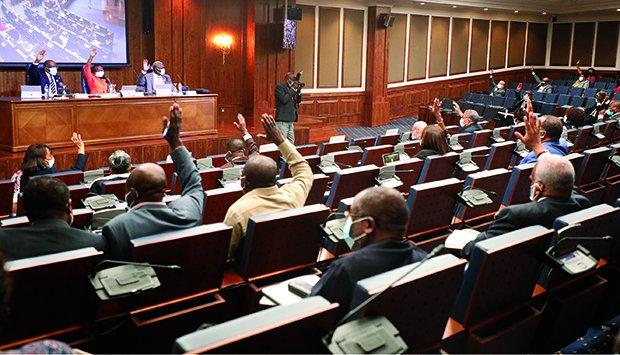
Africa-Press – Angola. The National Assembly approved, on Thursday, in general, the request of the Holder of the Executive Power to legislate on the Special Tax Regime for the province of Cabinda, with a view to promoting social well-being, the economy and national cohesion.
The Secretary of State for Finance and the Treasury made it known that the new tax regime for Cabinda is essentially aimed at expanding the scope of products that can benefit from special conditions in the customs area, including services subject to VAT, as well as improving taxation. of the province, namely the capital investment tax, reduction of industrial and property tax.
Ottoniel dos Santos guaranteed that, with the proposal, the Executive intends to reduce the costs of goods and services for the population of Cabinda, generating more income for companies, families and, also, more equity and social justice. The diploma, according to the official, will ensure tax and fiscal justice in a region that sees its products or goods and services at high prices due to its geographical location, compared to other provinces.
Deputy Júlia Ornelas, who presented the Report Opinion of the Draft Law, clarified that the Special Regime aims to meet the needs of the province and allow the entry of goods into Cabinda not to be aggravated by the costs of taxes or customs fees, allowing greater fiscal equity to the investor, whether national or foreign.
He explained that the Executive’s intention is to transform the port customs regime and the transfer of goods in force in the province of Cabinda, to a special tax regime.
The Secretary of State for the Treasury and Finance, Ottoniel dos Santos, underlined that the request for authorization for the Holder of the Executive Power to legislate is based on the need to ensure that the tax system can meet the particularities of certain territorial jurisdictions, which appeal for differentiated treatment.
The draft law offers greater simplicity to the tax system and more efficiency in obtaining revenue, satisfying the financial needs of the State, as well as materializing the mechanisms that offer the business community and the local population an environment conducive to business improvement.
The deputies also unanimously approved the Bill that Authorizes the President of the Republic to Legislate on the Amendment of the Regime Applicable to the Oil Concession of the Maritime Zone of Cabinda.
According to the Secretary of State for Oil and Gas, José Barroso, the aim is to have a tax regime for activities carried out in the area of the oil concession in the Cabinda Maritime Zone that encourages production, based on the discovery of hydrocarbons already identified. , as well as future discoveries.
The Executive intends to make the new projects more attractive, guaranteeing the financing of investments with the increase in oil and gas production in the national territory. Just yesterday, the deputies unanimously approved the Bill that Authorizes the President of the Republic, as the holder of the Executive Power, to legislate on the Extinction of the Concession granted to the National Concessionaire for Oil and Gas.
Secretary of State José Barroso said that this is a measure that is part of the priority actions of the oil and gas sector, essentially aimed at encouraging the start of production of non-associated natural gas, discovered in, as well as developing projects to be he associated.
The Angolan state, represented by Sonangol, he added, has the largest share, being the largest investor with 41 percent. Oil exploration in this block began in 1960 and, in 1968, the first commercial discovery was made, with activities starting this year.
Block Zero, said José Barroso, has potential for resources, in addition to the contingent resources already identified, which, when developed, will contribute to a significant increase in production in this block and, consequently, in the country, mitigating, in part, the decline in production currently taking place.
He explained that the Petroleum and Gas and Biofuel Agency submitted for approval the Executive’s action the extension of the contract for Block zero for an additional period of 20 years with effect from 2030, containing tax incentives and benefits aimed at increasing production by 6.5 million from barrels of oil to around 1.4 billion barrels of oil, allowing the State to receive an additional tax.
The Secretary of State for Oil and Gas, José Barroso, said that the proposed tax incentives and benefits will be granted, exclusively, to Block Zero, not being applicable to other concessions. He informed that with the extension of the Block Zero contract, the State, represented by Sonangol, will be the main beneficiary, generating revenue of approximately 7.6 billion US dollars, which corresponds to a total of 71 percent of the revenues generated by the block oil production.
Executive Wants To Strengthen Workers’ Rights
The Executive presented to Parliament the proposal for a Basic Law on Civil Service, which aims to reinforce the rights and guarantees of civil servants, as well as its adequacy to the current context of administrative modernization.
The diploma intends to modernize and continuously improve the quality of public services, design and implement policies aimed at the social well-being of its employees and administrative agents, said the Minister of Labor and Social Security. Teresa Rodrigues added that the proposal will bring together, in a single instrument, the fundamental bases of the Civil Service, avoiding the dispersion of laws on the matter, clarifying actions in the civil service.
Among the most urgent changes, highlighted the minister, are the domain of the legal employment relationship, the reinstatement of appointment as a rule for entry into the Civil Service, the reduction of the probationary period from 5 years to one year, in order to perform functions of the staff definitively, the elimination of the maximum age for entry into the Civil Service, of 35 years, as it is understood to be contrary to the constitutionally established precepts, namely those provided for in article 23, on the principle of equality, and 76, on the right to work. .
The diploma, approved unanimously, proposes that the employee who requests his/her definitive exoneration from the Civil Service framework be denied the possibility of being readmitted in the following three years. The proposal brings as a novelty the reduction of the working period in the Civil Service, from 37 hours to 35 weekly, which corresponds to 7 hours a day, from 8 am to 3 pm from Monday to Friday.
In this area, it also proposes the introduction of the telework regime in the Civil Service as an innovation, paternal leave, which brings together the following modalities: exclusive leave of the mother, father and parental leave, to be taken by the father at the mother’s option. The right of the parent employee to be absent for seven working days, on the occasion of the birth of the child, among other consecrations, are also included in the proposal presented by the Minister of Labor.
Teresa Rodrigues also presented the Proposal for a General Labor Law, stressing that the Executive’s intention is that the Law serves the working class with more dignity, and that some issues of justice, which were insufficiently addressed, be remedied. The diploma, according to the minister, defends the mandatory reduction of the employment contract, for a determined period, in writing, the introduction for the conclusion of a contract for a determined period and the reduction of the duration limit of the contract for a determined period.
The deputies also voted in general on the Bill that amends the Organic Law of the Courts of Appeal. The Secretary of State for Justice, Orlando Fernandes, explained that the proposal aims to change the framework of judges of the Courts of Appeal, with a view to structural improvement of the judicial system. It is intended, with the diploma, to introduce, in the table in account, for the posting of the remuneration table of the judges, namely, exclusivity, investigation, study and stimulation.
For More News And Analysis About Angola Follow Africa-Press