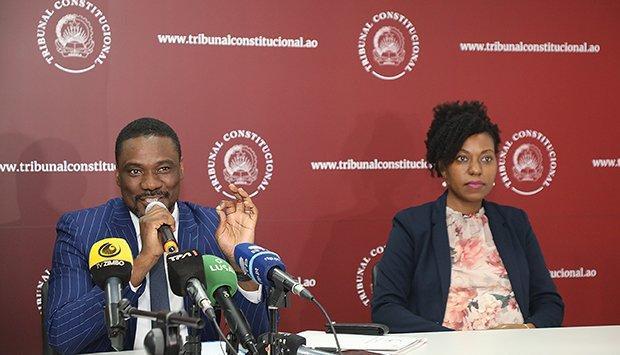
Africa-Press – Angola. The Constitutional Court (TC) clarified, on Friday (02), in Luanda, when assuming, for the first time, the guise of an Electoral Court, that it did not receive any request for annulment of the General Elections of 24 August, as the UNITA, quoted by the international press.
The director of the Office of Political Parties of the Constitutional Court, Mauro Alexandre, underlined, by way of denial, that the institution received only two requests filed by UNITA and CASA-CE, whose contents, as he underlined, “cannot be, shared for the time being, as this is “very” preliminary information, which has not yet been analyzed”.
Mauro Alexandre, who addressed the matter, after being questioned, in a “Briefing” with the press, where the news from the Lusa agency was listed, which, citing a source close to the UNITA board, advanced the information that the largest opposition party interposed , in the Constitutional Court, on Thursday, a request for annulment of the General Elections of 24 August.
“It is false to ask for the annulment of the General Elections”, stressed the director of the Political Parties Office of the Constitutional Court. After “insisting” that only two requests had been received by UNITA and CASA-CE, he advanced: “What we can say is that these requests, naturally, will go through a process of consideration in relation to the procedural formalism that , basically, it is to see if all the presuppositions for its admission are met”.
Mauro Alexandre guaranteed that the TC will henceforth hold meetings with the national and foreign media, to clarify public opinion about the daily incidences of the processes that come into the institution.
The director of the Office of Political Parties of the Constitutional Court clarified that of the processes that were filed at the institution, “none of them makes any reference, in terms of requests made, to an annulment of the elections”. “None of the processes received yesterday (Thursday) requests, in terms of request, any annulment of the electoral process”, he pointed out.
He added that it was premature, and not well advised, to reveal the concrete content of these complaints, making it clear that, many times, “what is conveyed as requests, is not in accordance with the nature of the electoral dispute itself”.
Intervention of international organizations in the process
Regarding the possibility of an intervention by international organizations in the Angolan electoral process, as the leader of UNITA wishes, in response, the director of the Office of Political Parties of the Constitutional Court, Mauro Alexandre, clarified, by the way, that the court, in the exercise jurisdiction, has powers in legal and constitutional matters of electoral political parties.
He added that, in this dimension of the exercise of its powers in electoral matters, the Constitutional Court is a body with full jurisdiction. “In other words, the Constitutional Court of the Republic of Angola, having full jurisdiction in electoral matters, its decision is for the purposes of verification and validation of the General Elections”, he stressed.
Mauro Alexandre stressed that in a possible direct confrontation between Angolan domestic law norms and norms resulting from international law, these questions should, naturally, be the subject of a study on the jurisprudential panorama in relation to decisions already produced by the Constitutional Court itself.
He stated that, although it follows from the Angolan Constitution, which is also applicable to Angolan Law, norms of International Law, “however, this application, naturally, can only take place in circumstances that do not jeopardize the sovereignty of the Angolan State”. “We are talking about a situation in which the Angolan electoral legislation has full coverage of these hypothetical situations”, clarified the constitutionalist.
Recount of votes
Regarding the issue related to a possible recount of votes, the director of the Office of Political Parties of the Constitutional Court clarified that carrying out the scrutiny of votes is not a genuine competence of that Court, but of the National Electoral Commission.
“The Constitutional Court may, in coherence with the jurisprudence already established, and in honor of the principle of electoral truth, and in an exceptional situation, find itself in the need to carry out an eventual recount, depending on the summary minutes that can be delivered by the competing formations. in, let’s say, litigation”, said Mauro Alexandre.
Thus, he added that this exercise, in terms of the evidentiary procedure, has to address some technical and operational issues. “Our Data Processing Center has all the technological conditions created for this purpose”, he pointed out.
Beginning of the electoral dispute
On the occasion, the director of the Office of Technical Advice and Jurisprudence of the Constitutional Court, Aida Gonçalves, said that the entry of the two requests at the institution, filed by UNITA and CASA-CE, at the end of Thursday afternoon, initiate the electoral dispute before that Court.
Aida Gonçalves said that the Constitutional Court immediately began a process to verify these same requirements which, as she said, is a preliminary step aimed at their admission. “Before being admitted, the applications have to be verified, if the procedural and formal presuppositions are fulfilled”, she clarified.
He explained that, when we talk about procedural assumptions, we are talking about a confirmation of the legitimacy of those who come to appeal, the competence of the Constitutional Court to assess these same requests and analyze them, then, until the end of what is requested, and whether this request arrived within the deadlines determined by law.
“Having verified the procedural assumptions, it is also important that the application itself undergoes a formal verification, that is, the Law provides that the application must contain reasons in fact and in law”, he highlighted. The director of the Office of Technical Advice and Jurisprudence of the Constitutional Court, Aida Gonçalves, added that, having made this connection, between the reasons of fact and of law, this piece will have to, in the end, present the conclusions and end with the formulation of a request that will then be considered by the court.
At this moment, he made a point of mentioning, the Constitutional Court is carrying out the verification of all these processes, which will culminate, later, with the admission of the referred requests filed by CASA-CE and by UNITA, which may, in the end, be or not admitted.
For More News And Analysis About Angola Follow Africa-Press