Africa-Press – Angola. The President of Cuba, Miguel Mario Díaz-Canel, reiterated, this Monday, his thanks to Angola for always uniting its voice to the world in favor of ending the economic and financial embargo imposed by the US on his country.
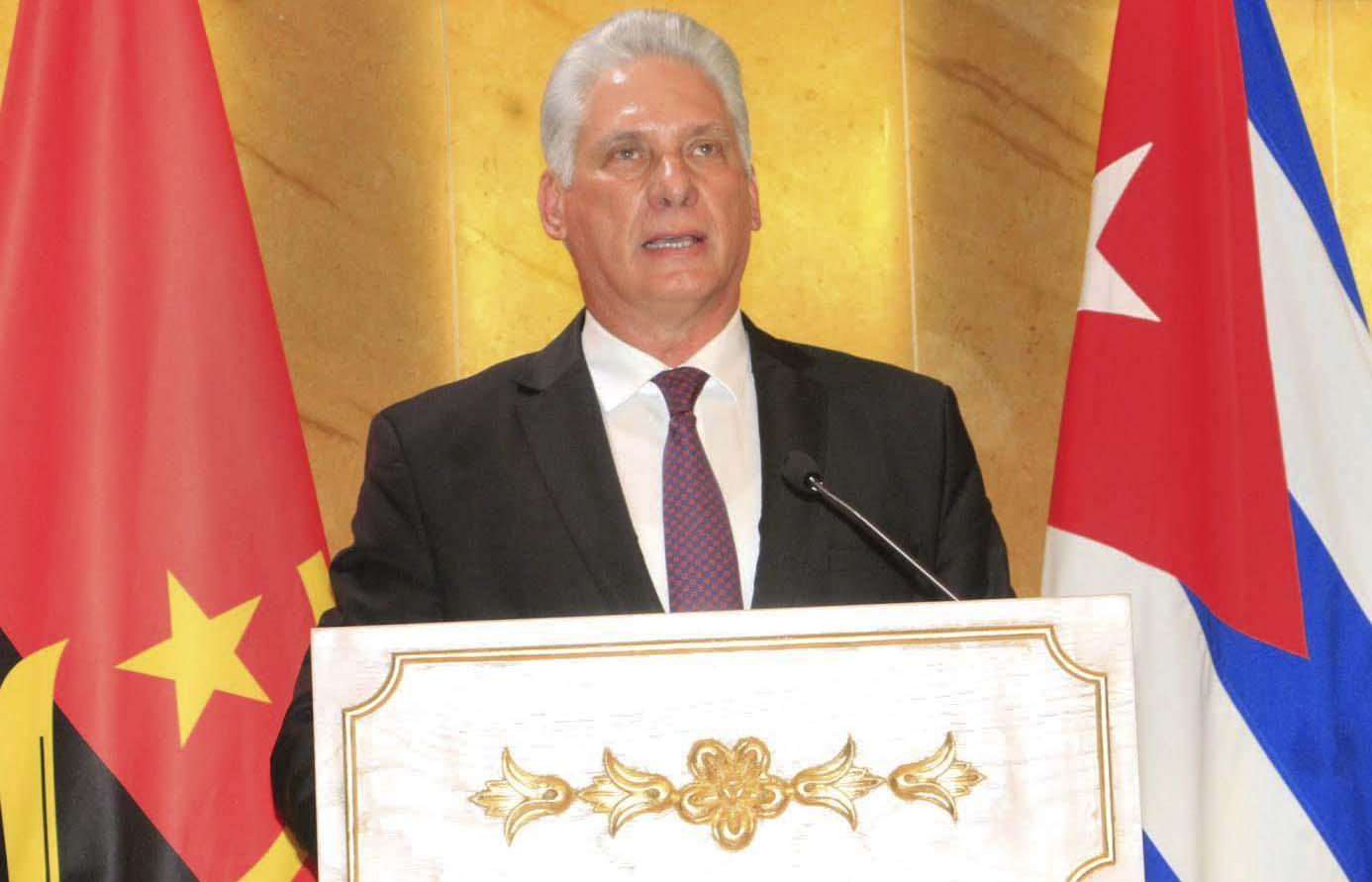
The Cuban statesman was speaking at the National Assembly (AN), on the occasion of his three-day state visit to Angola, aimed at strengthening bilateral cooperation.
Miguel Mario Díaz-Canel emphasized that this decisive support materializes each year with the vote in favor of the United Nations resolution and a similar one in the African Union (AU).
He also expressed gratitude for the support provided by governments and civil society organizations to the Caribbean country, which was recently devastated by a natural disaster.
The Cuban President recognized that his country is going through a difficult socio-economic situation, mainly due to the persistence of the economic, commercial and financial blockade imposed for more than 60 years by successive governments of the United States of America.
He said that in this complex circumstance, “Cuba counts on the support and solidarity of its friends as always, adding: we particularly feel that we have a bulwark of friendship in Africa to continue working for the economic recovery and development of the country”.
bilateral relations
In his speech at the Angolan Parliament, Miguel Mario Díaz-Canel highlighted the fact that Angola is the African country where Cuba has the most diversified and numerous collaboration, a fact “opens” possibilities to explore, more and more, new sectors and mutually advantageous links.
He recalled that in April of this year, the 5th session of the Intergovernmental Commission between the two countries took place in Havana, which signed various legal instruments, added to the agreements initialed this Monday, in the Angolan capital, in the presence of the Heads of both States.
For the Cuban President, parliamentary management will be essential to support the initiatives of the current levels of bilateral cooperation, economic and commercial exchange and mutual investments.
Interparliamentary Cooperation
The Cuban Head of State defended the increase of cooperation between the parliaments of both countries, starting from their representatives and the parliamentary group of friendship, “to better know the respective experiences in the difficult legislative exercise and to correspond to the needs of the electorate”.
He recalled that in the last three years Cuba has approved a new Constitution and, with that, the legislative timetable for greater popular participation has multiplied.
The Cuban parliament is made up of 470 deputies elected representing the country’s 168 municipalities, of which 226 are women who represent 55.74 percent of the total number of deputies.
The Cuban President congratulated Angola for hosting, in October this year, the 147th General Assembly of the Interparliamentary Union (UIP), in which the Caribbean country will be represented with a high-level parliamentary delegation.
He also congratulated Angola for assuming the rotating presidency of the Southern African Development Community (SADC).
The extraordinary solemn plenary session was witnessed by representatives of the Association of Angolan former students in the Republic of Cuba.
Angola and Cuba maintain cooperative relations in various areas such as security, education, health, transport, public works, construction, oil, sports, culture, tourism and agriculture.
The two States established diplomatic relations on November 15, 1975, four days after Angola’s independence and, a year later, signed the General Cooperation Agreement.
This legal instrument would later lead to the establishment of a Bilateral Commission between Angola and Cuba.
Due to the political circumstances at the time, the General Cooperation Agreement continued to privilege actions of technical-military assistance, until 1991, a year before the implementation of multipartyism in Angola.
For More News And Analysis About Angola Follow Africa-Press