Africa-Press – Angola. The debt of the nine municipalities in Luanda province to the Public Water Company (EPAL), accumulated from previous years until last May, reached 105 billion kwanzas, revealed this Tuesday, the director of Engineering of the institution.
Alel Azzidine Pinto Leite explained that the municipality of Luanda is the one that accumulates the largest domestic debt, as it has a large number of customers and household connections. The engineer recalled that EPAL continues to work to carry out a series of projects, mainly resulting from the implementation of new production improvement networks, but the very unbalanced financial part hinders their execution.
He stressed, for example, that nominal production is around 690,000 cubic meters of water per day, but, for various reasons, including financial ones, this achievement is at 500,000 cubic meters per day.
The official acknowledged the deficit situation regarding current production, which does not even reach 50 percent of Luanda’s needs, taking into account that it would need more than 1,200,000 cubic meters of water per day.
Alel Azzidine Pinto Leite said that the current water supply situation in Luanda has around 32 distribution centers and 14 water treatment stations in the nine municipalities.
These distribution centers spread across the nine municipalities of the country’s capital, some operate regularly, and others with a deficit, due to the average 12 hours of work in these establishments, which impacts the volume of water that reaches consumers’ taps.
The Director of Engineering explained that EPAL has only about 11 thousand kilometers of distribution network. This means that “we do not have the province connected to the distribution network, and given the deficit, there are projects, some already underway, and others for the next few years, which will cover the entire length of Luanda”.
Alel Azzidine Pinto Leite made it known that the Candelabro Water Treatment Plant (ETA), located in Kifangondo, municipality of Cacuaco, is being built since May 2017, is in phase III, will increase production capacity of water from 120 thousand cubic meters to 210 thousand and reinforce distribution to more than one million families.
He referred that the Morro Bento Zone, characterized as a gray area, with a network built under the project of 700 thousand connections, cannot receive water, because the System 3 line, from ETA Luanda Sudeste, benefits from the construction of a “buster”, a set of hydropressor to reinforce the line that leaves Benfica and take the product to Morro Bento.
At the moment, the average distribution of the centers is between eight and ten hours, with the exception of Cidade do Kilamba, which has a dedicated system and can supply for about 18 hours, and the center of Luanda, with 12 hours a day.
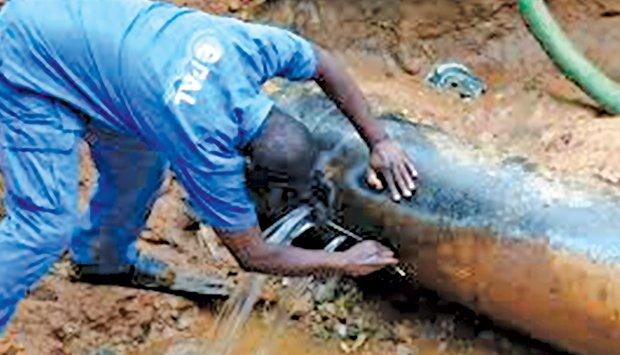
When asked about the mining, the Director of Engineering considered that this problem does not only have to do with EPAL, but with the whole of society, as it is a matter of people’s mentality.
“No matter how much effort we make in terms of building infrastructure to introduce water in certain neighborhoods, we need to change people’s mentality to put an end to mining”, stressed the director of Engineering.
The official referred to the “Bita” and Kilonga projects, which are new complete supply systems, the first of which will have a water catchment and treatment plant for 259,200 cubic meters per day.
This system will have four distribution centers with around 123 thousand meters of network and more than 165 thousand new connections. “Bita” is a project that covers the South and Southeast areas of Luanda, with emphasis on Ramiros, Zona Verde and Bairro Mundial, as well as represents a reinforcement in the districts of Camama, Benfica, Cambolombo, Capalanga, Morar, Vila Flor, Sapu and the area where it will be installed.
Alel Azzidine Pinto Leite explained that the two projects (Bita and Kilonga) are currently on paper, and the prospects are, this year, to take their first steps towards materialisation.
The engineer acknowledged that it is regrettable that the water supply infrastructure is one step behind the city’s rapid population growth.
For More News And Analysis About Angola Follow Africa-Press