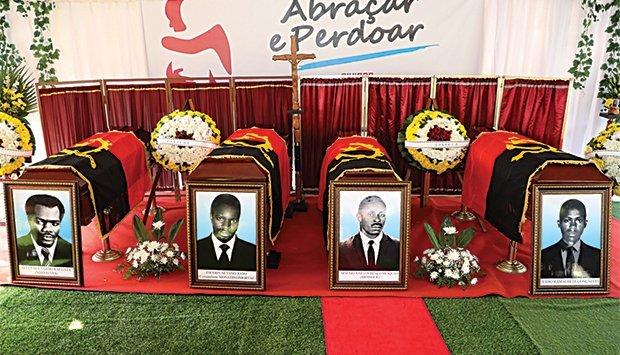
Africa-Press – Angola. The team of Portuguese forensic doctors and anthropologists, which has been in Luanda since Monday, concluded, Friday (22), the first phase of analysis and sampling of the genetic profiles of the families of Sita Valles, José Van-Dúnem and more than 36 people killed on the occasion of May 27, 1977.
After this step, the analysis phase of the material (DNA) collected such as bones, teeth and skeletons, which will be amplified and compared with the DNA of the victims’ relatives who are in the diaspora. At the end of the lecture on “The return of identity in situations of disasters and conflicts: humanitarian forensic action”, the Minister of Justice of Justice and Human Rights said that there is an intention to continue to count on the support of the forensic team , to work together in the future.
In the lecture accompanied virtually by some relatives of the victims of the 27th of May, Francisco Queiroz said that cooperation offers guarantees so that the final result of CIVICOP’s mission is even better.
In turn, Professor Duarte Nuno Vieira, from the University of Coimbra, said that the laboratory tests will make it possible to issue definitive conclusions and complete all the work within the stipulated period. In good time, he stressed, the work will be completed and it will be possible to help, indicating the entities in the cases that are possible of the bodies found.
Faced with the time horizon for the conclusion of the definitive results, the professor underlined: “in Forensic Sciences (not) it is very advisable to establish horizons, because things do not happen like in the CSI series and sometimes there are complications that force the repetition of the exams and new studies.
This part of the work is all completed and there will be no need for repetition, he reinforced, but as for the laboratory work, the specialist said he believes that a few weeks is enough time to have conclusive results. “It all depends on what comes up in the first analyzes that are going to be done,” he noted.
DNA alone is often not enough and time ends up making the work difficult: “DNA, contrary to what people often think, is not a panacea for all ills. It is a very valuable resource from the point of view of forensic activity, namely in individual identification.” Duarte Vieira said that there are cases in which the process of contamination due to other difficulties may not be possible, especially in degraded bones in old things, as in these cases it is not possible to determine the DNA profile. identification is a multidisciplinary process, which involves several elements, in which DNA is one of the contributions that can be associated with others, such as dental characteristics, medical treatments that the person in question has had, such as a trauma, for example,suffered throughout life and left marks on the bones.
Process Difficulties
For another specialist in the field, Eugénia Cunha, one of the main difficulties was the fact that the team did not have the opportunity to follow the process from the beginning of the phase of prospecting, excavation and exhumation of human remains.
According to the forensic doctor, it would have been easier if that were the case, but the main obstacles were overcome and the bodies can be individualized and the anthropological analysis of the biological profile can be carried out to obtain the characterization of people in terms of sex, age, geographic origin and stature.
According to Eugénia Cunha, there are now conditions to make exclusions and really know who is worth comparing with: “If the victim is a woman, for example, we will not compare it with the DNA of a male victim, as we already have the things well done, as well as triage and we know the tests that need to be done”.
Experts Praise Government
On the occasion, Professor Duarte Vieira praised the openness of the Angolan Government for its commitment to the entire process of identification and interaction with families and beyond. In his opinion, the fact denotes total transparency and independence.
The opening of the Ministry of Justice and Human Rights, he said, was exemplary and guaranteed support in a procedure that facilitated the work with transparency. However, he pointed out some lapses committed in the initial phase: “This happens, above all, when there is no past experience in relation to these situations”.
He took the opportunity to express his intention to continue collaborating with the Executive to improve the quality of the work and avoid any lapses in the future. He said that there may be support from the Judiciary Police and the National Institute of Legal Medicine and Forensic Sciences, always with the commitment of the Coimbra University Center.
On the same subject, Eugénia Cunha said that in other countries there is no such openness and they hide the establishment of the truth and do not even cooperate with the scientific teams: “There is (here) a transparency, a clear will and humility”.
For More News And Analysis About Angola Follow Africa-Press