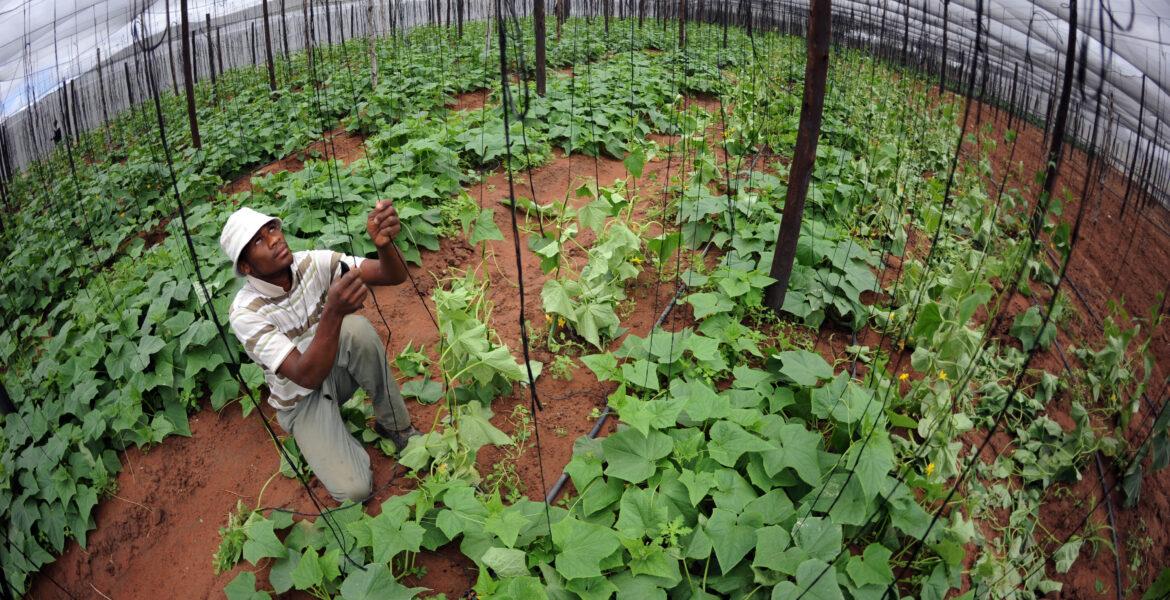
Africa-Press – Angola. The Executive will invest US$5.7 billion over the next five years to produce 6.1 million tons of wheat, rice, soybeans and corn, with the aim of increasing agricultural production rates in the country, as part of the National Plan for the Promotion of Grain Production (PLANAGRAN) declared, this Monday, in Luanda, the Secretary of State for Planning.
Milton Reis, who spoke at the opening ceremony for the presentation of the International Monetary Fund (IMF) Report on Regional Economic Perspectives for Sub-Saharan Africa, which took place at the Money Museum, indicated that, alongside the program to promote agricultural activity, the The Government will also invest US$300 million to finance the development of beef, pork, goat, lamb and poultry production, as well as to improve the infrastructure of the livestock sector in the country, within the scope of the National Plan for Promotion and Development of Livestock (PLANAPECUARIA).
According to the Secretary of State for Planning, the objective of this plan is to increase the production of beef to 110,000 tons, pork to 120,000, goat to 310,000 and sheep to more than 240,000 tons. According to Milton Reis, egg production will increase to 3.1 million and milk to 17 million liters in 2027.
According to the minister, within the framework of the National Plan for the Promotion of Fisheries (PLANAPESCAS), the Government expects to mobilize US$300 million, with funds from the Development Bank of Angola (BDA), to finance the promotion of business fishing activity, increase the production and processing of fish and salt.
He added that the plan also foresees ensuring the regular supply of fish to the population and ensuring food security for the population, reaching a production of 752 thousand tons of fish and 473 thousand tons of salt, in 2027.
Mitigate the crisis
According to Milton Reis, within the framework of the National Development Plan (PDN) 2023/2027, the Government adopted three priority measures to mitigate the economic crisis caused by the Russia/Ukraine war, which has already caused an increase in food prices and refined fuels, which have to do with the development of human capital, with a focus on education, health, employment, entrepreneurship and professional training.
The second measure, according to Milton Reis, involves the expansion and modernization of infrastructure, with a focus on mobility, transport and logistics, housing, water and energy. The third is aimed at diversifying the economy, focusing on improving the business environment, agriculture, livestock, fisheries, tourism and the manufacturing industry.
For him, the Government’s forecasts for the economy, in the period 2023/2027, point to an annual average real growth of the Gross Domestic Product (GDP) of 3.6 percent, to be leveraged by the non-oil sector, in which it is expected an average growth of 4.6 percent.
Angolan economy may grow 2.9 percent
The representative of the International Monetary Fund (IMF) in Angola, Marcos Rietti Souto, said that economic growth projections for Angola, for next year, will be set at 2.9 percent, as a result of the reform program that is being to be implemented by the Angolan Government.
According to the IMF representative, who presented the “Report on the Regional Economic Perspectives for Sub-Saharan Africa”, this data appears in the latest report by the International Monetary Fund, which indicates that, for this year, there was a growth of 3.4 percent. “Next year, we anticipate an average inflation for the year of 21 percent, this year it’s 15 percent. We also project a deficit, in case of a fiscal surplus, of 3 percent this year. For next year, it is around zero percent”, he indicated.
On the occasion, the Secretary of State for Finance and Treasury, Ottiniel dos Santo, said that, between 2014 and 2015, the country’s economic growth was more focused on two variables of the Gross Domestic Product (GDP), which are linked to government spending. Government and consumption.
Now, according to him, the Executive must look at a third variable, that of investment, which involves encouraging the diversification of the economy, with the participation of the private sector.
For More News And Analysis About Angola Follow Africa-Press