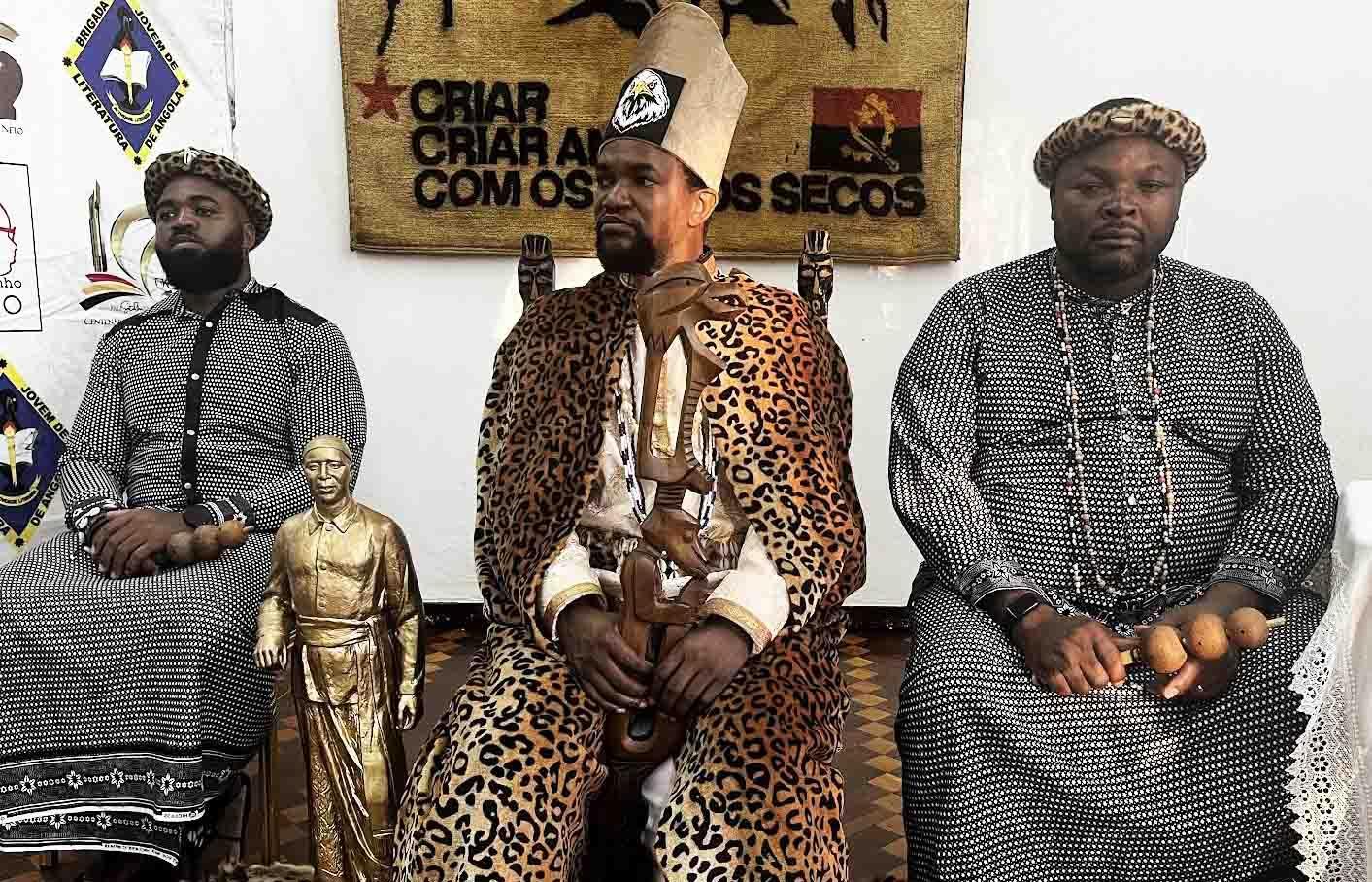
Africa-Press – Angola. The didactic work, entitled “The Hegemony of the Ovimbundu in the Kingdom of Mbalundu”, written by King Ekuikui VI Tchongolola Tchongonga, was launched on Thursday, at the headquarters of the Union of Angolan Writers (UEA), in Luanda.
Published under the auspices of the publisher “Alupolo” and the Brigada Jovem de Literatura (BJLA), the work has 122 pages and an initial print run of a thousand copies.
In the work, the author presents an originality of facts, as sovereign in the center of the country.
The book raises several situations in the Mbalundu kingdom, seeking to indicate positive paths of tradition and leave a legacy of original life in the kingdom.
The publication of the book falls within the festivities of the 48th anniversary of National Independence, proclaimed on November 11, 1975.
King Ekuikui VI Tchongolola Tchongonga said that the work aims to rescue the habits and customs of the people, as well as giving an opportunity to the new generation to learn about the real history of the people that make up Angola.
The sovereign also mentioned that it is necessary to restore reading habits, but to do so, the publication of books is imperative.
Graduated in Customary Law, the king speaks French, Portuguese, English and Umbundu, the latter official language of the Kingdom of Mbailundo.
King Tchongolola Tchongonga Ekuikui VI is the 37th sovereign of the Bailundo kingdom. He belongs to the Ekuikui lineage, being the first legitimate matrilineal grandson of the late King Augusto Katchitiopololo (King/SOMA Ekuikui IV).
History of the Bailundo Kingdom
With a court made up of 37 members, the Bailundo Kingdom emerged during the reign of Ekuikui II, from 1876 to 1890. However, it was King Katyavala I who founded it, coming from the lands of Cuanza Sul with his family, when he lived in the vicinity of the Halavala Mountains.
Before the 17th century, the kingdom remained outside colonial rule. It was only around 1770/71 that Portugal settled in the Kingdom of Bailundo with the presence of a judge. In (1885), the Portuguese colony was already represented in the kingdom with a captain-major.
King Ekuikui II had the character of an excellent diplomat. He dared to avoid war and encouraged the practice of agriculture among the population and, during his reign, Bailundo did not face major wars. After his death, great wars arose that culminated in the subjugation of the locality and the entire Central Plateau region, in 1902.
Also reigning in Bailundo were the sovereigns Jahulo I, Samandalu, Tchingui I, Tchingui II, Ekuikui I, Numa I, Hundungulo I, Tchissende I, Jungulo, Ngundji, Tchivukuvuku Tchama Tchongonga, Utondossi, Bonji, Bongue, Tchissende II, Vassovava, Katiavala II, Ekongoliohombo, Numa II, Moma, Kangovi, Hundungulo II, Mutu Ya Kevela (viceroy), Tchissende III, Jahulo II, Mussitu, Tchinendele, Kapoko, Numa II, Pessela Tchongolola and Ekuikui III Ekuikui IV.
For More News And Analysis About Angola Follow Africa-Press