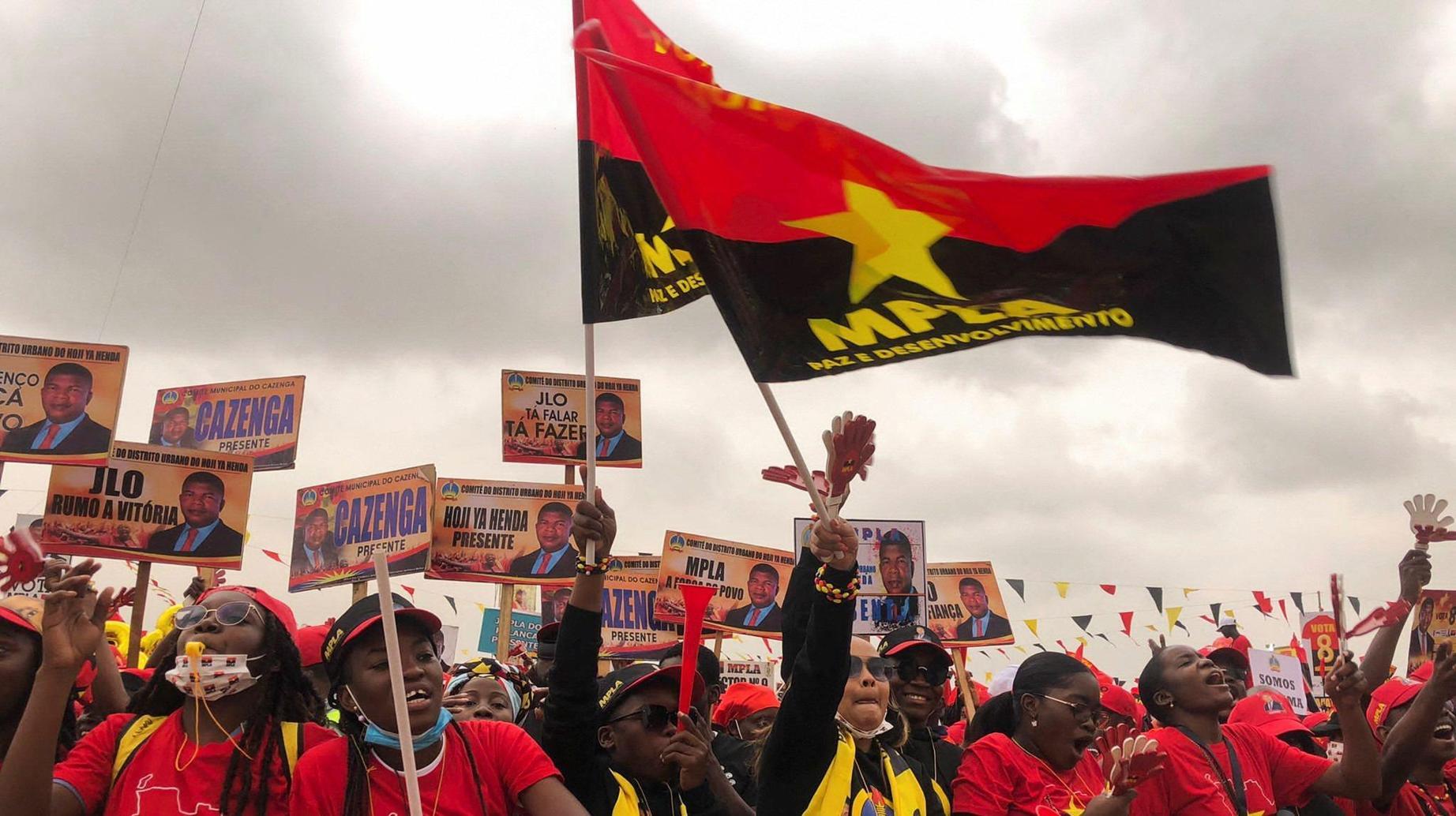
Africa-Press – Angola. The vice-president of the MPLA, Luísa Damião, reiterated, on Tuesday, in Menongue, capital of Cuando Cubango, her party’s commitment to continue fighting for the eradication of illiteracy in the country, so that young people and adults contribute to the development of Angola .
Luísa Damião, who spoke during the launch of the National Literacy Program for young people and adults, said that the MPLA continues to make efforts so that Angolans can realize their dreams and be truly participants in the country’s development.
The party leader highlighted that proof of this is the inauguration of the first literacy school, initiated by her party, built in the Castilho neighborhood, on the outskirts of the city of Menongue.
The vice-president of the MPLA made it known that the province of Cuando Cubango was chosen by her party’s leadership to host the event, which she considered very important, within the scope of compliance with Directive No. 4 of the SBP/2023, relating to the Literacy Campaign of young people and adults.
The vice-president of the MPLA recalled that her party’s VIII Ordinary Congress and the Government program presented to voters in August 2022 establish the issue of literacy as one of the priorities, as the country still has young people and adults who need to be literate.
The leader highlighted that the problem of illiteracy affects more than 773 million young people and adults in the world, according to the United Nations Scientific, Educational and Cultural Organization (UNESCO).
Luísa Damião assured that Angola has taken significant steps in reducing illiteracy and for this reason she welcomed the initiatives of civil society organizations, in particular churches, which have been contributing to ensuring that young people and adults, women and men know how to read and to write.
According to Luísa Damião, literacy is a very powerful instrument that allows the appropriation of written language and that puts the possibility of their social emancipation in the hands of individuals.
“By opening up to the world of writing and reading, we favor the appropriation of a set of scientific and technological knowledge that is increasingly indispensable to our lives and our communities in today’s world”, he said, adding that, in this way, we also “expand the possibility of becoming participants in this universe, being able to share creative and innovative capacity, as well as the way of seeing the world, so that we are better understood”.
Therefore, he said that aware of the imperative that literacy represents for populations in this condition, the MPLA spares no effort and launches the National Literacy Campaign in the province of Cuando Cubango.
Luísa Damião highlighted that the National Literacy Program is an activity that, along with other programs, the structures of the MPLA and its social organizations, the OMA and the JMPLA, must fulfill, that is, they must carry out, because it is the orientation of the party leadership, and which will be monitored and evaluated as they materialize.
Luísa Damião argued that for the success of this ambitious program it is necessary to mobilize and raise awareness among young people and adults about the need to participate actively, without complexes, as the benefits that literacy generates for the individual, for the family, for professional life are evident. and for the whole society.
“A literate person guarantees the best exercise of citizenship, begins to understand and know better about their rights and duties, becomes more inserted and engaged in society and the world that today offers us countless opportunities”, he highlighted.
The party leader greeted with great emotion everyone who has been engaging in an “altruistic way and who will join this cause of helping others learn to read and write”, without forgetting their “compatriots, men and women , who will be the target of literacy processes, because they will be happy”.
Luísa Damião announced that, in addition to literacy, the structures also need to revisit Executive Directive No. 0003 on the Health Education Campaign in Communities.
First literacy school
The launch of the National Literacy Program was preceded by the inauguration of a two-classroom school, initiated by the MPLA, in the Castilho neighborhood, on the outskirts of the city of Menongue, named after Joaquina Litchoni Calenga, a former prominent activist member of the OMA in the province, who died in 2016, a victim of illness.
Luísa Damião said that the inauguration of this first school, intended exclusively for the literacy process, is proof that her party values the well-being of the population and promotes a qualitative increase in their participation in public life.
He predicted that, following the example of this literacy school in the Castilho neighborhood, many others will be built in all municipalities and locations in the country to benefit young people and adults, not just MPLA activists, but all those who want to “embrace the opportunity to see the world through of written language”.
The leader highlighted that the task of teaching literacy and teaching those who don’t know it belongs to everyone and is not limited to the school environment or facilitators.
Luísa Damião highlighted that with the introduction of schools with this particularity, a better systematization of the literacy process can be developed and allow the process to continue to the formalization levels of the national education system.
“By ensuring the eradication of illiteracy we are, at the same time, ensuring more sustainable communities, we are ensuring that information on the prevention of various diseases is accessible to populations and allowing the evolution of the paradigm for organizing the social and cultural life of our communities “, he said.
In the view of the vice-president of the MPLA, in a changing world, with the advancement of new technologies, literacy is fundamental as an essential human right for the fulfillment of the human person.
The first secretary of the MPLA in Cuando Cubango, José Martins, revealed that the province currently has six thousand and 94 young people and adults studying literacy, 166 classrooms available and 65 literacy teachers mobilized for two shifts.
José Martins said that the province embraces the party’s initiative and reaffirms its unwavering will to do everything to comply with and enforce the guidelines of the National Literacy Program.
For More News And Analysis About Angola Follow Africa-Press