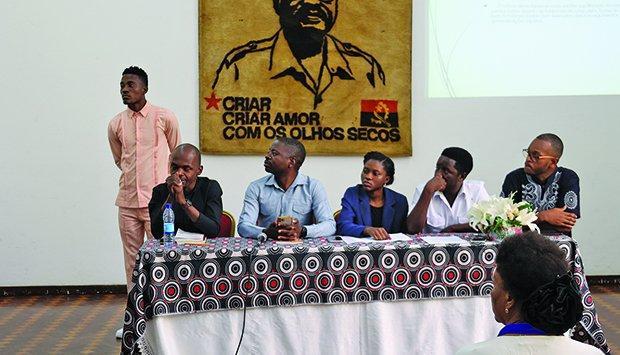
Africa-Press – Angola. The second edition of the National Symposium of Literary Criticism, which took place on Saturday at the Union of Angolan Writers (UEA), in Luanda, paid tribute to the writer Uanhenga Xitu, who, if he were alive, would have turned 100 on 29 August.
The Circle of Literary and Linguistic Studies “Litteragris” and the UEA joined forces, and with a certificate of merit addressed to the writer’s family, they expressed their appreciation to Uanhenga Xitu for his contribution to Angolan literature.
The Secretary General of the UEA, David Capelenguela, in statements, highlighted the patriotic side of Uanhenga Xitu, who tirelessly addressed the country’s social problems in his works.
“Uanhenga Xitu showed us what the social role of a writer should be, by being committed to the country’s social causes in his works”, he stated.
On the other hand, the vice-coordinator of Litteragris, Agostinho Gonçalves, said that Uanhenga Xitu is one of the main references in national literature, having a literary criticism that needs to be developed, given the grandeur of his work.
According to the person in charge, Litteragris is helping to intensify literary studies on the writer’s work, ensuring that from then on it is intended to carry out more academic activities focused on the work of Uanhenga Xitu.
Literary criticism needs to develop
The various personalities from different areas of knowledge, such as writers, journalists, teachers and students, who attended the second edition of the National Symposium of Literary Criticism held on Saturday at UEA, in Luanda, showed that literary criticism in the country still needs to develop, in order to be able to respond, promptly and efficiently, to the number of works published throughout the national territory.
The writer Jeremias Sebastião, when addressing the theme “The Writer’s Perspective on Literary Criticism”, stated, after having carried out research work with several writing professionals from Luanda, that literary criticism in Angola is not going through a good time.
“Despite the emergence of several literary movements and critics, there is no high-quality criticism, because most of it has been commissioned criticism, where the writer asks for the opinion of the literary critic”, he explained.
According to the interlocutor, this means that the same authors are studied, while new authors or those who are not close to the critics are forgotten.
The literary scholar David Calivala, when speaking about “Ethics in Literary Criticism”, mentioned that, often, commissioned criticism may lack important ethical principles for fair criticism, which harms the development of the literary market.
David Calivala, therefore, called for the need to criticize based on principles and practices that guarantee the quality of criticism.
To achieve this, he said, impartiality, respect for the author, transparency, honesty, respect for diversity and efficient argumentation must be taken into account.
“Criticism needs to focus on the work and contribute to the debate on its value and impact on society,” he stressed.
The moment also served as an opportunity for literary critic AC Khamba, who spoke about the “Problem of Literary Prizes in Angola”, calling for institutions linked to literature to be at the forefront of the prizes, so that they are awarded correctly.
The second edition of the National Symposium of Literary Criticism was attended by Amélia da Lomba, Lopito Feijóo and Aminata Goubel, better known as Mamã África.
Literature in Benguela and Cuanza-Sul
During the second National Symposium of Literary Criticism, held on Saturday at UEA, in Luanda, the literary figures Fernando Tchacupomba and Haires Fernando spoke, in particular, about the state of literature in the provinces of Cuanza-Sul and Benguela.
Haires Fernando, for example, stated that literature in the province of Cuanza-Sul still faces several difficulties, largely due to the lack of human development and the lack of essential infrastructure.
Haires Fernando, however, admitted that literature in that province exists and reflects, for the most part, the rich cultural and historical heritage of the region.
“Writers often explore rural life, stories of resilience and the everyday experiences of locals, offering an authentic insight into the reality of the province,” he explained.
The writer also mentioned that oral literature continues to be widely explored in the region. Through myths, legends, proverbs and traditional songs, he said, various moral, ethical, historical and social teachings are transmitted from generation to generation, which play an important role in the education and preservation of the cultural identity of Cuanza-Sul.
According to Haires Fernando, the Angolan writer Viriato da Cruz, born in Cuanza-Sul, is the main reference for writers from that province.
On the other hand, Fernando Tchacupomba stated that the province of Benguela also faces several difficulties, but that it is currently experiencing a considerable increase in new writers. According to him, the emergence of new writers is due to their desire to express themselves and the emergence of more local publishers.
Focusing on literary criticism, Fernando Tchacupomba said that it is almost non-existent in Benguela, as there are no elements that facilitate criticism, such as, for example, scientific magazines, newspapers, radio sections or literary clubs.
“Without literary criticism, many writers can emerge, but the quality of their works will be low,” he stated.
For More News And Analysis About Angola Follow Africa-Press