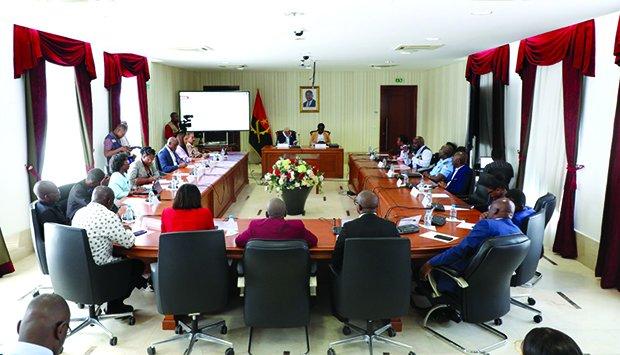
Africa-Press – Angola. Parliamentarians supervise works and collect information After three days dedicated to visits to the municipalities of Luanda, the deputies of the 4th Commission for State Administration and Local Power obtained from the authorities and inhabitants information on the functioning of some institutions in the country’s capital, with the Urban District da Maianga was covered last Saturday.
The parliamentarians traveled, Saturday, to the Urban District of Maianga. They visited the Catambor and Cassequel health centres, the Óscar Ribas and 1159 schools, as well as a taxi stop and the Teixeira market.
Some points drew attention, especially at the Cassequel Health Centre. Here, the services provided in the areas of General Medicine, Emergency Bank, Pediatrics, Laboratory, Orthopedics and Pharmacy work regularly, despite the flooding that occurs every day.
According to data released on the website of the National Assembly, on the Internet, the only difficulty that the center faces is the “reduced number of doctors to care for patients”.
“We have all the services that this center has operating normally, from Pediatrics to general practice services. However, we have a very small number of doctors and nurses, which is why you are seeing, at the moment, this flood of our users” , explained the clinical director of the health unit, Celestina Garcia.
For their part, at the Óscar Ribas National School of Special Education, the deputies were informed of the functioning and learned from the pedagogical director, Antónia Cortez, that the school enrolled, in this Academic Year, around 32 students, of which eight are visually impaired, seven are deaf and six mute.
“Our great concern is related to the lack of some means of work, such as Braille writing machines for blind students and teachers trained to work with children with special needs”, said the official.
The field day of the deputies of the 4th Commission of the National Assembly continued in the market and at the Teixeira taxi stop, where they maintained contact with saleswomen and taxi drivers who took the opportunity to express their concerns.
Arminda Cassongue, a citizen, praised the initiative of the Cassequel District Administration in creating the Teixeira market, a space that welcomes more than 200 saleswomen.
“We are very satisfied, because before we sold on the road and ran the risk of being run over. Now, we are in a safe place and we appeal to those people who still sell on the streets to come to the square to market their business”, she invited.
For the administrator of Luanda, Milca Casseque, the visit of the parliamentarians allowed the interaction between the Executive and Legislative Powers in the inspection of the acts of the State Administration.
“We were satisfied with the visit of the deputies to the Health centers, schools and markets of Maianga, where they verified the real functioning of the institutions, as well as the difficulties they face. We also take good note of the recommendations left and we will try to improve day after day our services”, he emphasized.
In turn, deputy Irina Ferreira, on behalf of the deputies of the 4th Commission, considered the positive balance of the work carried out, although she also noted some difficulties in the daily lives of the inhabitants.
“We heard the residents who presented cross-cutting concerns. They complain, for example, about the service time at the Health centers, basic sanitation, the improvement of some circulation routes. solve problems,” he added.
Cacuaco creates social adaptation process
As municipal administrator for three years, Auzílio Jacob, said that Cacuaco was the stage for a bit of dispute: the different parties carried out their political actions, there was a lack of water, electricity, roads, health centres, schools, high of delinquency, factors that were reflected in the emotional state of the inhabitants.
“We created a process of social adaptation that met the concerns that people had, reducing bureaucracy in the administration. We also sought to maintain a close relationship with political parties, philanthropic associations, non-governmental organizations and we made substantial changes to the Budget 2020, in order to adapt it and respond to the main difficulties of the population”, he said.
At the reception, Thursday, of the deputies of the 4th Specialized Work Commission, inserted in the Inspection Program of Municipal Administrations, Jacob presented the circumscription framework, now with about one million, six hundred thousand inhabitants.
Cacuaco is administered by the Environment, Culture, Human Resources, Political and Social Area, Health, Education, Finance, Police Security, Media, Social Action, Records, Inspection, Agriculture, Energy and Water, Transport, Youth and Sports sectors.
Auzílio Jacob highlighted the programs of the PIIM (Integrated Plan of Intervention in the Municipalities), considering it the way of raising revenue for the growth of the municipality.
According to the administrator, quoted by the National Assembly, health was the first mosaic to be restructured. In the scenario presented to parliamentarians, in 2020, Cacuaco had a hospital without response capacity for the existing population. Therefore, efforts were made to build hospital units, namely the Maternal and Child centers in Cacuaco, Funda and Vila Verde Cativa, in Sequele.
The Education sector in the municipality also presents weaknesses, since three years ago, 70% of the schools were private, with low wages and a high birth rate, which constituted factors of social instability.
Based on the available data, enrollment in the PIIM boosted the growth of over 15 schools in the locality. According to the administrator, “today, 23 schools are under construction, with a physical execution above 60% and will start operating in the next academic year, reducing from 37 thousand to 15 thousand children outside the Education System”.
The taxation system also catapulted development, since with the 2020 Budget alone it was not possible to cover expenses: “After carrying out a market study, we understood that Cacuaco was the municipality that had many sources of income, due to of the geographic location and the investments that there were here. So, we considered the collection of revenues as a viable source”.
As a result of this incentive, the Administration of Cacuaco has, to date, displayed the table of fees, where each citizen complies with the payment models, in a Single Treasury Account, for the acquisition of any documentation, avoiding extortion and generating collection of administrative revenue.
“We are the municipality in Angola that collects the most. We started collecting 100 to 200 million kwanzas per month, covering what the OGE was unable to respond”, concluded information on the problems of the country’s capital
Crime and road accidents are a concern
In addition to the days on Saturday and Thursday, the 4th Specialized Work Commission of the National Assembly also carried out a verification visit to the municipality of Luanda, last Wednesday, with a delegation led by its vice-president, deputy Paulo de Carvalho, who reviewed some points of the Urban District.
The deputies, on that day, were received by the municipal administrator of Luanda, Milca Caquesse, who was accompanied by those responsible for the areas of the Administration that she directs.
Concerned about the growth of the crime rate in the capital city, the parliamentarians began visiting the Criminal Investigation Department (DIC) in Ingombota and surroundings, to verify the working conditions available to that body.
The deputy municipal administrator for the Technical Area, José Balsa, presented some projects and achievements within the financial execution plan, considering the steps taken so far to be positive. Even so, he informed that the Health and Education sectors remain among the priorities, as both add up to more than 26 million kwanzas for hospital management and equipment.
The Integrated Intervention Plan in the Municipalities of Luanda has served to fight poverty, develop sustainable projects and have a social impact. According to the administrative authorities, so far, the municipality of Luanda has more than five thousand commercial agents.
Milca Caquesse pointed out the growth of tourism and the emergence of various hotel equipment as major transformers in the lives of citizens, whose impact is felt by the inhabitants.
During the verification visit, other concerns were raised, with emphasis on the problem of public water and energy distribution, collection and treatment of solid waste. Ação Social, in the municipality of Luanda, expressed concern about the growing number of children on the streets and called for everyone’s effort to collect them and reintegrate them into their families.
The municipality currently has 23 projects registered with the PIIM, of which 16 have been concluded, which have generated, so far, 396 direct jobs.
Deputies were concerned about road mobility, in addition to bad parking, lack of knowledge of the Road Code by some citizens, and the emergence of small markets along the roadway.
Still on the road accident rate, the parliamentarians pointed ways for the reduction. Paulo de Carvalho indicated the improvement of the asphalt mat and the replacement of public lighting as fundamental for the reduction of road disasters.
For More News And Analysis About Angola Follow Africa-Press